Nervous System
Vagus Nerve Exercises That Actually Work
The internet has a peculiar obsession with finding exotic vagus nerve exercises, typically involving gargling, humming, or sticking your face in a bowl of ice water. While some of these have a kernel of physiological tru
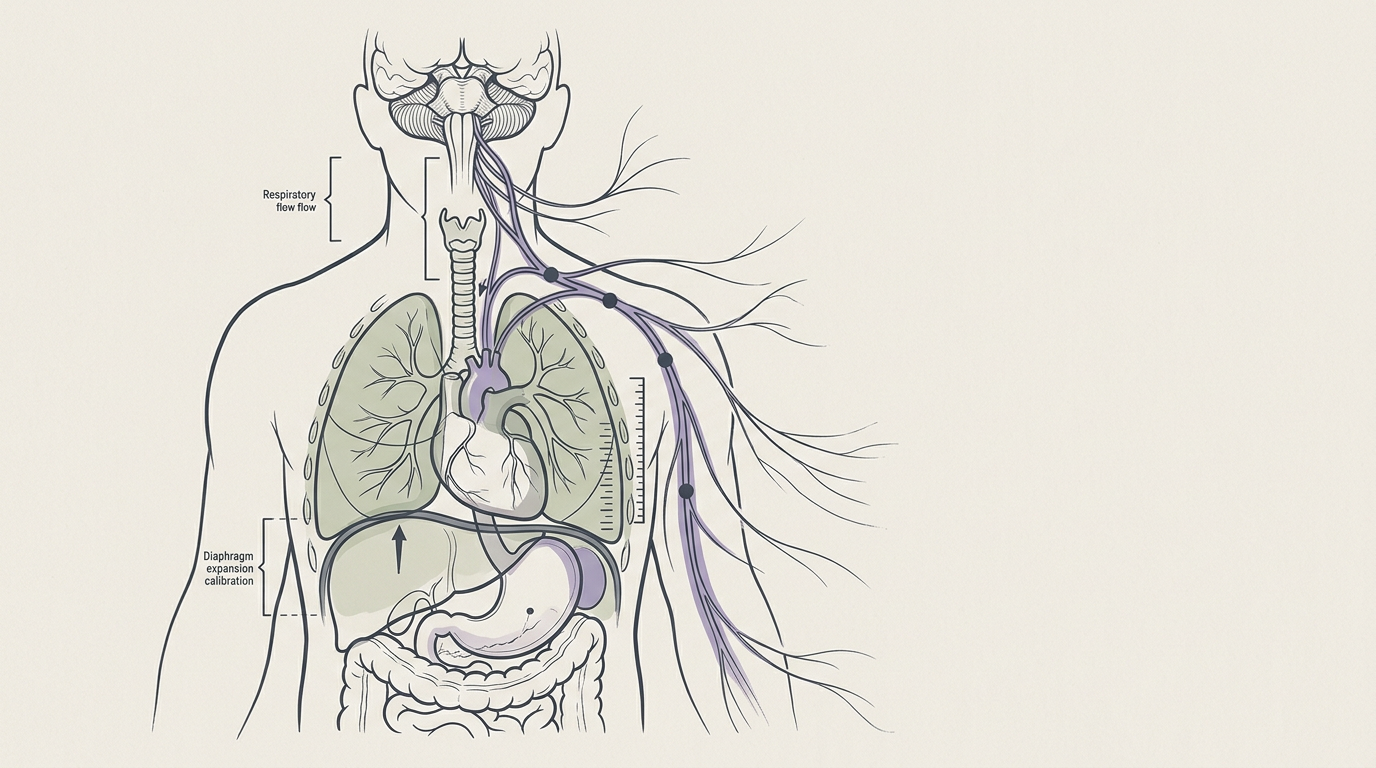
I'm calling it. The internet has somehow decided that the vagus nerve is a muscle you can isolate and flex at the gym. Scroll for five minutes and you'll find someone submerging their face in a bowl of ice water or aggressively gargling to stimulate it (because nothing says healing like gagging on mouthwash at 7am). You cannot train a cranial nerve by startling it. The real work of shifting your autonomic state happens through slow, mechanical changes to your breathing.
You know what low capacity feels like long before you have the neurological vocabulary for it. It's the tight, shallow breathing while you draft an email. It's the familiar 3pm jaw clench that you only notice when your teeth start to ache. You feel tired but wired, staring at the ceiling at midnight while your heart thumps against your ribs. Maybe you wake up at 3am every night and start running through tomorrow's schedule, or you just feel anxious for no reason while standing in the kitchen waiting for the kettle to boil. Your system is exhausted but can't rest, caught in a sympathetic loop that makes even a quiet Tuesday feel like a low-grade threat. You just need to send a mechanical signal of safety to your brainstem.
Common Questions
What is the vagus nerve?
It is the tenth cranial nerve and the primary communication highway between your brainstem and your organs. It controls your parasympathetic nervous system, the branch responsible for digestion, recovery, and lowering your heart rate after a threat has passed.
What does vagal tone mean?
Tone is a measure of responsiveness. High vagal tone means your nervous system can smoothly decelerate from a stressed state back to a baseline of calm. It indicates flexibility, meaning your body adjusts to demands accurately rather than overreacting.
Do vagus nerve exercises actually work?
Yes, provided you choose the right ones. Viral trends often create a temporary shock to the system. Consistent, structured breathing practices create lasting physiological changes. By physically moving the diaphragm, you mechanically signal the brain to slow down.
The ice bowl is a sledgehammer
I used to think a cold shower was the ultimate nervous-system reset. I spent a whole winter ending my morning routines with sixty seconds of freezing water, entirely convinced I was building resilience. I was just startling myself. A sharp blast of cold triggers a massive sympathetic stress response, which forces a parasympathetic rebound as your body scrambles back to baseline. It is a biological sledgehammer. While temperature manipulation has its uses, relying on a daily shock to force your vagus nerve into action misses the point of regulation. Kokorology want the system to glide down into recovery smoothly.
The respiratory sinus arrhythmia loop
The most direct access terminal to your nervous system is the diaphragm. The vagus nerve passes right through this massive sheet of muscle. Every time you pull a full breath into your lungs, the diaphragm descends and physically massages the nerve. The real leverage happens on the exhale. Extending your out-breath slows your heart rate through a mechanical loop called respiratory sinus arrhythmia. As you breathe out, you send a direct, biological command to the vagal pathways to quiet the engine. This shifts your state from threat detection to recovery. You increase your heart rate variability (HRV), the core metric of an adaptable nervous system, simply by pacing your lungs.
Calibrating the engine
If you want to change how your body handles stress, you have to change the rhythm. For most adults, resonant frequency breathing sits at around 5.5 breaths per minute. That breaks down to a 5.5-second inhale and a 5.5-second exhale. When you breathe at this specific pace, the oscillations of your heart rate and your respiratory rate synchronize. This coherence amplifies vagal activity and clears the static. It is a physical trick to pull the parking brake.
The best intervention for your nervous system is mechanical. Leave the psychology at the door.
The gut and the conversation
Breath is the fastest lever. Other inputs matter too. Roughly 80 percent of your vagal nerve fibres are afferent, meaning they carry data from the body up to the brain. A massive portion of those fibres originate in the gut. An inflamed, sluggish digestive tract sends distress signals straight to your brainstem, which is why tracking your dietary inputs inside the Journal is so revealing. Coregulation provides another direct input. The vagus nerve is exquisitely tuned to social cues. The tone of a friend's voice in a coffee shop or a calm facial expression physically downregulates your threat response. That's why chronic isolation takes such a massive physiological toll, and why Kokorology emphasize shared practice in the the community.
What to do this week
- Find your resonant pace: For five minutes today, use a timer to breathe in for five seconds and out for five seconds. Don't force the air. Let it flow smoothly.
- Use the cyclic sigh: When you hit that afternoon wall, take two sharp inhales through the nose, followed by a long, complete exhale through the mouth. Repeat this three times. Notice the immediate drop in heart rate.
- Calm the system with air: Skip the ice water on your face for a few days. Rely entirely on your breath to shift your state.
Where this fits in the Kokorology system
Modulating vagal tone through breath is a core competency for nervous system regulation. These slow, deliberate inputs form the basis of the routines Kokorology teach inside the Regulation L1 course, giving you a reliable way to shift out of hypervigilance.
Closing
Your breath is a physical lever capable of altering your physiology from the bottom up. Start there. Practice it until it becomes a background process that holds you steady, even on the worst Tuesdays.
- Practice it daily inside Hacks
- Work with the mechanics in Performance L2
- Start with the free overview: The Regulation Guide
TL;DR
Viral hacks rely on extreme cold exposure or gargling. Structured breathing actually improves vagal tone. Extending your exhale and practicing resonant frequency breathing at 5.5 breaths per minute mechanically stimulates the vagus nerve. This slows the heart rate and improves heart rate variability, shifting the autonomic nervous system from hyperarousal back to a baseline of calm.
Sources
- Yilmaz Balban, M. (2023). Brief Structured Respiration Practices Enhance Mood and Reduce Physiological Arousal. Cell Reports Medicine.
- Thayer, J. F. (2012). A meta-analysis of heart rate variability and neuroimaging studies: implications for heart rate variability as a marker of stress and health. Neuroscience & Biobehavioral Reviews.
- Zaccaro, A. (2018). How Breath-Control Can Change Your Life: A Systematic Review on Psycho-Physiological Correlates of Slow Breathing. Frontiers in Human Neuroscience.