Workplace & Leadership
Return-to-office Mandates Are a Polyvagal Disaster. Here Is the Hybrid Model That Actually Works.
Understand why fixed return-to-office mandates derail workplace wellbeing and discover an effective hybrid model for employee success.
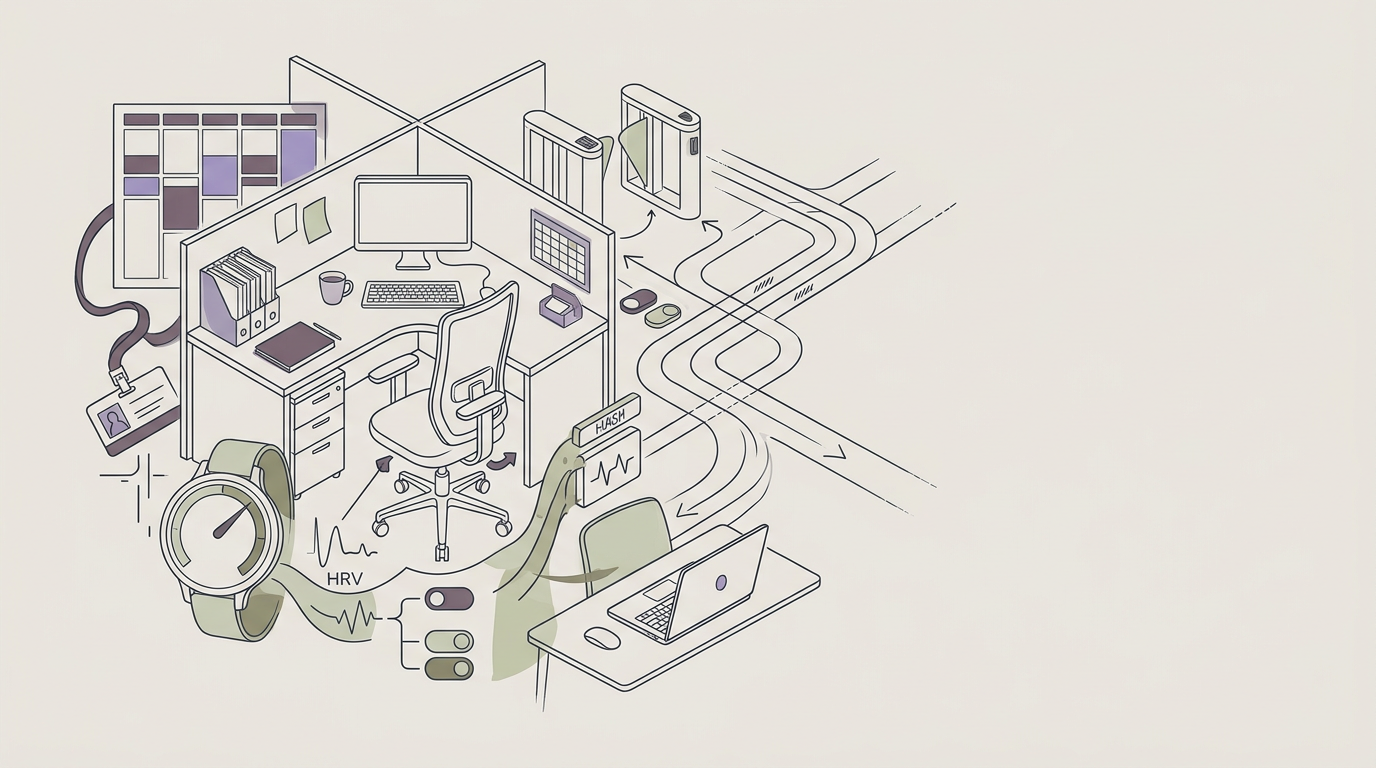
The corporate narrative on return-to-office mandates reads like a fairy tale about culture and collaboration. Executives genuinely believe that forcing people back to a desk for three arbitrary days a week will magically restore innovation. I'm calling it. The rigid mandate acts as a massive, unacknowledged biological stressor, spiking allostatic load and triggering chronic threat detection. When you strip autonomy from an adult, their nervous system doesn't collaborate. It defends itself.
You already know how this feels in the tissue. It is the jaw that won't unclench during the Tuesday morning commute, the hollow stare at your monitor when the ambient noise of the open plan gets too loud, and the sudden, irrational irritation when a colleague simply asks how your weekend was. You drag yourself home feeling tired but wired, staring at the open fridge with no appetite, desperate for quiet. Your system is overloaded, leaving you with severe brain fog after lunch and lying awake at 3am, exhausted but can't rest. The environment is entirely safe, but your body is running the physiology of someone being hunted.
Common Questions
What is allostatic load?
It is the physiological wear and tear the body accumulates when exposed to repeated or chronic stress. Think of it as the total burden your nervous system is carrying. When demands exceed your capacity to adapt, the load becomes destructive.
Why do office mandates cause stress?
Removing autonomy triggers the body's threat detection circuitry. Unpredictable or forced schedules disrupt your established circadian rhythms and baseline regulation, forcing the brain into a state of hypervigilance rather than focus.
What is an anchored hybrid model?
It requires two fixed, company-wide office days for collaborative work and leaves the rest of the week entirely flexible. This provides the predictability the nervous system needs for safety while maintaining the autonomy required for recovery.
The Illusion of the Potted Plant
The prevailing workplace narrative treats human beings like potted plants—just put them under fluorescent lighting and wait for them to bloom. I used to believe that physical proximity naturally bred better ideas, right up until I sat in a perfectly designed Lisbon coworking space and watched twenty people aggressively wearing noise-canceling headphones to ignore each other.
When an employer issues a sweeping return-to-office policy, they provoke a biological reaction. The loss of predictability signals danger. The vagus nerve—the parking brake of nervous system regulation—releases its grip, and autonomic arousal spikes. You can't mandate creativity from a body that believes it is under threat.
The Neuroscience of Forced Presence
I was reading a paper this week on brief belonging interventions and how they lower workplace cortisol over a 12-month period. The mechanism explains exactly why forced attendance fails. Humans are wired for social regulation. When Kokorology feel secure in the group, the prefrontal cortex stays online, allowing the system to plan, decide, and innovate.
Introduce chronic uncertainty or arbitrary rules, and the amygdala takes over. Heart rate variability plummets. Kokorology start to see what looks like a dorsal collapse—a state of profound physiological withdrawal where the nervous system essentially plays dead because the environment feels unmanageable. The employee hasn't lost their work ethic. Their system is just trying to conserve energy and minimize perceived risk.
The Anchored Hybrid Solution
Kokorology respond to this physiological crisis with ping-pong tables and free snacks. That is useless. The actual solution is an anchored hybrid structure. Two company-wide core days for meetings and connection, with the rest of the week completely flexible. Predictability tells the brain it is safe to down-regulate. It is that simple.
When everyone knows exactly who will be in the building on a Wednesday, the threat of the unknown vanishes. These consistent, low-stakes interactions reduce the perceived threat of colleagues or managers. You start to understand their rhythms and non-verbal cues, building a subtle but powerful sense of physiological safety that haphazard hybrid setups destroy.
Designing the Somatic Transition
The daily commute used to serve a biological purpose. It gave the system 45 minutes to shift from domestic mode to threat-readiness. Now, Kokorology expect people to teleport from their kitchen table into a high-stakes strategy meeting without a single moment of interoceptive recalibration. Interoception is your brain's ability to read the physical state of your body. When you ignore it, you miss the early warning signs of capacity failure. The inbox has never once been impressed by your heart rate.
A workplace that ignores the nervous system of its employees is just manufacturing its own turnover.
Kokorology have to build intentional transitions back into the week. A five-minute walk around the block before opening the laptop. Ten minutes of absolute silence after a commute. Kokorology need physical zones where people can rely on Anchors to check in with their internal state before pushing forward.
What to do this week
- Fix your days. If you have the power to do so, pick two non-negotiable days for the office and hold the rest of the week sacred for deep work.
- Create a transition ritual. Do not open your laptop the second you sit down. Take three minutes to orient yourself to the room and let your physiology register that you have arrived.
- Audit your interoceptive cues. Notice what happens in your chest and throat when the ambient office noise peaks around 2pm. Name the sensation, then step away.
Where this fits in the Kokorology system
Kokorology explore capacity and systemic load directly inside the Performance curriculum for leaders who want to build sustainable teams. For immediate relief when the office static gets too loud, rely on the 60-second tools in the Hacks library, or systematically rebuild your baseline at home through the structured Reset program.
Closing
The corporate world will eventually realize that physiology dictates output, but you don't have to wait for the policy document to catch up. Protect your own baseline first.
- Work with the system directly through Coaching to navigate workplace stress and map your internal patterns.
- Continue the practice inside the Performance course to build nervous-system capacity in your leadership.
- Sit with this topic weekly through the free Newsletter.
TL;DR
Return-to-office mandates fail because they strip autonomy and trigger chronic threat detection, driving up allostatic load. The nervous system requires predictability to feel safe and flexible enough to collaborate. By implementing an anchored hybrid model with two fixed company-wide days, organizations provide necessary structure while preserving the flexibility employees need to regulate their physiological state and sustain long-term capacity.
Sources
- Walton, G.M. (2024). Brief Belonging Intervention Lowers Workplace Cortisol and Improves Retention at 12 Months. Nature Human Behaviour.
- Craig, A.D. (2002). How do you feel? Interoception: the sense of the physiological condition of the body. Nature Reviews Neuroscience.
- Thayer, J.F., & Lane, R.D. (2000). A model of neurovisceral integration in emotion regulation and dysregulation. Journal of Affective Disorders.
- McEwen, B.S. (2019). The neurobiology of stress: from serendipity to clinical relevance. Dialogues in Clinical Neuroscience.