Workplace & Leadership
Regulated Feedback Conversations
Stop wrapping criticism in praise. Your nervous system knows you're lying, anyway.
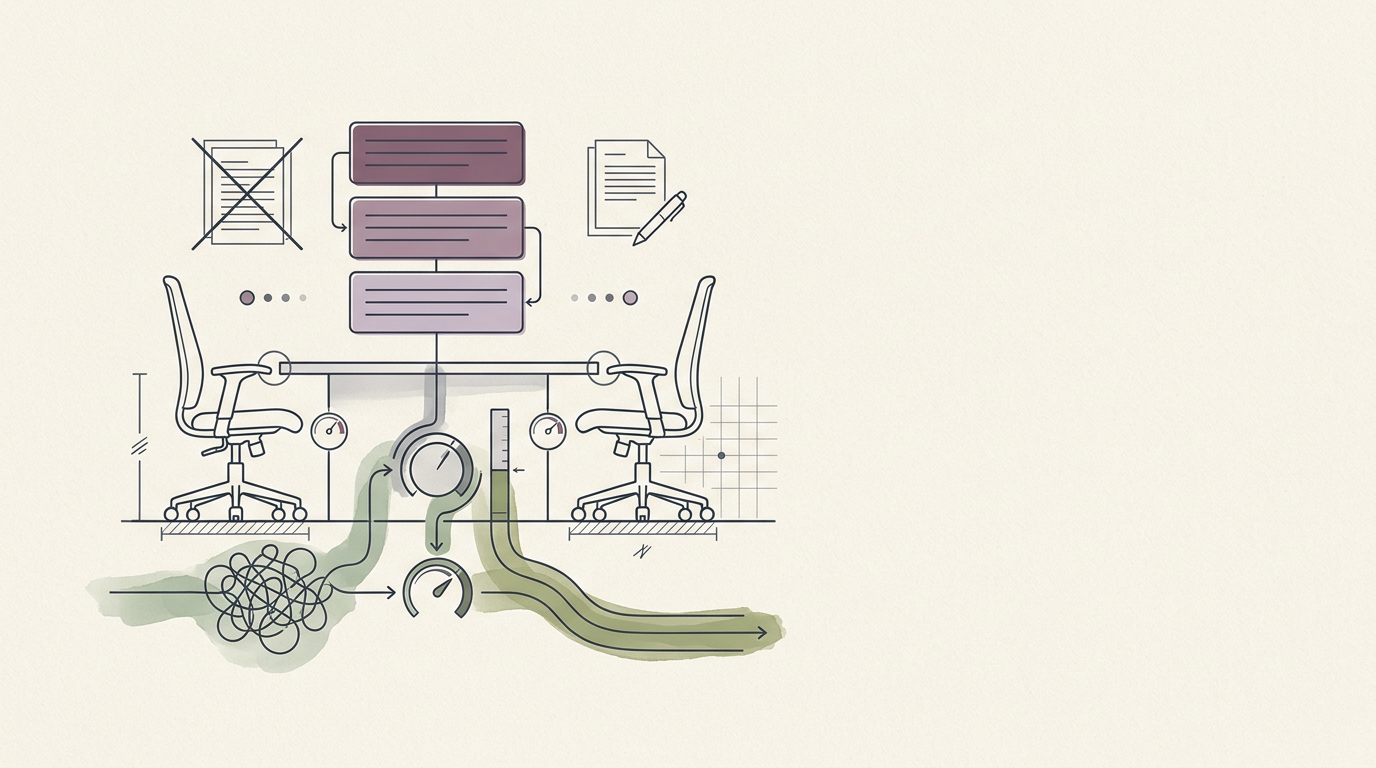
Every manager I know keeps a cheat sheet for difficult conversations saved somewhere on their desktop. It usually involves a feedback sandwich or a script they memorised from a corporate seminar. I've stopped recommending these entirely. You can't script your way out of a biological threat response. A regulated feedback conversation relies entirely on the autonomic state of the two people sitting in the room. The words don't matter if the prefrontal cortex is offline.
You know exactly how this feels in your body before you even open the Zoom link. Your jaw locks up at 2:50 PM. You stare at the calendar invite, feeling anxious for no reason, and suddenly you have no appetite for the coffee you just poured. By the time the call starts, your shoulders are creeping up to your ears and you feel disconnected from your body. You're tired but wired, rehearsing the opening line over and over while your chest gets tight. The other person logs on, you see their eyes dart to their second monitor, and that familiar brain fog after eating rolls in right as you try to deliver the criticism. You push through the script anyway, talking slightly too fast, hoping they won't notice the tremor in your voice.
Common Questions
What is regulated feedback?
It is a dialogue where both parties actively manage their nervous system state before and during the conversation. You secure the internal capacity to listen without triggering a defensive survival response. The baseline physiology dictates whether the communication actually lands.
Why do feedback scripts fail?
Scripts address the software of language while completely ignoring the hardware of the body. If an employee is already flooded with stress hormones from a back-to-back schedule, the most carefully phrased constructive criticism registers as a physical attack. State always overrides vocabulary.
How does state impact team performance?
A chronically dysregulated loop creates a low-level threat environment. Employees become risk-averse, collaboration stalls, and creative thinking stops entirely. Teams with secure psychological safety maintain higher autonomic resilience, which gives them the capacity to process challenges without shutting down.
The Threat Response in the Calendar Invite
I used to spend hours drafting the perfect bullet points for performance reviews, convinced that precision was a form of respect. I was wrong. The person receiving the feedback runs a subconscious threat scan long before you clear your throat. A vague calendar title or a slight tone shift on Slack are processed by the brain as data points of impending doom.
Remote work exacerbates this dynamic. Without the micro-cues of walking into a shared office, your team relies entirely on digital breadcrumbs to assess their standing. A message that just says "Call me" triggers an immediate spike in cortisol. By the time they sit down with you, their sympathetic nervous system is already highly activated. Kokorology react to corporate tension with the exact same cascade of stress hormones once reserved for escaping actual predators.
Your nervous system doesn’t care about your talking points. It cares about its threat assessment.
Trying to land a nuanced critique when someone's biology is primed to run away is a waste of a Tuesday afternoon. The feedback sandwich is basically hiding the vegetables in the mashed potatoes, but for adults. Your team needs basic nervous system regulation before they need another corporate acronym for giving criticism. The inbox has never once been impressed by your heart rate, but a direct report absolutely is. You can feel the tension right through the screen.
The Metric of Regulated Feedback Capacity
Your company probably tracks financial burn rate and server uptime, while ignoring the single most critical resource in the building. That resource is allostatic load. It represents the cumulative wear and tear on the body from chronic stress. When that load stays high, the system runs hot with elevated cortisol and a hair-trigger threat response.
You see the physical manifestations in every team meeting. It looks like the engineer who snaps at minor scope changes, or the director who gets tension headaches every Thursday afternoon. Dropping heavy feedback on a person carrying this physiological weight guarantees a system crash. They have zero spare capacity to process ambiguity or challenge. I notice in sessions that leaders who ignore this biological reality end up with a team that stays constantly defensive. Building a high-performance culture requires actively managing this physiological metric. Kokorology treat this as non-negotiable inside the Performance L2 course, where leaders learn to read the room's autonomic state before they read the agenda.
The Nerd-Out: HRV and the Prefrontal Cortex
Let's look at the actual machinery governing these conversations. The most reliable proxy Kokorology have for measuring regulatory capacity is heart rate variability (HRV), the beat-to-beat variation in your heart rhythm. High HRV indicates a flexible nervous system, driven by healthy vagal tone. When vagal tone stays high, the vagus nerve signals the heart to slow down, creating a state of calm readiness.
This keeps the prefrontal cortex—the brain's executive centre—online and fully resourced. You can process complex, uncomfortable information without reading it as a mortal threat. When stress spikes, HRV plummets, and vagal activity drops offline. The prefrontal cortex goes dark, and the amygdala takes over. Now, every piece of constructive advice is processed as immediate danger. They stop integrating your feedback entirely. They just survive it. Understanding this autonomic shift is a baseline requirement for leadership. It sits at the absolute centre of the practitioner certifications.
Coregulation Over Scripting
The alternative to a rigid script involves building the physiological foundation to hold the conversation. It starts with interoception, the skill of noticing your own internal state. Notice if you can feel your breath. Check if your stomach is tied in knots. Logging these physical inputs in the Kokorology Journal builds the awareness you need to intervene before you speak.
Then, you move to coregulation. A regulated leader drops the temperature of a room just by sitting down. Your stable nervous system sets the baseline for the people around you. This is a learnable, mechanical skill. By deliberately pacing your speech, uncrossing your arms, and lengthening your exhale, you signal safety at a fundamental biological level. You literally tell the other person's nervous system they can afford to power down their defensive structures and listen. The conversation stops being a battle for survival and becomes an actual exchange of information.
What to do this week
- Close the laptop early. Five minutes before your next one-on-one, step away from the screen. Take three slow breaths with a long exhale to shift your autonomic state.
- Notice your physical tension. Check your jaw, your shoulders, and your grip on the mouse. Don't try to fix them, just register the data.
- Open with a coregulatory bid. Ask a flat, non-work question before launching into the agenda. Let their system settle into the space.
- Break the input into doses. Deliver one piece of feedback, then pause. Give their prefrontal cortex time to process the words before you stack more on top.
Where this fits in the Kokorology system
This approach belongs inside the broader framework of Nervous System Regulation. Kokorology treat leadership strictly as a biological capacity. The tools to build this runway live inside the Cortisol Anchor, which focuses on managing your stress hormones so you can hold space for the people who rely on you.
Closing
You build the biological foundation to ensure the points actually land. The next time you feel the urge to rush through a difficult meeting, pause and check the room's autonomic state. That's the actual work.
- Work through a specific workplace dynamic in a private Coaching session.
- Build leadership capacity inside Performance L2.
- Start with the fundamentals in the free guide to the nervous system.
TL;DR
Most corporate advice on difficult conversations focuses on memorised scripts. The capacity to give and receive regulated feedback is entirely physiological. When an employee's nervous system gets stuck in a threat state with high allostatic load, their prefrontal cortex goes offline, making it impossible to process critique constructively. Effective leaders build team capacity by managing their own autonomic state and teaching their people the mechanics of nervous system regulation.
Sources
- Chandola, T., et al. (2008). Work stress and coronary heart disease: what are the mechanisms?. European Heart Journal.
- Epel, E. S. et al. (2024). Caregiver Load and Telomere Attrition: A 10-Year Longitudinal Study. Molecular Psychiatry.
- McEwen, B. S. (2019). The brain on stress: The good, the bad, and the ugly. In Stress resilience (pp. 21-34). Academic Press.
- Sapolsky, R. M. (2017). Behave: The biology of humans at the best and worst. Penguin Press.
- Thayer, J. F., & Lane, R. D. (2000). A model of neurovisceral integration in emotion regulation and dysregulation. Journal of Affective Disorders.