Nervous System
Nutrition on GLP-1 — how to eat when your stomach has been muted
GLP-1 drugs slow the upper GI and mute hunger cues. Eating the way you used to will quietly cannibalise your muscle, hair, and gut lining.
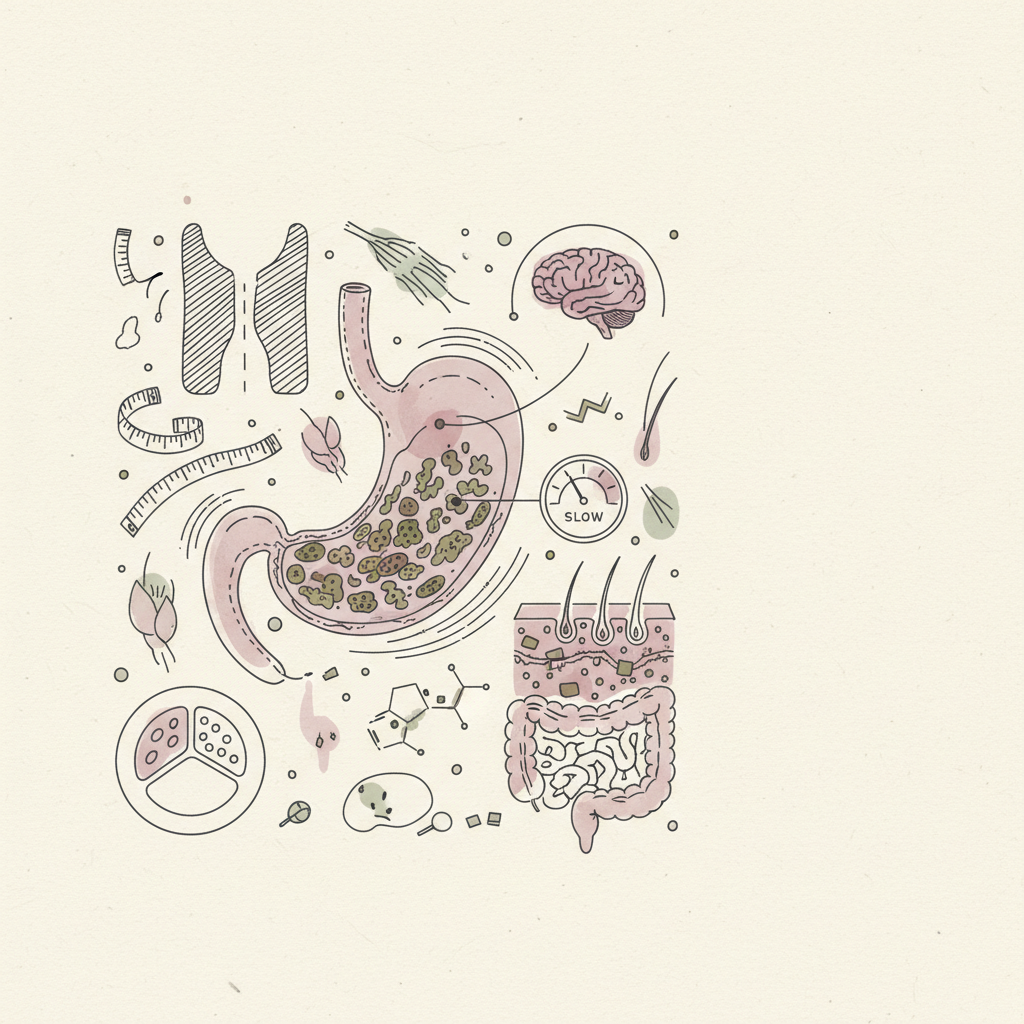
I'm looking at clinical trial data showing that up to 40 percent of the weight lost on semaglutide is lean mass. The standard advice tells people to enjoy their suppressed appetite and eat whatever they crave in smaller portions. That approach triggers a systemic starvation response, and the nervous system immediately reads the sudden nutrient undersupply as a low-grade threat. The rules of eating change completely the day your gastric emptying slows down.
The scale drops, but the mirror tells a stranger story. You open the fridge at 3pm, stare at the shelves with absolutely no hunger, and close it again. Half your usual portion of dinner leaves you uncomfortably full, yet you wake up with a jaw that won't unclench. People type exhausted but can't rest into Google at midnight while noticing extra strands in the shower drain. You're carrying less physical weight, but your state is pure tired but wired. The fatigue is bone-deep, the second coffee doesn't land, and you have this strange brain fog after eating that makes stringing a sentence together feel like wading through mud. Your body is smaller, but your capacity is static, and the cold sensitivity never seems to turn off.
Common Questions
Should I take an EAA powder on a GLP-1?
Yes, as a daily baseline. Essential amino acids require zero digestion, making them highly effective when your gastric emptying is delayed. They are incredibly useful first thing in the morning or right before you do any resistance training to keep amino acid levels stable.
How much muscle can I actually save?
With protein at 1.6 to 2.0 grams per kilogram of body weight and resistance training two to three times a week, lean mass loss stays under 10 percent of the total weight lost. You have to eat the protein and do the actual lifting.
Is intermittent fasting on a GLP-1 a good idea?
You already have chemically suppressed appetite and delayed gastric transit. Shrinking your eating window makes hitting your protein requirements physically impossible. You need multiple, spaced-out opportunities to ingest nutrients throughout the day.
Why does my hair keep falling out?
A massive caloric deficit combined with protein undersupply and plummeting iron causes the body to arrest hair growth to conserve energy. You stop telogen effluvium by raising your protein intake and testing your ferritin and zinc levels immediately.
The mechanical slowdown
GLP-1 receptors in the hindbrain stall your entire digestive transit while simultaneously reducing your desire for food. Food sits in the stomach two to four times longer than baseline. Downstream absorption of amino acids, iron, B12, and fat-soluble vitamins plummets. I've stopped thinking of these medications purely as metabolic regulators. I was completely wrong. They're fundamental nervous system interrupters.
The gut and brain are in constant communication via the vagus nerve. When the stomach stays artificially distended for hours, vagal tone shifts. The brain interprets the sudden caloric deficit and the altered gut signaling as an allostatic load, activating the HPA axis to manage the perceived threat. You feel fine because the drug has muted the signal that normally screams you're running on fumes, but underneath, the nervous system regulation machinery is working overtime to maintain homeostasis.
The ruthless scavenger
When you drop into a 40 to 50 percent calorie deficit, the body panics. It doesn't selectively burn fat while politely leaving your glutes and deltoids alone. It becomes a ruthless scavenger. It consumes skeletal muscle to get the amino acids it needs to keep your organs functioning. It downregulates collagen synthesis because glowing skin and thick hair are biologically irrelevant when you're starving.
Protein is biological life-support when your absorption is compromised. You need 1.6 to 2.0 grams of complete protein per kilogram of your ideal body weight, every single day. Whey isolate, Greek yogurt, chicken breast, fish, and eggs contain the full spectrum of essential amino acids. Staring at a bowl of lentils for an hour won't magically yield the leucine required to trigger muscle synthesis in a heavily suppressed state. You have to eat dense, highly bioavailable protein consistently.
The priority of the first bite
The stomach now operates with the turnover rate of a slow cooker. What goes in first is what actually gets digested and absorbed before you feel painfully full. If you start your meal with bread or a massive salad, you fill that limited space with fiber and carbohydrates, leaving zero room for the nutrients that keep your tissues intact.
Front-load 30 to 40 grams of complete protein before 10am. Whatever hits the stomach first dictates your recovery for the day. Eat small, dense meals 60 to 90 minutes apart. The ceiling for protein absorption in a single sitting under delayed emptying is roughly 30 grams. You can't just eat one massive steak at dinner and hope for the best. You'll just feel nauseous and sleep terribly. Kokorology track this pacing carefully inside the Journal because subjective hunger is no longer a reliable cue.
The hydration and sodium deficit
Brain fog on a GLP-1 is almost always sodium depletion. These medications reduce inflammation rapidly, and as a result, the body flushes water and sodium. The sympathetic nervous system ramps up when blood volume drops, pushing you into a hypervigilant state. You feel jittery, cold, and entirely depleted.
Drink 30ml of water per kilogram of body weight, and add 2 to 4 grams of sodium to that water daily. Salt your morning glass before you do anything else. It stabilizes blood volume, quiets the autonomic alarm bells, and brings your cognitive capacity back online. When I notice a client in 1:1 coaching complaining of afternoon dizzy spells, Kokorology always fix the sodium before Kokorology touch anything else.
The movement requirement
Muscle is your body's primary glucose sink and its emergency amino acid reserve. If you're shedding weight rapidly without sending a mechanical signal to the tissue that it needs to stick around, it will vanish. You have to lift heavy things two to three times a week. Squats, push-ups, rows, and deadlifts signal to the brain that the muscle is still required for survival.
There are four mandatory inputs to run alongside this: 5 grams of creatine monohydrate daily, an omega-3 delivering 2 to 3 grams of EPA/DHA, vitamin D3+K2, and quarterly blood panels for iron and B12. Without these, you are just getting smaller while systematically wrecking your internal machinery. You can read the specific mechanisms behind these essential compounds in the Library.
What to do this week
- Multiply your ideal body weight in kilograms by 1.8. Eat that many grams of protein daily.
- Set a whey shake and a Greek yogurt on the counter tonight for tomorrow morning.
- Do one 20-minute bodyweight session focusing on squats, push-ups, rows, and planks.
- Add a pinch of sea salt to your first glass of water every morning.
- Book a blood panel to check your ferritin, B12, vitamin D, and HbA1c.
Where this fits in the Kokorology system
This protocol establishes the biological baseline for the GLP-1 Anchor. It actively supports the Anti-Aging Anchor by preserving collagen synthesis, while proper sodium and meal spacing stabilizes your evening arousal levels.
Closing
Eat mechanically to preserve your tissues.
- Start with the 7-Day Nervous System Reset to stabilise your sleep and hormonal noise.
- Practice tracking your daily protein floor and lift days inside the Journal.
- Continue expanding your physiological capacity inside the Performance course.
TL;DR
GLP-1 medications drastically slow gastric emptying and mute your hunger signals, forcing a massive caloric deficit that will consume your muscle and hair if left unmanaged. You must eat 1.6 to 2.0 grams of complete protein per kilogram of body weight, front-loaded early in the day, in small frequent meals. Lift weights two to three times a week, salt your water aggressively, and supplement with creatine, omega-3s, and D3+K2 to preserve your lean mass and cognitive function.
Sources
- Wilding JPH (2021). STEP-1: Once-weekly semaglutide. New England Journal of Medicine.
- Jastreboff AM (2022). SURMOUNT-1: Tirzepatide once weekly. New England Journal of Medicine.
- Longland TM (2016). Higher protein during energy deficit combined with intense exercise. American Journal of Clinical Nutrition.
- Phillips SM (2011). Dietary protein for athletes. Journal of Sports Sciences.
- Prado CM (2025). Muscle Mass Loss With GLP-1 Therapy: Clinical Relevance and Mitigation. Lancet Diabetes & Endocrinology.
- Kreider RB (2017). ISSN position stand on creatine. Journal of the International Society of Sports Nutrition.