Journal Practice
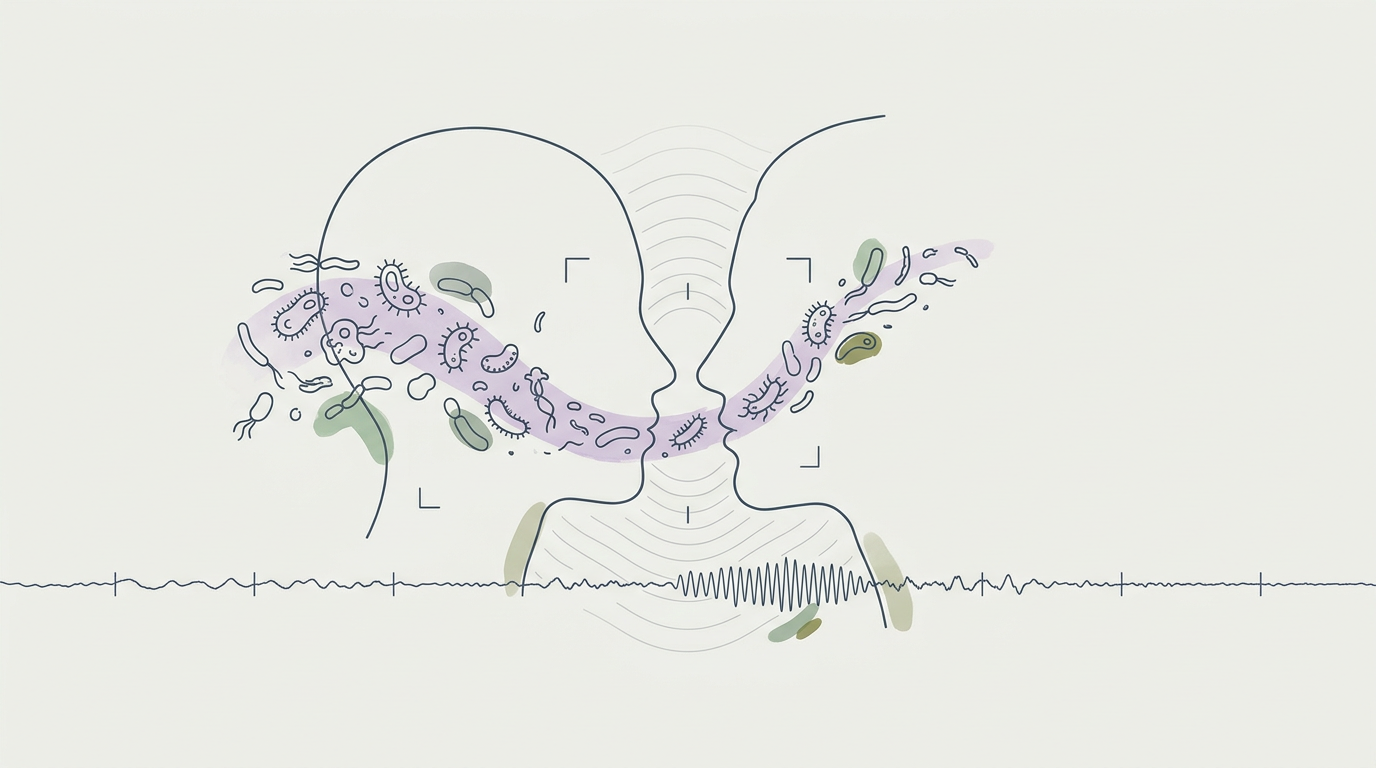
That kiss was an 80 million bacteria data transfer
A hug is a nervous system data transfer, not a feeling to analyze. Connection is a biological event, not a story you need to write down.
For years, I dismissed most journaling as self-indulgent homework. I thought the goal was to write a better story about my feelings, a task that felt both exhausting and pointless. I was wrong. The most effective journaling has nothing to do with narrative. It is a practice of sensory data collection, a way to tune into the quiet, constant broadcast of your own nervous system. It is the cheapest, most effective tool you have for building interoception (your perception of your body’s internal state).
This week holds World Suicide Prevention Day, a date that brings the physiology of connection into sharp focus. You might feel a pang of loneliness that has no obvious cause, a sense of being fundamentally separate. Then, a friend gives you a brief hug. For a split second, the static clears. That moment is a data transfer. Your nervous system is registering another nervous system, a biological event of co-regulation that momentarily quiets the isolation signal. You are taught to ignore this data in favour of the big, loud feelings. The work is to start listening to the signal underneath the noise.
Your body is a sensory radio
Your brain runs on a tight energy budget. To manage it, it doesn't wait for you to write a novel about your emotional state. Instead, it constantly listens to a direct, raw data feed from your body. The anterior insula is the part of your brain that processes this feed, acting as a central hub that integrates signals about your heart rate, your gut, your temperature, and your breath. Think of it as a radio receiver tuned to the frequency of your own biology.
For most of the day, the volume on this broadcast is turned way down, drowned out by the noise of cognitive tasks, social obligations, and the endless internal monologue. The purpose of sensory journaling is to improve the signal-to-noise ratio. When you pause to note 'tightness in my chest' or 'a cool feeling on my skin,' you are training your brain to pay attention to the broadcast it was already receiving. You are not inventing new feelings; you are simply adjusting the dial. You are learning to distinguish the faint, crucial signal of your physical state from the loud, distracting static of your thoughts about it.
This is not a metaphor. Your brain uses this interoceptive data to make predictions about your needs and to allocate resources accordingly. If the signal is clear, it can anticipate a need for rest, food, or social connection and prompt you to act before a deficit becomes a crisis. If the signal is noisy or ignored, the brain is flying blind, leading to the kind of miscalculations that leave you tired, wired, and wondering what went wrong.
Language is a lever on your nervous system
The act of putting a name to a sensation is a powerful intervention. It is functional, more than descriptive. When you label a physical feeling—a practice called affect labelling—you engage your prefrontal cortex, the part of your brain responsible for executive function. This, in turn, sends a signal to dial down the activity in the amygdala, your brain’s alarm system. You are using language to actively change your brain's response to an internal stimulus, moving from reacting to responding.
The mechanism works for internal states, and it works for the data you get from the outside world. An intimate kiss, for instance, transfers around 80 million bacteria. The sudden change in your oral microbiome is a massive, invisible data exchange. Your immune system registers it. Your vagus nerve, which heavily innervates the gut and has outposts that monitor the mouth and throat, registers it. This microbial exchange is a data point about safety and intimacy that your system processes long before you have a thought about it.
The journaling practice is to notice the subtle inputs your system is processing all day long. Instead of getting lost in the story of a touch, you can learn to ask: where in my body do I feel the echo of that contact? What is the sensation, separate from the narrative? By shifting your attention from the story to the physical echo, you are training a more fundamental kind of awareness.
The physiological cost of a weak signal
Ignoring your body's broadcast has a real, physiological cost. When your interoception is poor, your brain is running on outdated or inaccurate information. It's like navigating with a map from last year; you keep making decisions based on conditions that no longer exist. You push through fatigue because your brain fails to register the body's plea for rest. You agree to another social event because you miss the subtle signs of overstimulation that precede overwhelm.
A mismatch between your perceived capacity and your actual capacity is a direct route to burnout. Burnout is a protective shutdown, a physiological strike action your body takes when the demands placed upon it consistently exceed its resources. The cynicism, exhaustion, and sense of ineffectiveness are the symptoms of a system that has been running on an empty tank for too long because the fuel gauge was broken.
A system this disconnected also amplifies feelings of isolation. Loneliness is a physiological state, a distress signal triggered by a lack of perceived social connection. Your nervous system is wired to detect the presence of other friendly nervous systems through subtle, non-verbal cues—a shared glance, a matched breathing rhythm, a gentle touch. If your internal receiver is offline, you can be in a room full of people and still feel alone because your body isn't registering the very signals that tell it you are safe and part of a group. Improving your interoceptive signal clarity can help your system recognise these moments of co-regulation when they happen.
Tonight's practice
This practice is about data collection, not feeling-generation. Find five minutes where you will not be disturbed. The goal is to notice one point of contact between your internal state and the world outside of it. This builds the muscle of interoception, the same one that tells you when you need to rest before you are exhausted.
Notice the temperature of the air on your skin. Where is it coolest? Where is it warmest? What does that distinction feel like inside your body?
- Set a timer for five minutes. This contains the practice and prevents it from feeling like another open-ended task on your to-do list.
- Sit or lie down. Choose a position where you can be relatively comfortable and still. Close your eyes if that helps you tune inward, or soften your gaze.
- Bring your attention to the surface of your skin. This is a large, neutral sensory field. Start with your hands or face, areas with high sensitivity.
- Without judgement, simply notice. Scan your body for places where the air feels cool, and where it feels warm from contact with fabric or a surface. The goal is not to change anything, only to observe what is already there. Is the sensation sharp, diffuse, tingling, or still?
- Write down three sensory words describing the distinction. Use data, not narrative. For example: 'Cool on forearms, warm on back, pressure behind knees.' This act of labelling anchors the observation and engages the prefrontal cortex, completing the loop.
Common Questions
Is this kind of journaling better than writing about my feelings?
It's a different, more foundational practice. Naming sensory data builds your capacity to notice your state shifting in real time. This makes processing emotions less overwhelming because you catch the physiological signal earlier, before it escalates into a full-blown emotional crisis. Think of it as learning the alphabet before you try to write a novel; it gives you the basic components of your own internal language.
What if I don't feel anything?
That is also a signal. 'Numbness,' 'static,' or 'nothing' are valid interoceptive reports. Your job is not to force a feeling but to accurately log what is actually there. Writing 'numbness in my hands' or 'can't connect to my body' is the first step toward re-establishing that connection. It is an honest observation of your current state, and the most important data point you can collect today.
How does this help with something as big as suicidal ideation?
It serves as a tool for physiological anchoring. States of extreme overwhelm and isolation are all-consuming cognitive and emotional spirals that can make your thoughts feel dangerously abstract and untethered from reality. This practice provides a method for intentionally shifting your attention, for a few minutes, to a single, neutral, physical sensation in the present moment. It offers a temporary anchor in your physical body, which can act as a vital circuit-breaker.
Closing
This practice gives you a more accurate instrument with which to read the signals your body is already sending.
- Start logging your sensory data with the Kokorology Journal.
- Build your toolkit for nervous system regulation with the Foundations workshop.
- Get a free weekly prompt by signing up for the Kokorology newsletter.
TL;DR
Effective journaling is a tool for sensory data collection, not emotional narration. Your body constantly broadcasts information about its internal state, a faculty called interoception. The practice is learning to tune into that signal. By naming subtle physical sensations—like the temperature of air on your skin—you use language as a lever to regulate your nervous system. This builds a more accurate awareness of your body's capacity, providing a powerful, grounding tool against the physiological states of burnout and overwhelm.
Sources
- Craig, A. D. (2009). How do you feel—now? The anterior insula and human awareness. Nature Reviews Neuroscience, 10(1), 59–70.
- Kort, R., et al. (2014). Shaping the oral microbiota through intimate kissing. Microbiome, 2(1), 41.
- Lieberman, M. D. (2023). Communication with others and oneself: language as a nervous-system intervention. Curated primary studies and meta-analyses (1994–2023).
- Maslach, C. (2016). Understanding the burnout experience: Recent research and its implications for psychiatry. World Psychiatry, 15(2), 103–111.
- Pennebaker, J. W. (2023). Journaling and the nervous system: from expressive writing to affect labeling. Curated meta-analyses and primary studies (1986–2023).