news
New Omics Data Finds Neuroblastoma Prognosis Marker
Researchers identified a new "poor outcome" marker for neuroblastoma in a study of just over 50 patients, using advanced single-cell RNA sequencing and spatial omics. This data reveals how certain cancer cells interact with their environment, offering a deeper look into the disease's progression than previous lab models allowed. The finding could lead to more precise treatments, changing how specific patient populations are approached.
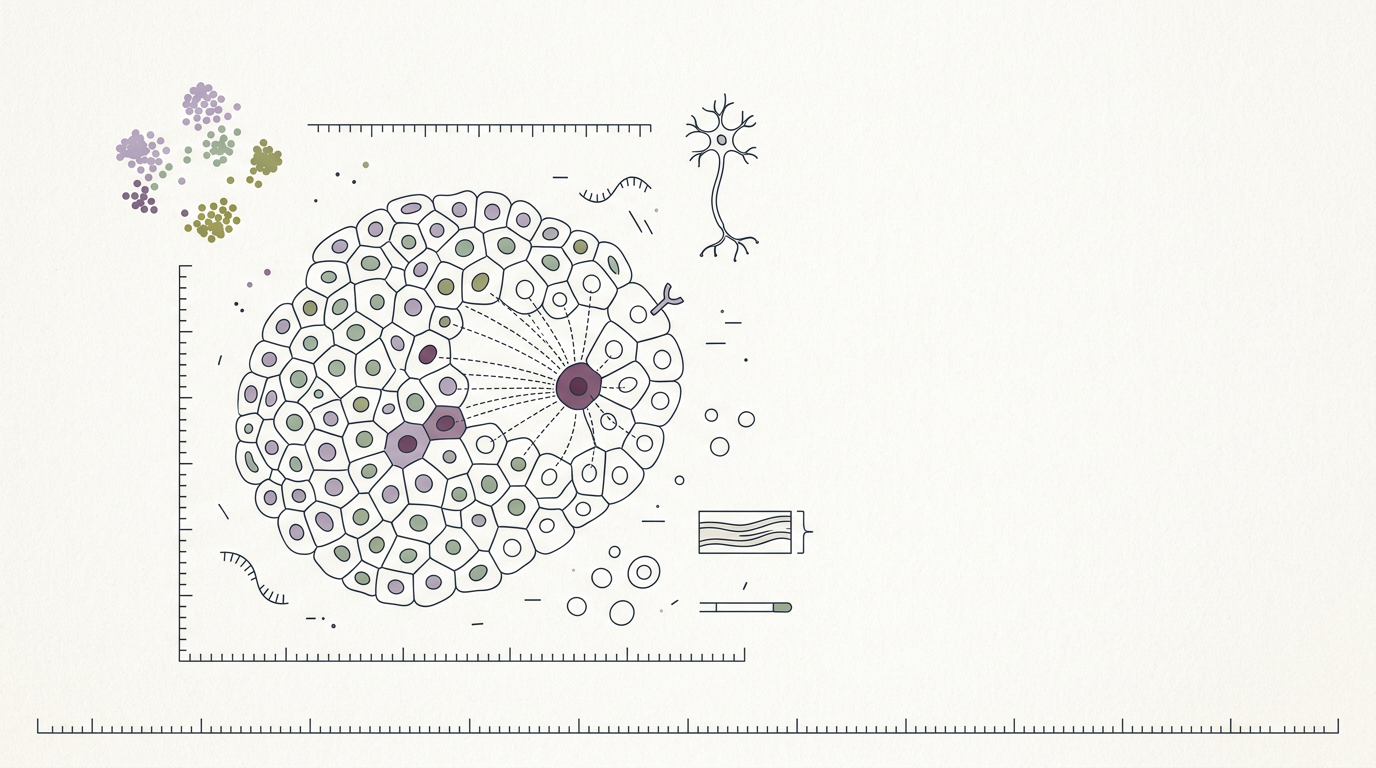
Researchers identified a new "poor outcome" marker for neuroblastoma in a study of just over 50 patients, using advanced single-cell RNA sequencing and spatial omics. This data reveals how certain cancer cells interact with their environment, offering a deeper look into the disease's progression than previous lab models allowed. The finding could lead to more precise treatments, changing how specific patient populations are approached.
The architecture take
I see this kind of study pop up, and my first thought is always: great for cancer research, but what's the broader play? This is about understanding cell-level communication — spatial omics maps exactly how cells are talking (or not talking) to their neighbors, which is the definition of a body system. That communication, or lack thereof, dictates resilience or vulnerability. It's not just about cancer; it's about the fundamental signals that keep a system regulated, or send it sideways. For those of us tracking longevity or complex chronic conditions, these are the tools you watch. They might not be diagnosing your everyday fatigue yet, but the tech itself — mapping cellular whispers, understanding a specific cell type's local neighborhood — is the future of knowing what's actually happening inside a body. Not just what's broken, but why.