news
Nature Neuroscience Study Finds Psilocybin Effects Unreproducible in Mice
A multi-lab study led by Odilia D. Lu at UC Berkeley found that a 2 mg/kg dose of psilocybin failed to produce reproducible behavioral results in mice. Published in Nature Neuroscience, the collaborative research challenges standard rodent assays long used to evaluate psychedelic therapies. The findings suggest animal models alone cannot reliably forecast how these compounds regulate mammalian nervous systems.
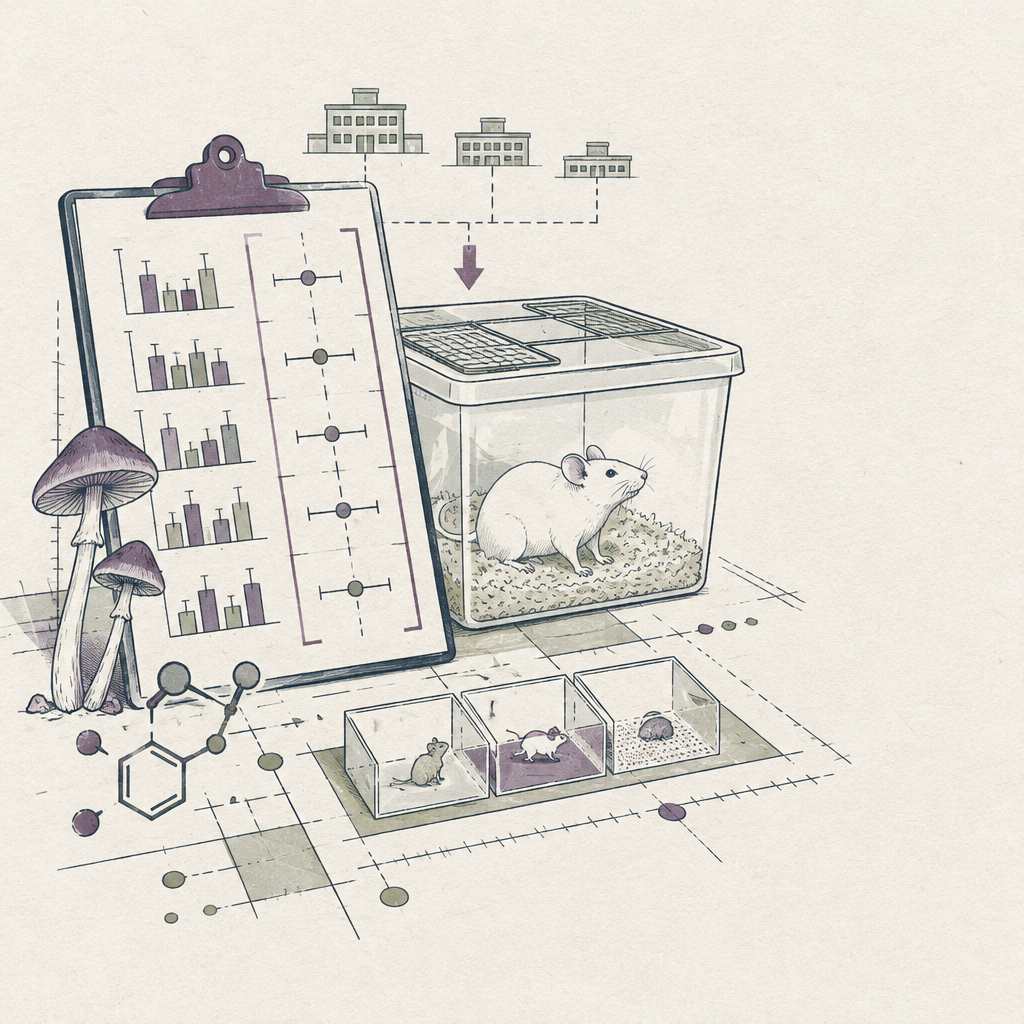
A multi-lab study led by Odilia D. Lu at UC Berkeley found that a 2 mg/kg dose of psilocybin failed to produce reproducible behavioral results in mice. Published in Nature Neuroscience, the collaborative research challenges standard rodent assays long used to evaluate psychedelic therapies. The findings suggest animal models alone cannot reliably forecast how these compounds regulate mammalian nervous systems.
The architecture take
I used to think preclinical psychedelic trials gave researchers reliable proof, but this multi-lab result made me change my mind. Lead author Odilia D. Lu at UC Berkeley led a team across several labs testing a 2 mg/kg dose of psilocybin in mice for Nature Neuroscience. The drug failed to show reproducible behavioral benefits across standard animal stress models. Mice do not feel awe. Serotonin 5-HT2A receptors mediate cortical plasticity, yet the chemical alone did not reliably shift rodent baselines without specific environmental context. I watch biotech pitch decks cite these exact mouse assays every week to justify nine-figure valuations. I suspect the industry will finally have to admit that subjective human states and relational support do the heavy lifting, not isolated compound delivery in a plastic cage. You cannot measure nervous system recovery in people using tests designed to see how long an animal treads water before giving up.