Daily read · 18:00
Cold therapy loses its clinical footing while bedroom physics replaces trackers
Ulta Beauty placed $399 biometric rings into 1,000 stores as clinical trials dismantled the physiological rationale for post-exercise ice baths.
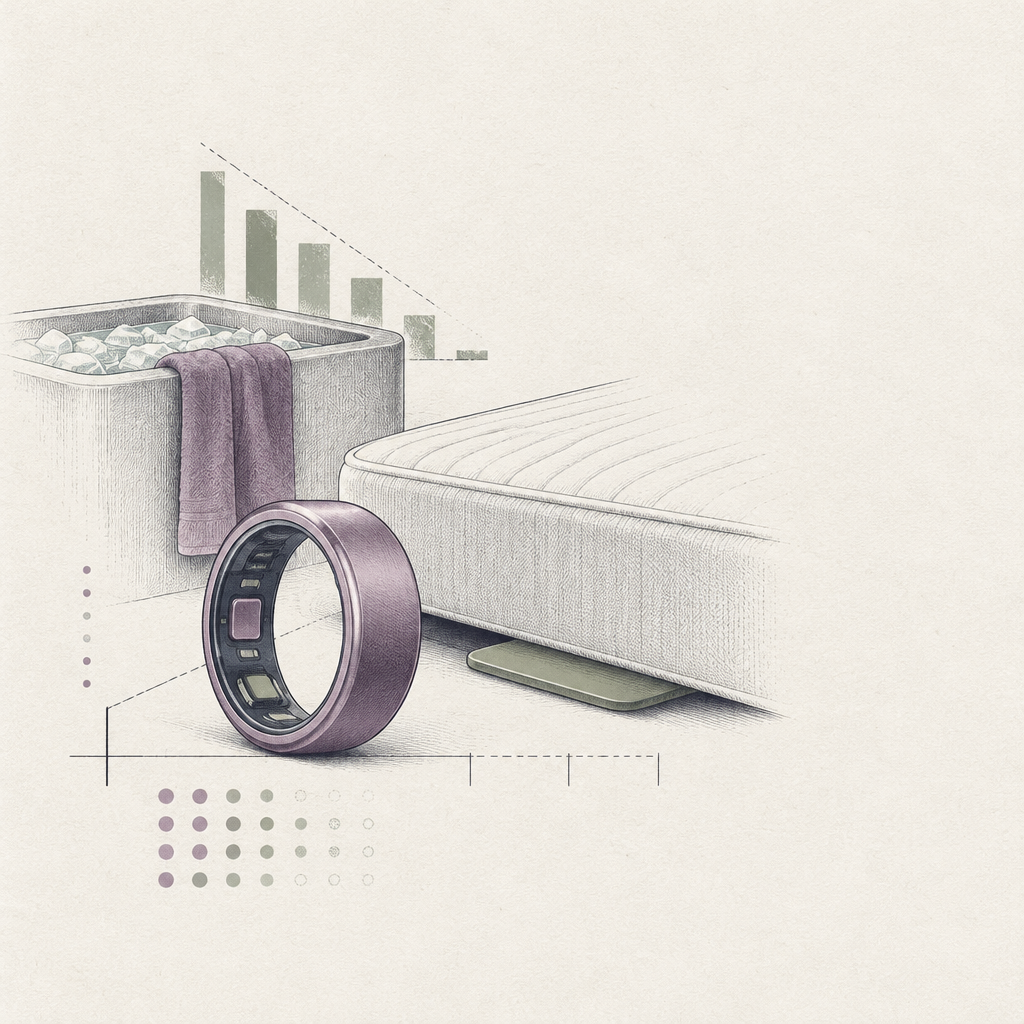
Ulta Beauty placed $399 biometric rings into 1,000 stores as clinical trials dismantled the physiological rationale for post-exercise ice baths.
In today's read: 1. Post-workout cold therapy loses clinical backing · 2. Functional hydration drops athletic extremes · 3. Bedrooms become clinical recovery chambers · 4. Longevity protocols shift to algorithmic trials
1. Post-workout cold therapy loses clinical backing
Cold water immersion drops local tissue temperature and constricts microvasculature immediately after resistance exercise. That vasoconstriction suppresses the acute inflammatory response and downstream kinase signalling required for muscle protein synthesis.
I was wrong about post-lift ice baths for years before the hypertrophy data caught up with the marketing. Expect commercial recovery lounges to pivot floor space toward contrast heat and pneumatic compression when member retention drops.
Evidence from today:
- Ice baths after exercise may delay recovery rather than speed it — New Scientist — A study highlighted by New Scientist indicates that cold water immersion directly after strength training blunts muscle repair compared to passive rest. Researchers found the rapid drop in tissue temperature dampens the necessary inflammatory cascade, leaving lifters with delayed tissue remodeling.
- Cold Therapy Slows Muscle Recovery After Exercise, Study Finds — New Scientist - Health & Medicine (specific focus) — A new trial shows cold water immersion right after training delays muscle repair and blunts strength gains compared to passive rest. Freezing temperatures constrict blood vessels and suppress the natural acute inflammation required for tissue adaptation. If the goal is rebuilding muscle rather than numbing acute soreness, resting quietly works better.
2. Functional hydration drops athletic extremes
Formulators are replacing 1,000-milligram sodium packets with sub-gram mineral doses, while clinical meta-analyses show 2g/L of dissolved protein slows gastric emptying to raise oncotic pressure. Retaining water in systemic circulation doesn't require overloading sedentary kidneys with raw salt.
Desk workers noticed the bloat. Brands formulating for basal metabolic hydration will squeeze electrolyte companies stuck selling marathoner fuel to office workers.
Evidence from today:
- Adding protein to water improves fluid retention, meta-analysis finds — Sports Medicine (Springer) — A systematic review of 16 human trials in Sports Medicine found that adding at least 2g/L of protein to drinks significantly improves fluid retention and net fluid balance over plain water. Slower gastric emptying and higher oncotic pressure keep fluids in circulation rather than flushing them straight through the kidneys.
- Poppi Founder Allison Ellsworth Launches Jetty to Counter High-Sodium Hydration Packets — Modern Retail — Poppi co-founder Allison Ellsworth is launching Jetty, a daily hydration brand formulated with lower sodium levels than heavy-sweat competitors. The product targets everyday desk workers who do not need the 1,000 milligrams of salt found in performance electrolyte sticks. It marks an industry push to decouple casual fluid intake from extreme athletic fueling.
3. Bedrooms become clinical recovery chambers
Nighttime ambient air with elevated PM2.5 triggers low-grade vascular inflammation that spikes morning cortisol and disrupts fasting glucose, while acoustic spikes fragment slow-wave sleep. Whole-body low-frequency vibration and targeted noise cancellation assist glymphatic waste clearance without pharmaceutical sedatives.
Sleep tech isn't sticking to diagnostic wristbands that passively report poor rest after the fact. Companies engineering physical room controls will capture the consumer spend currently wasted on sleep hygiene apps.
Evidence from today:
- Anker Debuts Soundcore Sleep Earbuds 4 Targeting Snoring and Night Noise — CES Digital Health — Anker unveiled the Soundcore Sleep Earbuds 4 at CES, adding a 3 to 5 dB reduction boost in active noise cancellation specifically tuned to muffle partner snoring and ambient bedroom noise. The low-profile earbuds target the estimated 20 million American couples battling sleep fragmentation from nightly acoustic interruptions. The release shifts sleep audio away from general earbuds toward dedicated nighttime recovery gear.
- Running a Bedroom HEPA Filter Can Help Lower Morning Blood Sugar — Nautilus — Recent environmental health trials link fine particulate air filtration during sleep directly to tighter overnight glucose control. Breathing elevated PM2.5 levels triggers nighttime inflammatory cascades that nudge up morning cortisol and insulin resistance. For anyone managing blood sugar, cleaning bedroom airflow is an overlooked physical lever.
- Vibrating Mattress Clears Alzheimer Proteins in Small Clinical Trial — ScienceAlert — Researchers at the University of Oulu tested 30 minutes of whole-body low-frequency vibration combined with blood pressure medication on human subjects, measuring changes in Alzheimer's-linked proteins in the blood. The combination boosted the movement of amyloid-beta out of brain tissue into systemic circulation. It suggests mechanical stimulation can physically assist the brain's nighttime waste clearance.
4. Longevity protocols shift to algorithmic trials
Longevity medicine is migrating from observational cohort studies to automated N-of-1 trial platforms that measure biological age shifts against individual behavioral inputs. Multi-agent models correlate daily sleep, autonomic load, and biomarker readouts to isolate whether specific compounds actually alter methylation pace.
Decoupling protocol validation from institutional grants lets digital health startups iterate interventions in months rather than decades. Platforms providing genuine algorithmic feedback will pull high-LTV longevity consumers away from static supplement stacks.
Evidence from today:
- NeuroAge launches a 500-person trial to reverse cognitive aging — Longevity Technology — NeuroAge is enrolling 500 participants in a six-month trial tracking biological brain age against tailored daily protocols. The program monitors sleep, stress load, and nutrition markers alongside cognitive testing. The goal is gathering hard data on whether everyday behavioral shifts can register on brain aging biomarkers.
- Insilico and David Sinclair Open-Source Longevity AI for Personal Experiments — Longevity Technology — Insilico Medicine partnered with Harvard researcher David Sinclair to launch Longevity Grok, a free multi-agent AI system built to run personal N-of-1 health trials. The tool analyzes daily biomarker metrics to determine whether common interventions like magnesium or earlier bedtimes produce measurable biological shifts. It targets self-experimenters seeking hard data on their longevity protocols.
Also moved today
- Ulta puts Oura rings into 1,000 beauty stores — Glossy — Ulta Beauty rolled out Oura rings across 1,000 stores to capture wearable biometric revenue directly on retail beauty floors.
- CMS and FDA Move to Speed Medicare Coverage for Neuromodulation — Neurotech Reports — Medicare cleared faster reimbursement pathways for bioelectronic neuromodulation devices, bypassing multi-year commercial billing logjams for non-opioid pain hardware.
- Philips Sets Aside €288 Million to Settle US DOJ Sleep Recall — Sleep Review — Philips Respironics set aside €288 million to settle US Department of Justice investigations into toxic foam degradation across its CPAP lines.
- Over half of youth gambled in the past year, Rutgers reports — Healio - Psychiatry & Mental Health — Rutgers found 52.5% of surveyed youth engaged in gambling last year as gamified sportsbooks penetrated adolescent mobile habits.
- College Academic Slumps Trace Back to Depression, Not Stress or Anxiety — ScienceAlert — A 43,000-student study revealed depressive symptoms drive undergraduate GPA drops far more reliably than acute exam anxiety, proving campus wellness centers target the wrong emotional state.
- Durham Study Finds Psychedelic Mental Health Benefits Fade With Age — Neuroscience News — Durham University data indicated classic psychedelics lose their association with reduced anxiety and depression in older adults, challenging universal therapeutic efficacy across aging nervous systems.
- Oral Citicoline Preserves Retinal Nerve Cells in 12-Month Glaucoma Trial — Frontiers in Neuroscience (News & Research sections) — A 12-month trial demonstrated oral citicoline preserves retinal ganglion cells and microperimetric sensitivity in glaucoma patients without altering intraocular pressure.
- Hyperice adds integrated heat to wireless Normatec boots for $1,499 — Athletech News — Hyperice integrated active heating elements into its wireless Normatec boots for $1,499 to consolidate compression and thermal therapy into a single hardware SKU.
New this week in wellness goods
- Hyperice adds integrated heat to wireless Normatec boots for $1,499 — US — Hyperice launched the Normatec Elite Heat, bringing thermal elements to its flagship wireless pneumatic compression boots for $1,499. The design eliminates external hoses and combines dynamic air compression with active warmth across the full leg. It directly targets high-mileage runners and athletes looking for faster post-workout circulation.
- Poppi Founder Allison Ellsworth Launches Jetty to Counter High-Sodium Hydration Packets — US — Poppi co-founder Allison Ellsworth is launching Jetty, a daily hydration brand formulated with lower sodium levels than heavy-sweat competitors. The product targets everyday desk workers who do not need the 1,000 milligrams of salt found in performance electrolyte sticks. It marks an industry push to decouple casual fluid intake from extreme athletic fueling.
- Anker Debuts Soundcore Sleep Earbuds 4 Targeting Snoring and Night Noise — Global — Anker unveiled the Soundcore Sleep Earbuds 4 at CES, adding a 3 to 5 dB reduction boost in active noise cancellation specifically tuned to muffle partner snoring and ambient bedroom noise. The low-profile earbuds target the estimated 20 million American couples battling sleep fragmentation from nightly acoustic interruptions. The release shifts sleep audio away from general earbuds toward dedicated nighttime recovery gear.
- Insilico and David Sinclair Open-Source Longevity AI for Personal Experiments — global — Insilico Medicine partnered with Harvard researcher David Sinclair to launch Longevity Grok, a free multi-agent AI system built to run personal N-of-1 health trials. The tool analyzes daily biomarker metrics to determine whether common interventions like magnesium or earlier bedtimes produce measurable biological shifts. It targets self-experimenters seeking hard data on their longevity protocols.
Signal map
Global: 10 · North America: 6 · Oceania: 4 · Europe: 3
What I'd watch next
I am watching whether competitor wearable makers match Oura's retail expansion into beauty chains before holiday inventory locks. Keep an eye on how recovery studios adjust their pricing as the post-workout cold plunge data circulates.
Where this fits at Kokorology
I spent years watching people buy expensive recovery hardware to fix exhaustion that was actually caused by unmanaged autonomic load. The Nervous System Journal gives you the daily baseline tracking to spot your actual physiological state before you spend four figures on gadgets.