Daily read · 18:00
Closed-Loop Neurotech and Companion Formulations Reshape Clinical Baselines
Clinical protocols and consumer formulators are moving away from blunt, continuous interventions toward targeted modulation of specific autonomic and metabolic circuits.
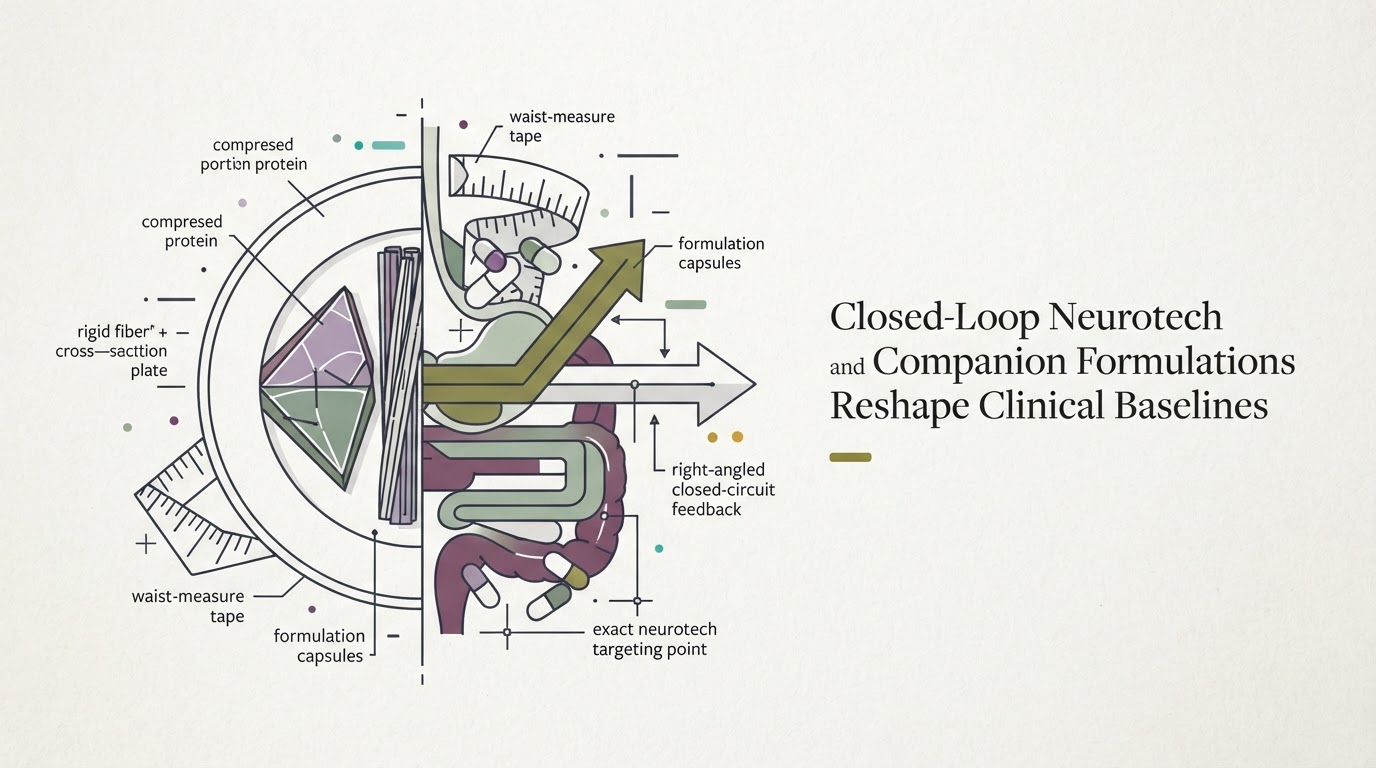
Clinical protocols and consumer formulators are moving away from blunt, continuous interventions toward targeted modulation of specific autonomic and metabolic circuits.
In today's read: 1. The GLP-1 Companion Supply Chain Solidifies · 2. Adaptive Neurotech Replaces Continuous Electrical Current · 3. Hormone Guidelines Catch Up to Real Phenotypes
1. The GLP-1 Companion Supply Chain Solidifies
Weight-loss injectables cut appetite while stripping skeletal muscle and gut motility, creating a secondary market for protective supplements. Mainstream CPG brands are now formulating directly for pharmaceutical side effects to capture spillover spend from insured patients.
Retail supplement margins will pivot from standalone diet products to companion formulas. The winners are manufacturers with existing mass retail distribution who treat GLP-1 users as recurring monthly accounts.
Evidence from today:
- NOW Foods drops a GLP-1 companion formula for metabolic support — SupplySide Supplement Journal — NOW Foods rolled out a targeted GLP-1 support formula designed to address the muscle loss and digestive slowdown tied to GLP-1 agonists. The launch aims at consumers on prescription weight-loss medications looking for over-the-counter companion nutrients. It signals how mass-market supplement makers are adapting to pharmaceutical appetite suppression.
- UK MPs Demand Faster Mounjaro Rollout and Doubled Weight-Loss Surgeries — The BMJ (British Medical Journal) — A House of Commons committee called England's phased tirzepatide rollout woefully small, demanding ministers accelerate access to Mounjaro on the NHS. Around one in three adults in England live with obesity, yet strict eligibility criteria currently leave most patients without coverage. The report also urged the government to double annual bariatric operations.
2. Adaptive Neurotech Replaces Continuous Electrical Current
Vagus nerve stimulation and deep brain chips now adjust delivery to vascular dynamics and real-time oscillatory synchrony rather than firing continuous current into tissue. Closing the loop drops power draw under 200 microwatts and prevents neural habituation.
Medical device makers face pressure to scrap open-loop hardware as real-time biomarker sensing becomes the clinical floor. Startups building non-invasive vagal or vibrotactile hardware will need clear hemodynamic data to secure clinical credibility.
Evidence from today:
- Tohoku University study links vagus nerve stimulation to brain vascular dynamics — Neurotech Reports — Researchers at Tohoku University found vagus nerve stimulation consolidates learning by tuning cerebral blood vessel dynamics after training. The animal study reveals autonomic signaling shapes memory physically through microvascular blood flow rather than pure neural firing. The finding changes how engineers and neurotech companies evaluate post-training recovery protocols.
- EPFL Develops Sub-200-Microwatt Brain Chip for Adaptive Depression Treatment — Neuroscience News — EPFL researchers built LogSync, an ultra-low-power brain chip that runs on less than 200 microwatts to deliver responsive deep brain stimulation for depression. Instead of blasting neural tissue with continuous current, the chip reads oscillatory synchrony across multiple brain regions to fire only when circuits drift out of tune. It marks a shift toward closed-loop psychiatric implants that adapt to mood states in real time.
- Chest vibrations paired with meditation alter brain wiring in trauma survivors — PsyPost — Researchers found that pairing sternum vibrotactile stimulation with mindfulness meditation measurably alters brain connectivity in trauma survivors. The sensory cue anchors attention to physical sensations, strengthening neural networks responsible for interoception and body awareness. It offers an accessible protocol for people whose nervous systems normally dissociate during silent meditation.
3. Hormone Guidelines Catch Up to Real Phenotypes
Clinical bodies are dropping the wait-and-see stance on endocrine shifts as epigenetic clocks reveal accelerated cellular aging during unbuffered reproductive strain. Restoring baseline hormone levels protects sleep architecture and vascular tone instead of forcing patients to absorb chronic systemic stress.
Standard OB-GYN practices will face direct patient demand for hormone replacement protocols they previously deflected to cash-pay telehealth clinics. Insurers will have to defend why they reimburse downstream metabolic illness while denying early endocrine care.
Evidence from today:
- ACOG Updates Menopause Guidelines for First Time in Twelve Years — Mindbodygreen — The American College of Obstetricians and Gynecologists published its first clinical guidance overhaul for menopause in 12 years, detailing protocols for hot flashes, sleep problems, and mood changes. The updated document broadens clinical acceptance of systemic hormone replacement therapy alongside non-hormonal options. It gives regular OB-GYNs formal backing to treat symptoms actively rather than telling patients to endure them.
- Pregnancy Speeds Up Epigenetic Clocks Before Postpartum Reversal — Nautilus — A review from Harvard Medical School geneticists shows that pregnancy temporarily accelerates biological age across epigenetic clocks, blood markers, and brain imaging. The data indicates cellular aging peaks in late gestation before rebounding sharply in the months after delivery. How fast that reversal happens depends directly on metabolic rest, sleep, and systemic recovery.
- SRI-81 Shatavari and Ashwagandha Trial Shows Female Libido Gains — Nutritional Outlook — Ixoreal Biomed published a placebo-controlled trial in the International Journal of Women's Health tracking its SRI-81 Shatavari extract and KSM-66 Ashwagandha. The 8-week study measured scores across desire, arousal, lubrication, and satisfaction in healthy adult women. Both botanicals produced measurable improvements over placebo, with the combination showing the clearest gains.
Also moved today
- Evening Metyrapone Lowers Overnight Cortisol in Adrenal Adenoma Trials — Deutsches Ärzteblatt — Evening metyrapone blunts nocturnal cortisol spikes and overnight blood pressure in adrenal adenoma patients, proving targeted timing can delay surgical intervention.
- Stalled Infant Gut Microbiome Maturation Linked to Type 1 Diabetes Risk — Deutsches Ärzteblatt — Longitudinal TEDDY cohort data links delayed infant microbiome diversification to islet autoimmunity, showing developmental timing matters more than isolated probiotic strains.
- Early Research Shows Social Media Bans Do Not Fix Youth Mental Health — Fast Company - Innovation (specific focus) — Early cohort data indicates blunt social media age bans leave adolescent sleep deficits intact while severing peer support networks.
- JAMA Study Shows Ultra-Processed Food Rewires Kids' Brain Reward Circuits — Neuroscience News — Pediatric neuroimaging shows ultra-processed diets prime the dorsal striatum for heightened food reward, driving body fat increases twelve months later.
- Cell Press Study Shows How Taurine Dials Down Chronic Inflammation — Cell Metabolism — Cell Press data demonstrates taurine directly suppresses NLRP3 inflammasome activation, moving the compound from anti-aging folklore into documented immune biochemistry.
New this week in wellness goods
- NOW Foods drops a GLP-1 companion formula for metabolic support — US — NOW Foods rolled out a targeted GLP-1 support formula designed to address the muscle loss and digestive slowdown tied to GLP-1 agonists. The launch aims at consumers on prescription weight-loss medications looking for over-the-counter companion nutrients. It signals how mass-market supplement makers are adapting to pharmaceutical appetite suppression.
Signal map
North America: 6 · Global: 5 · Europe: 2
What I'd watch next
Watch whether UK health authorities expand tirzepatide access under parliamentary pressure or protect NHS drug budgets by holding strict eligibility gates. On the device front, track whether closed-loop neurostimulation trials demonstrate human efficacy beyond microvascular animal models.
Where this fits at Kokorology
When clinical medicine finally admits that recovery speed dictates biological age, tracking baseline capacity stops being optional. I log daily state changes and autonomic load inside the Nervous System Journal to see what actually works.