Workplace & Leadership
School Trained You to Perform Not Recover
The entire modern education system is a training camp for burnout. It teaches us that the path to success is paved with all-nighters, last-minute cramming, and the brute-force suppression of our body’s need for rest. We
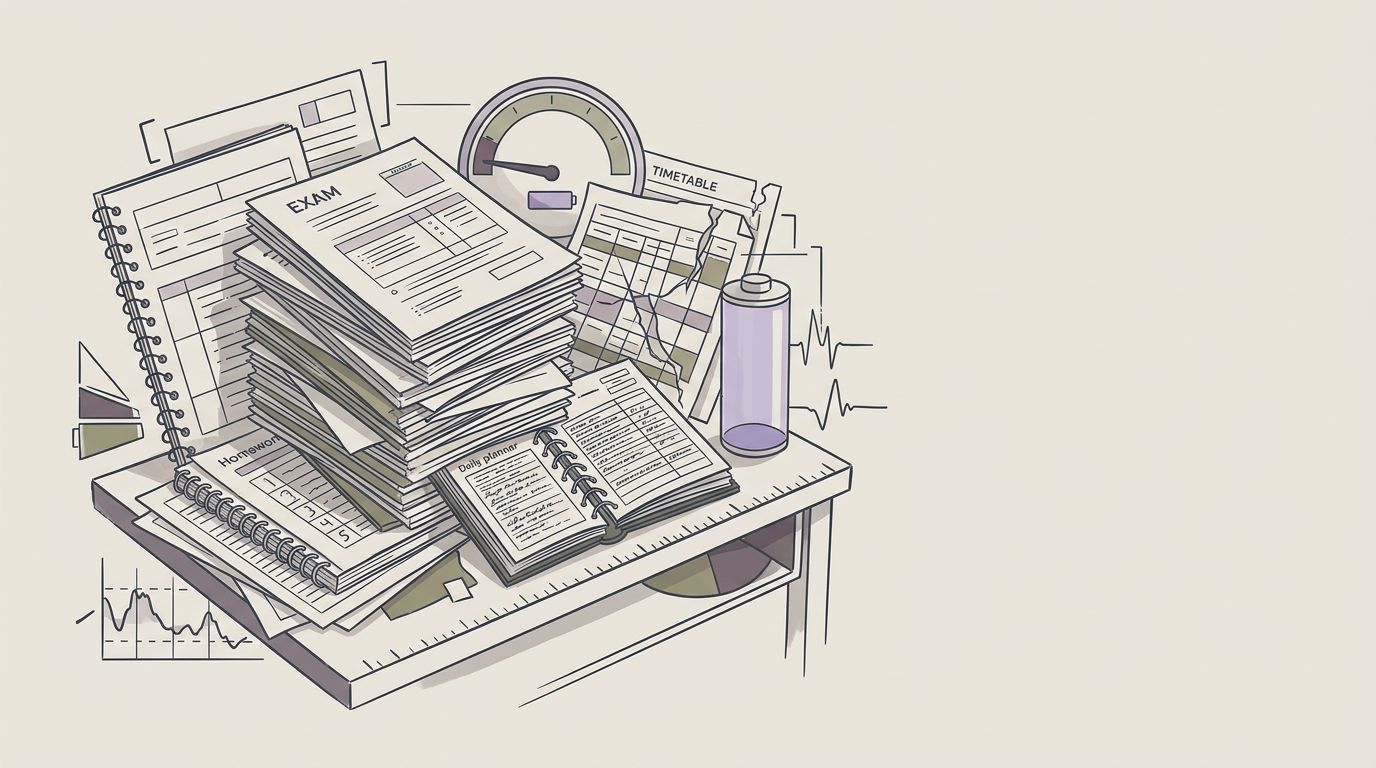
The entire modern education system is a training camp for burnout. It teaches us that the path to success is paved with all-nighters, last-minute cramming, and the brute-force suppression of our body’s need for rest. We are taught to perform, not recover. We get good grades for functioning on fumes and celebrate surviving on willpower alone. We then drag this model into our professional lives—especially into leadership—and wonder why our capacity cracks, our teams are exhausted, and our grand strategies collapse under the weight of accumulated biological debt. This isn't a failure of mindset. It’s a failure of architecture, one we were taught to build from the age of five.
Common Questions
Why is the "always-on" culture so damaging for leaders?
It creates a state of chronically high allostatic load—the cumulative wear-and-tear on your body from prolonged stress responses (McEwen, 2017). A leader running on high allostatic load has impaired executive function, reduced emotional regulation, and makes poorer decisions. You aren’t just tired; you are biologically compromised.
Is there a metric for leadership capacity beyond output?
Yes. Heart Rate Variability (HRV), the natural variation in time between heartbeats, is a powerful proxy for your nervous system's capacity. High HRV suggests a flexible, resilient system ready for challenges. Low HRV, common in chronic stress, indicates a system that is brittle and low on resources. It's a physiological readout of your ability to lead.
What is coregulation in a leadership context?
It's the physiological reality that a leader's nervous system state is contagious. Your calm can calm your team; your stress can stress them out, all at a biological level, entirely bypassing conscious thought. Your team's nervous systems are constantly, non-verbally referencing yours as a cue for safety or threat.
Related anchors: sleep anchor · HRV anchor · skin anchor
The Original Sin of Your Professional Life
We treat the ability to function without sleep and subsist on caffeine as a badge of honour. We learned it in university, where the grade was the only thing that mattered, not the biological cost of getting it. This isn't training for the real world; it's an indoctrination into a dysfunctional relationship with our own physiology.
This system teaches you to treat your body like an inconvenient piece of luggage you have to drag around while your brilliant brain does the important work. The result is a generation of leaders who can write a five-year plan but can’t read their own nervous system. You learn to silence the alarms—fatigue, irritability, brain fog—because you were rewarded for it. The problem is that those alarms are readouts from critical infrastructure. Disconnecting them doesn’t stop the fire; it just ensures you won’t notice it until the whole building is ablaze. This is the mechanism of allostatic overload in action: the slow, corrosive accumulation of stress until a system that once bent, now simply breaks (Sapolsky, 2017). If you’re a leader, your system breaking is a strategic risk for the entire organisation.
Leadership isn't the art of pushing through exhaustion. It's the architecture of sustainable capacity.
Your Capacity Isn't a Key Performance Indicator
The business world loves what it can measure. Revenue, churn, user engagement. So we try to apply the same logic to people. We measure hours worked, tasks completed, and targets hit. We treat human capacity as a linear, extractable resource. This is profoundly wrong. Your capacity for strategic thought, empathy, and creative problem-solving is not a fixed quantity. It's a dynamic state, governed by the flexibility of your autonomic nervous system.
For leaders, the most important metric you're not tracking is Heart Rate Variability (HRV). Think of it as the real-time stock price of your capacity. A high, fluctuating HRV indicates a system that is well-rested, regulated, and ready to meet challenges with adaptive flexibility. It's the biological signature of a state of nervous system regulation. A low, flat HRV is the sign of a system running on fumes—brittle, reactive, and with diminished prefrontal cortex function (Thayer, 2009). Your ability for 'strategic vision' is functionally zero when your biology is screaming that there's a tiger in the server room. The entire premise of the Performance L2 course is built on this insight: stop managing your time and start managing your state.
The Nerd Out: Leadership as a Coregulatory Field
Here’s the part of this conversation that most leadership training misses entirely. The myth of the stoic, lone-wolf leader is just that: a myth. You are not a self-contained unit. Your nervous system is in constant, silent dialogue with the nervous systems of the people around you. As a leader, your broadcast signal is stronger than anyone else's.
Your physiological state creates a ‘coregulatory field’. If you walk into a meeting with a dysregulated nervous system—high cortisol, low HRV, shallow breathing—your team’s bodies will register your state as a potential threat before you’ve even said a word. According to recent research, this isn't a metaphor. The social environment you create as a leader directly influences your team's biology, right down to how their genes are expressed. Work by researchers like Steve Cole on the Conserved Transcriptional Response to Adversity (CTRA) shows how a chronically threatening social environment (like a stressed-out boss) can literally get under the skin, tilting the immune system towards a pro-inflammatory state. You don’t need a culture deck to create a culture of anxiety; your own dysregulated system is a walking, talking memo everyone’s biology can read. This is why the most advanced leadership work isn’t about management theory; it’s about becoming a grounding presence for others, a skill we teach in our practitioner certifications.
From All-Nighter to Architectural Recovery
Because we were trained to think of performance as the goal, we treat recovery as its absence: a holiday, a weekend off, a Netflix binge. We see it as downtime. This is like thinking a construction crew builds a skyscraper by taking long lunches.
Recovery is not passive. It is an active, biological process with its own set of non-negotiable tasks. The most critical of these is sleep. During deep sleep, your brain’s glymphatic system—a kind of waste clearance network—gets to work, flushing out the metabolic junk that accumulates during waking hours (Nedergaard, 2013). This includes amyloid-beta, the protein famous for its role in Alzheimer's disease. The all-nighter you pulled to finish the deck didn't just make you tired; it actively prevented your brain from cleaning itself. Treating systemic burnout with a two-week holiday is like trying to fix a building’s faulty foundations with a new coat of paint. Real recovery is architectural. It requires structure, intention, and a deep respect for the biology you’ve been taught to ignore. Start with a non-negotiable sleep protocol—you can build one with our Sleep Anchor.
What to do this week
- Track your capacity, not just your tasks. For one day, use a notebook or our Journal to jot down your perceived energy level from 1–10 every two hours. Don't judge it. Just notice the peaks and troughs. Where do they correlate with meetings, meals, or moments of stress?
- Schedule one 20-minute 'recovery block'. Put it in your calendar. During this time, you are not allowed to do anything productive. Walk without a podcast. Stare out a window. Sit with a cup of tea. The goal is not to relax; the goal is to do nothing.
- Run a micro-experiment in coregulation. Before your next high-stakes meeting, take 60 seconds for yourself. Take three slow, deliberate breaths. Then walk into the room. Say nothing about it. Simply observe if your own internal state shifts the initial tone of the group.
TL;DR
Our education and work culture trained us to perform, not recover, creating a model of leadership built for burnout. This isn't a personal failing but a flaw in our understanding of capacity. True capacity isn't about willpower; it's a physiological state governed by your nervous system. Chronic stress creates high allostatic load (McEwen, 2017), which degrades decision-making. Metrics like Heart Rate Variability (HRV) offer a real-time view of your system's resilience (Thayer, 2009). As a leader, your nervous system state also coregulates your team's biology (Cole, 2007). Sustainable performance requires architectural recovery, like sleep, which is essential for brain health (Nedergaard, 2013).
Where this fits in the Kokorology system
This is a core concept inside our model of Nervous System Regulation. For leaders wanting to apply this framework directly to their work and teams, this is the central thesis of the Performance Level 2 course.
Closing
The shift from seeing your body as a machine to be driven to an ecosystem to be tended is the single most important pivot a leader can make. It's the difference between a career that burns out and one that endures. The first step isn't a grand gesture. It's noticing. It’s deciding that the data from your own physiology is as important as the data on any spreadsheet.
- Build your capacity infrastructure inside Performance L2.
- Work with us directly on stuck leadership patterns through 1:1 Coaching.
- Get our briefs on regulation and capacity in your inbox via the Kokorology newsletter.
Sources
- Cole, S. W. (2007). Social regulation of human gene expression. Current Directions in Psychological Science.
- McEwen, B. S. (2017). Neurobiology of stress, resilience, and allostatic load. Annals of the New York Academy of Sciences.
- Nedergaard, M. (2013). Garbage truck of the brain. Science.
- Sapolsky, R. M. (2017). Behave: The Biology of Humans at Our Best and Worst.
- Thayer, J. F., et al. (2009). A meta-analysis of heart rate variability and neuroimaging studies. NeuroImage.