Popular mobile game apps — dopamine architecture review
Popular game apps 2026 — what the mobile loops in your pocket are doing to your nervous system
Ten of 2026's highest-grossing and most-downloaded mobile game apps, ranked by what the variable-ratio loops, energy-timer mechanics, push-notification cadence and IAP architecture are actually doing to your dopamine baseline, your sleep, and your phone-to-attention relationship
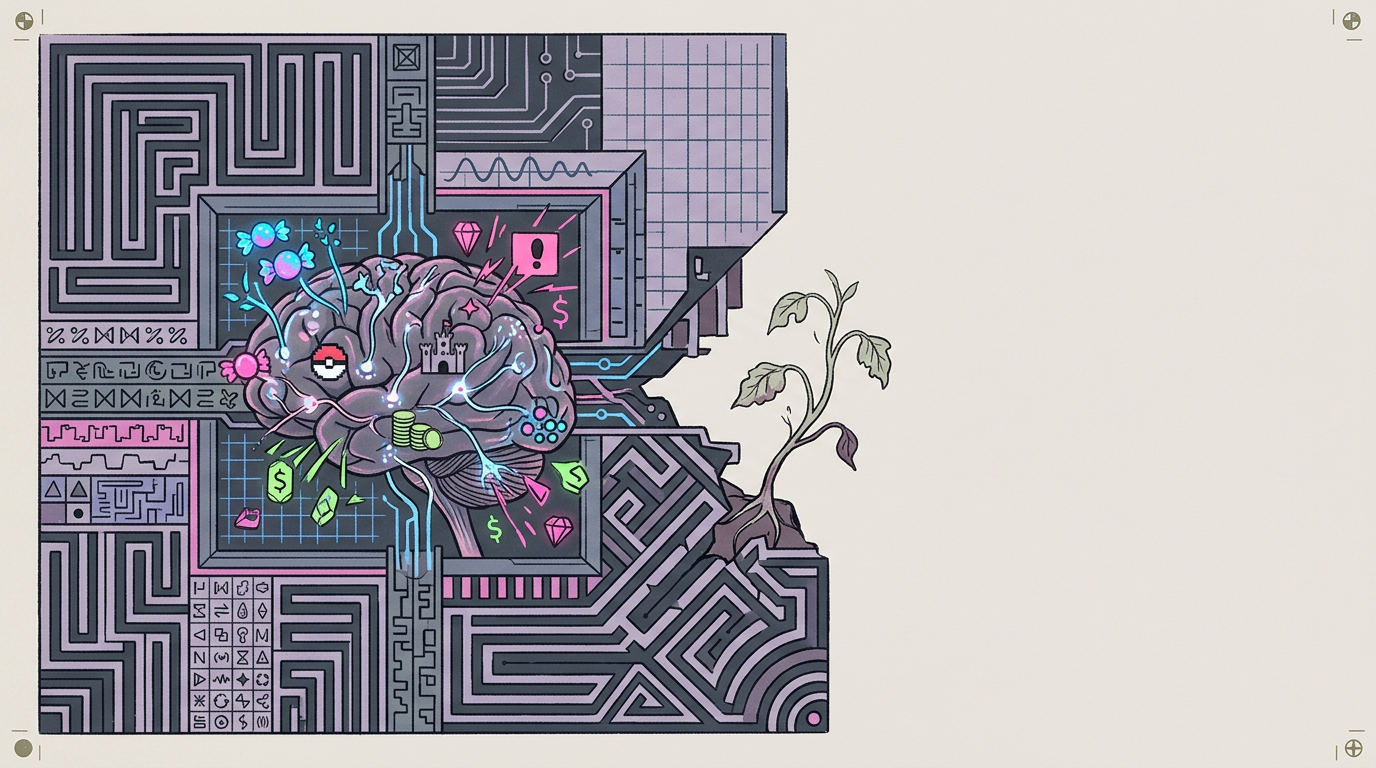
Mobile games are the most efficient variable-ratio reinforcement delivery system ever shipped to consumers. They are free at the door, monetised via timers, lives, pulls, packs and battle passes, and they are designed in tight collaboration with behavioural-economics teams to maximise daily-active-user retention curves that look identical, on a graph, to slot-machine retention curves. We pulled ten of 2026's biggest mobile titles and ranked them by what their loops actually do to dopamine baseline, sleep, and phone-attention. None of these publishers paid for placement. None of this is sponsored.
What it claims
- 'Free to play', 'just a casual game', 'something to do while waiting'
- 'Trains the brain', 'improves memory', 'keeps you sharp'
- 'Helps me unwind before bed' (almost universally not true)
- 'I can stop anytime' (the design is engineered specifically so you cannot)
What the label is not telling you
- Candy Crush Saga / Royal Match (King / Dream Games, free-to-play, $1B+/year each) — Match-3 puzzle wrapped around a lives-timer + booster economy. The variable-ratio reinforcement (which board states win, which don't) plus a fixed-interval timer (5 lives, 30 min to refill) is the textbook compulsion-loop design. Played in 3–5 minute bursts dozens of times a day, the cumulative effect is not entertainment — it is a phone-checking habit reinforced every waking hour. Royal Match's 2024–25 ad spend was the largest of any app in any category globally; you are paying for that with attention.
- Monopoly Go (Scopely, free-to-play, $3B+ first 18 months) — Hybrid board-game / slot-machine app. The 'roll' is literally a slot-pull with cosmetic dice. The social layer (tournaments, partner events) adds time-pressure and FOMO on top of the variable-ratio core. Several class-action and regulatory conversations in 2024–25 around its IAP design. One of the most aggressively monetised apps currently in the App Store top grossing chart, and one of the highest 'I deleted it and felt instantly better' rates in informal user reporting.
- Pokémon GO (Niantic, free-to-play) — The exception that proves the rule. Same gacha mechanics underneath, but the core loop requires walking outside, in daylight, often with other people. The published data here is real: step-count, light exposure, and self-reported well-being all rise with active Pokémon GO use (Althoff 2016, J Med Internet Res; Watanabe 2017, BMJ). The active ingredient is the embodied behaviour the app induces, not the screen — which means the recommendation is to use it deliberately as a walk-and-light tool and ignore the raid/PvP/IAP layers.
- Clash of Clans / Clash Royale (Supercell) — Real-time strategy with multi-day base-building timers explicitly designed so impatience converts to in-app purchases. The 'check in' habit (raid shield, troop training, builder timers) trains a multi-hour push-notification dependency. Social-clan obligation adds the threat-detection layer. High dysregulation per minute of play and per euro spent.
- Honkai: Star Rail / Genshin Impact mobile / FGO (HoYoverse, Aniplex) — Gacha role-playing games on phone. Same critique as the console-side Genshin entry: the game itself is genuinely beautiful and the exploration loop is parasympathetic; the gacha layer is variable-ratio chemistry with real money. Banner-expiry timers create artificial FOMO. Safe only if you treat it as a single-player adventure and never top up — which is not how 99% of users play it.
- Coin Master (Moon Active, free-to-play, $1B+/year) — A slot-machine UI with a thin village-building wrapper. The Federal regulators of multiple countries have looked at it and the loot-box conversation regulators have looked at it. There is no charitable nervous-system reading. The game is gambling with a cartoon coat. Delete.
- Subway Surfers / Temple Run / Crossy Road (endless runners) — Endless-runner format. Played in 60–90 second bursts repeatedly through the day. Lower IAP pressure than match-3 or gacha, but the same phone-checking habit conditioning. The TikTok side-screen meta — Subway Surfers playing under a podcast clip — is its own conversation about split-attention and the collapse of single-task tolerance.
- Duolingo (free-to-play with optional sub) — Designed by behavioural economists, gamified explicitly: streak pressure, push notifications, leaderboards, league relegation, gem economy. The pedagogical evidence for actual language acquisition is weak-to-modest; the dopamine-streak chemistry is exquisitely tuned. Useful if you treat the streak as a reminder to do real language study elsewhere; dysregulating if the green owl drives an anxiety spike when you miss a day.
- Idle / hyper-casual (Stumble Guys, Brawl Stars, hyper-casual ad-supported games) — High-density interstitial-ad model. Each 60-second session is ringed with 30-second forced video ads, often for other hyper-casual games. The user is the product more than in any other gaming category. Cognitive cost without cognitive benefit. The category most worth deleting wholesale.
- Monument Valley / Alto's Odyssey / Two Dots / Threes (premium, paid-once) — The only mobile-game category structurally not at war with your nervous system. Paid up-front (€4–8), no IAPs, no timers, no push notifications, no ads. Short, beautiful, calm. The active reminder that the dysregulating element of mobile gaming is the free-to-play monetisation model, not the form factor. If you want a mobile game, buy a paid-once premium title and ignore the entire free-to-play chart.
Effect on the nervous system
The free-to-play mobile-game model is not entertainment with a side effect — the loops are the product, and the loops are: variable-ratio reinforcement (every match, pull, roll is a probabilistic reward — the same chemistry as a slot machine, documented in Larche & Dixon 2018 and the loot-box literature reviewed by Zendle 2019, R Soc Open Sci), fixed-interval timers (lives, energy, builders — engineered to convert impatience into IAP), push-notification cadence (designed to interrupt other contexts and reactivate the loop dozens of times a day — the single largest contributor to ambient phone-checking baseline), and FOMO-on-expiring-content (battle passes, banners, limited events — manufactured urgency on a tightening clock). On the nervous-system side, this stack does three measurable things: it elevates phone-checking baseline (and with it, sympathetic micro-spikes throughout the day); it interferes with sleep — light, late-evening play, and the 'one more level' loop displace sleep onset by 30–90 minutes in young-adult cohorts (Király 2022; King 2019); and it conditions the dopamine system to short-burst variable rewards, which makes long-form, low-stimulation activities (reading, conversation, sitting still) feel more aversive than they used to. None of this is moral. It is mechanism.
Who it might suit
Pokémon GO used as a deliberate walk-and-daylight tool, ignoring the IAP and raid layers. Premium paid-once mobile games (Monument Valley, Alto's Odyssey, Threes, Two Dots, A Little to the Left, Mini Metro) as a low-arousal phone activity. Duolingo as a reminder app on top of real language study, not as the study itself. Otherwise: most adults will see meaningful improvement in sleep onset, ambient anxiety and phone-checking baseline within two weeks of deleting every free-to-play game from the phone.
Who should skip it
Anyone with a personal or family gambling history — gacha, Coin Master, Monopoly Go, and the booster economy of MTG-style mobile titles are mechanically the same activity as a slot machine and trigger the same circuitry. Anyone in active burnout, peri-natal hormone shift, post-illness recovery, or chronic sympathetic baseline — the push-notification cadence alone is too much load to absorb. Anyone whose sleep-onset complaint is 'I can't stop checking my phone' — the free-to-play layer of the phone is doing most of that work. Children and adolescents, full stop, on the free-to-play side — the dopamine architecture is calibrated for adult retention and lands on a developing reward system that cannot defend against it. Use premium paid-once games for kids on devices instead.
Bottom line
Of the ten, ranked by net nervous-system fit at a normal user dose: premium paid-once titles (Monument Valley / Alto's Odyssey / Two Dots / Threes) > Pokémon GO (used as a walking tool, IAP ignored) > Duolingo (as a reminder, not the curriculum) > hyper-casual ad-supported (delete) > Subway Surfers and endless runners (low-grade, mostly harmless, mostly pointless) > Candy Crush / Royal Match (the modal match-3 compulsion loop) > Clash of Clans / Royale (notification-timer dependency) > Star Rail / Genshin mobile (good game, gacha trap) > Monopoly Go (slot machine in a board-game coat) > Coin Master (slot machine with no coat — delete). The two-week experiment is unusually predictive here: delete every free-to-play game on the phone, keep one paid-once premium game if you want a mobile gaming option, and measure sleep onset, phone-pickup count and ambient anxiety on day 14. Read the Sleep and Wired & Tired anchors next, and the Popular digital games and Popular physical games reviews to see the full regulation-vs-dysregulation map across formats.