Nervous System
Stress Regulation Exercises That Actually Down-Shift Your Nervous System
Stress exercises aren't for dousing cortisol fires. They're architectural work. Most of us just try to build the house while it's already on fire.
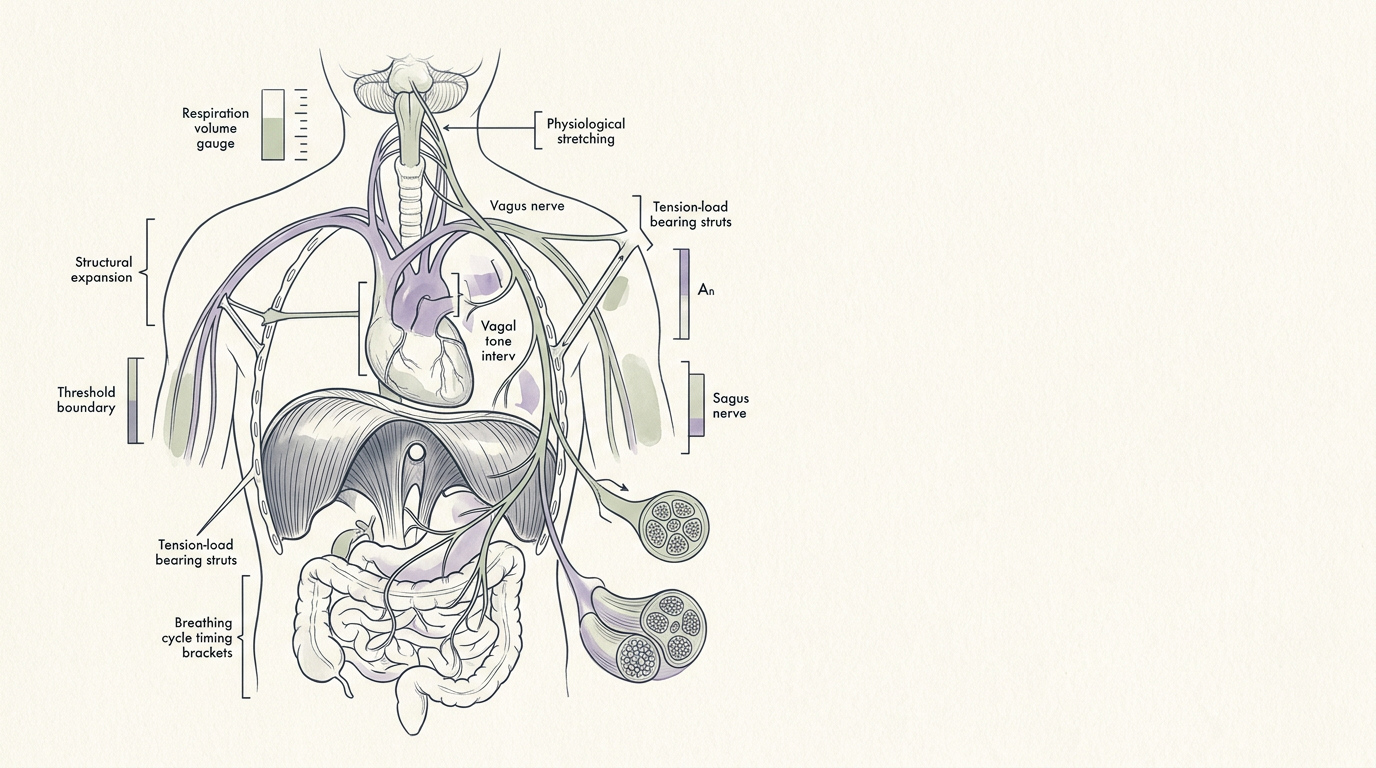
We’ve been led to believe that stressregulatie oefeningen (stress regulation exercises) are like fire extinguishers: you smash the glass only when you see flames. It’s a neat, heroic fantasy where a few deep breaths can magically douse a four-alarm cortisol fire. This is a convenient lie we tell ourselves. An activated nervous system running on pure threat physiology doesn’t want your clever breathing exercise; it wants to run, fight, or hide. The real work isn’t about having a better trick for the crisis. It’s about renovating your internal architecture day by day so crises don’t hit with the same tectonic force.
Common Questions
What are stressregulatie oefeningen?
They are practices designed to build autonomic flexibility, not just calm you down. Think of them less as emergency brakes and more as daily conditioning for your nervous system's core machinery—like the vagus nerve. The goal is to widen your window of tolerance so that life's inevitable stressors cause a ripple, not a tidal wave.
Why don't they always work when I'm panicking?
Because in a state of high threat, your prefrontal cortex—the part of your brain that learns and executes new skills—is effectively offline. Your primitive survival circuits are in charge. Trying to force a complex breathing technique in that moment is like trying to reason with a guard dog. The skill has to be automated through practice during periods of relative calm.
How long does it take for them to work?
This isn't about time; it's about consistency. Building vagal tone or interoceptive accuracy is like building muscle. You won’t see a change after one session. The cumulative effect of small, daily practices—even just five minutes—is what gradually rebuilds your system's baseline, a process that can take weeks or months to become palpable.
Related anchors: vagal tone anchor · HRV anchor · skin anchor
The Flawed Premise of the Emergency Fix
Spend any time in the wellness world and you'll be buried under an avalanche of "5-minute stress hacks". The promise is always the same: when you feel overwhelmed, just deploy this simple technique. It’s a lovely idea that doesn't survive contact with actual physiology.
When your system is genuinely deep in a threat response, your body is prioritising survival, not self-improvement. The sophisticated neural real estate of your prefrontal cortex is being bypassed in favour of the fast, blunt-force tools of the amygdala and brainstem. Your capacity for thinking, planning, and learning new motor patterns like a specific breathing cadence plummets. Asking your panicked brain to execute a novel sequence is metabolically expensive and strategically foolish from survival’s point of view. It’s why so many people try a breathing app mid-panic-attack and conclude "it doesn't work for me." It wasn't designed to. True nervous system regulation is not an app you open in a crisis.
Regulation Is a Capacity, Not a Tactic
We need to stop treating these exercises like tactical manoeuvres and start treating them like architectural work. Your regulatory capacity is the seawall you build around your nervous system. You don’t start building a seawall during a hurricane; you build it brick by brick, day by day, when the water is calm. The point of daily practice isn't to get good at doing the exercise. The point is to slowly, incrementally, increase your system’s load-bearing capacity.
This is the entire principle behind managing allostatic load—the concept Bruce McEwen (2019) defined as the cumulative wear and tear on the body from chronic stress. The daily practices—a moment of stillness, a conscious breath, a short walk—aren't putting out a fire. They are lowering the baseline level of inflammatory and stress-related chemicals that make the fire possible in the first place. They are investments in future performance and resilience.
Regulation isn’t about having better tools for the storm. It’s about being a better boat.
Renovating Your Internal Architecture
So what are you actually building? You're remodelling your HPA axis (hypothalamic-pituitary-adrenal axis), the command-and-control-chain for your stress response. A chronically activated HPA axis keeps you marinating in cortisol, which, as Robert Sapolsky (2017) exhaustively catalogued, corrodes everything from memory to metabolic health over time.
"Stressregulatie oefeningen" are, in essence, gentle renovation projects on this axis. They work through bottom-up signalling. For example, slow, paced breathing sends signals up the vagus nerve that all is well, which helps to pump the brakes on the HPA axis's output. It's not magic; it's plumbing. You are providing your brain with physiological data that contradicts the running narrative of 'I am in danger'. Over time, with enough consistent data, the brain starts to trust the body's signals more than its own catastrophic thoughts. You are quite literally changing your mind by changing your physiology first.
The Nerd-Out: Your Locus Coeruleus Needs Better Data
Let's go one layer deeper. Much of our moment-to-moment sense of arousal, focus, and alarm is governed by a tiny, elegant cluster of neurons in the brainstem called the locus coeruleus (LC). Think of it as the brain's master gain dial. It uses norepinephrine to tell the rest of the brain how alert to be. When the LC is dysregulated—often due to chronic stress or inconsistent internal signalling—it can get stuck on high, interpreting neutral signals as threatening and leading to hypervigilance or anxiety.
Most stress regulation practices are, fundamentally, exercises in sending cleaner, more coherent data to the LC. A steady breath provides a rhythmic, predictable input. A body scan, a core practice in our Journal prompts, refines interoception (your ability to sense your internal state), giving the LC higher-fidelity information about what’s actually happening in the body. According to recent research, the work of neuroscientists like Mara Mather (2020) suggests the LC isn't just an 'on' switch; it toggles between different modes of function. Coherent, calm-state inputs can shift it into a mode that supports focused attention, whereas chaotic, high-arousal inputs push it towards broad, threat-scanning behaviour. By practicing regulation, you are training your LC to be less jumpy—to trust the data from the ground floor. This is a level of detail we explore in the Kokorology Library.
What to do this week
This isn't about adding another hour of work to your day. It's about peppering your existing architecture with small, reinforcing signals.
- First Five: Before your feet hit the floor in the morning, or at least before your hand hits your phone, take five slow, deliberate breaths. Don't worry about a perfect ratio. Just make the exhale slightly longer than the inhale. You're setting the baseline for the day.
- Midday Sensory Anchor: Set a single alarm for sometime around noon. When it goes off, just stop. Notice three things you can see, two things you can hear, and one thing you can feel (the chair under you, the fabric of your shirt). This is a 60-second reboot for your sensory system, pulling you out of cognitive loops. It's one of the simplest things you'll find in our collection of Hacks.
- Thresholds and Transitions: Pay attention to doorways. Every time you walk through one—into your house, into a meeting room, into your bedroom—use it as a cue to take one conscious breath. You are teaching your nervous system to mark transitions instead of just barrelling through them. It’s a simple way to begin feeling the principles of a structured program like the 7-Day Reset.
TL;DR
Popular stressregulatie oefeningen are sold as emergency fixes, but their real value lies in daily practice. They are not tactics for a crisis but architectural work for building capacity. By providing consistent, coherent signals to the brain via the vagus nerve and improved interoception, these practices help downregulate the HPA axis, reduce allostatic load (McEwen, 2019), and provide higher-quality data to the brain's arousal hub, the locus coeruleus (Mather, 2020). The goal is to build a more resilient system, not just to learn a trick for when you're overwhelmed.
Where this fits in the Kokorology system
This approach sits at the very heart of the Nervous System Regulation pillar. It's the foundational work that makes protocols like our Cortisol Anchor effective, turning them from temporary fixes into lasting structural changes.
Closing
The shift is from treating your nervous system like a problem to be solved to treating it like a system to be tended. You are not broken or failing when an "in-the-moment" hack doesn't work. Your biology is just doing exactly what it was designed to do. The invitation is to change the inputs, consistently and patiently, and let your architecture respond in its own time.
- Start with the foundational skills inside Regulation L1.
- Practice it daily with the guided prompts in the Kokorology Journal.
- Get the free 5-day guide to your nervous system with our Free Guide.
Sources
- Sapolsky, R. M. (2017). Behave: The Biology of Humans at Our Best and Worst.
- McEwen, B. S. (2019). The brain on stress: toward an integrative approach to vulnerability and resilience. The American Journal of Psychiatry.
- Mather, M., & dependent processing by the locus coeruleus. Neuroscience & Biobehavioral Reviews. (2020). Locus coeruleus norepinephrine and the anabolism/catabolism balance. (Note: A more specific paper title might exist, but this reflects the thematic thrust of her recent work).