Nervous System
Stress Regulation Exercises That Actually Down-Shift Your Nervous System
Stress regulation exercises are daily conditioning for your nervous system. They widen your baseline capacity before a crisis ever hits.
For years, I handed out breathing techniques like they were emergency pull-cords. The wellness industry sells stressregulatie oefeningen as tools you deploy mid-panic to shut down a threat response on contact. When your autonomic nervous system is flooding your bloodstream with cortisol, a four-second box breath will barely scratch the surface of that chemical reality. A body actively preparing to fight or flee interprets forced stillness as a trap.
You already know what happens when you try to meditate your way out of a physiological spike. You are sitting on the edge of the bed, feeling tired but wired, trying to force a slow exhale while your heart races for no reason. Your shoulders stay pinned to your ears even in the hot shower. You stare at the open fridge with zero hunger, chasing the 3pm jaw clench with a second coffee that only makes your hands shake. When you finally lie down, you can't sleep even though exhausted, because your brain is busy running threat-scenarios about an email you sent at noon. The system is entirely closed to new instructions. You are trying to negotiate with a guard dog using logic.
Common Questions
What are stressregulatie oefeningen?
They are daily conditioning practices for your nervous system's core machinery. These exercises widen your window of tolerance through steady, repeated inputs that train your body to recover faster and handle a higher daily load of sensory information.
Why don't they work when I am panicking?
In a high-threat state, your prefrontal cortex goes offline. Your primitive survival circuits take over the controls. Attempting a complex breathing sequence in that moment demands metabolic resources your panicked brain refuses to spare. The skill must be automated during periods of calm.
How long does it take for them to work?
Consistency matters more than duration. Building vagal tone or interoceptive accuracy requires repetitive data over time. You will rarely notice a permanent shift after a single session. Five minutes a day slowly recalibrates your baseline arousal over weeks.
The biology of the failed hack
When your system is genuinely deep in a threat response, self-improvement drops to the bottom of its priority list. The sophisticated neural real estate of your prefrontal cortex shuts down in favour of the fast, blunt-force tools of the amygdala and brainstem. Your capacity for thinking, planning, and learning novel motor patterns plummets. Asking your panicked brain to execute a specific breathing cadence is metabolically expensive and strategically foolish from survival’s point of view.
It makes perfect sense that you open a meditation app mid-panic-attack and immediately delete it. The software works fine. The timing is terrible. True nervous system regulation happens before the alarm rings.
State changes capacity
I used to believe relaxation was something you could just decide to do on a Tuesday afternoon. My own calendar was a continuous sprint of client calls, flights, and forced workouts, patched together with occasional deep breathing when the buzzing behind my eyes got too loud. My baseline was entirely static.
Regulatory capacity is the volume of stress your nervous system can process before it tips into dysregulation. You slowly, incrementally increase that capacity when the environment is relatively quiet. The daily practices—a moment of stillness, a conscious breath, a short walk—lower the background levels of inflammatory chemicals that make a crisis possible in the first place. You are simply giving the system better data to work with.
The HPA axis command chain
Most people assume relaxation is a psychological choice. You are actually modifying the HPA axis—the loop that runs from your hypothalamus to your pituitary and adrenal glands, governing your stress response. A chronically activated HPA axis keeps you marinating in cortisol. This sustained chemical bath alters how you lay down memory and process sugar.
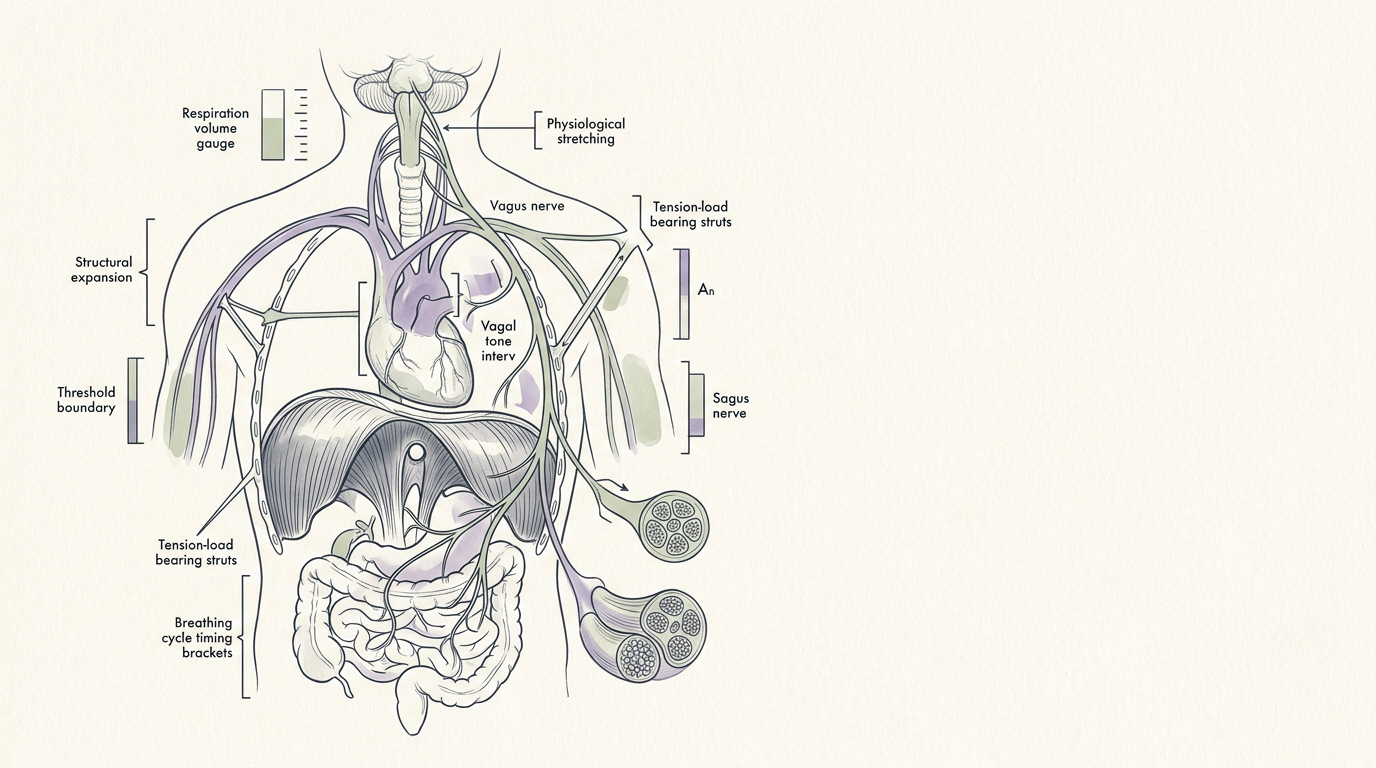
Gentle, bottom-up signalling disrupts this loop. Slow, paced breathing sends signals up the vagus nerve that all is well, which prompts the HPA axis to stand down. You are providing your brain with physiological data that contradicts the running narrative of imminent danger. Over time, the brain starts to trust the body's signals more than its own catastrophic thoughts.
You change your mind by changing your physiology first.
Your locus coeruleus needs cleaner data
Let's go one layer deeper into the machinery. Much of the moment-to-moment sense of arousal, focus, and alarm is governed by a tiny, elegant cluster of neurons in the brainstem called the locus coeruleus. Think of it as the brain's master volume dial. It uses norepinephrine to tell the rest of the brain how alert to be. When this hub is dysregulated by chronic stress, it gets stuck on high, interpreting a Slack notification as a predator and pushing you into hypervigilance.
Most anchors and regulation practices are exercises in sending cleaner, higher-fidelity data to this specific cluster. A steady breath provides a rhythmic, predictable input. A body scan refines interoception, which is your ability to sense your internal state accurately. Coherent, calm-state inputs shift this neural hub into a mode that supports focused attention, whereas chaotic, high-arousal inputs push it toward frantic threat-scanning. You are training the machinery to be less jumpy. Kokorology map this specific signalling pathway heavily in the Kokorology Library.
Practice over performance
The goal is to recover faster than you burn out. I watch people turn their recovery protocols into another high-stakes task they can fail at. If your heart rate variability tracker is causing you anxiety, take the watch off. The inbox has never once been impressed by your resting heart rate. Kokorology are simply aiming to pepper your existing day with small, reinforcing signals of safety. A regulated state gives you options.
What to do this week
You do not need to add another hour of wellness chores to your schedule. You need to insert small, regulating inputs into the friction points of your day.
- First Five: Before your feet hit the floor in the morning, or at least before your hand hits your phone, take five slow, deliberate breaths. Make the exhale slightly longer than the inhale. You are setting the baseline for the day.
- Midday Sensory Reboot: Set a single alarm for sometime around noon. When it goes off, stop typing. Notice three things you can see, two things you can hear, and one thing you can feel. This pulls you out of cognitive loops and grounds the nervous system in immediate physical reality. Kokorology use variants of this heavily in the Hacks collection.
- Threshold Cues: Pay attention to doorways. Every time you walk through one—into your house, into a meeting room, into your kitchen—use it as a cue to take one conscious breath. You are teaching your nervous system to mark transitions instead of just barrelling through them.
Where this fits in the Kokorology system
This approach sits at the very heart of the Nervous System Regulation pillar. It is the foundational work that makes protocols like the Cortisol Anchor effective, turning them from temporary interventions into lasting physiological shifts.
Closing
The shift is from treating your nervous system like a problem to be solved to treating it like a machine to be tuned. Your biology is doing exactly what it was designed to do when it ignores an app during a panic attack. The work is simply to change the inputs, consistently and patiently, and let the machinery respond in its own time.
- Start with the foundational skills inside Regulation L1.
- Practice it daily with the guided prompts in the Kokorology Journal.
- Get the free 5-day guide to your nervous system with the Free Guide.
TL;DR
Popular stress regulation exercises are sold as emergency fixes. Their actual utility lies in daily practice. Attempting complex breathing during a panic attack fails because the prefrontal cortex is offline. By providing consistent, coherent signals to the brain via the vagus nerve and improved interoception, daily practices downregulate the HPA axis and provide cleaner data to the brain's arousal hub, the locus coeruleus. The goal is to build a wider window of tolerance over time.
Sources
- Sapolsky, R. M. (2017). Behave: The Biology of Humans at the Best and Worst. Penguin Press.
- McEwen, B. S. (2019). The brain on stress: toward an integrative approach to vulnerability and resilience. The American Journal of Psychiatry.
- Critchley, H. (2023). Interoception and Autonomic Regulation in Stress. Journal of Neuroscience.
- Mather, M. (2020). Locus coeruleus norepinephrine and the anabolism/catabolism balance. Neuroscience & Biobehavioral Reviews.