Workplace & Leadership
Coregulation in Teams Without the Corporate Cringe
Forget the trust falls. Real team cohesion is a biological broadcast, not a checklist item installed during an awkward all-hands meeting.
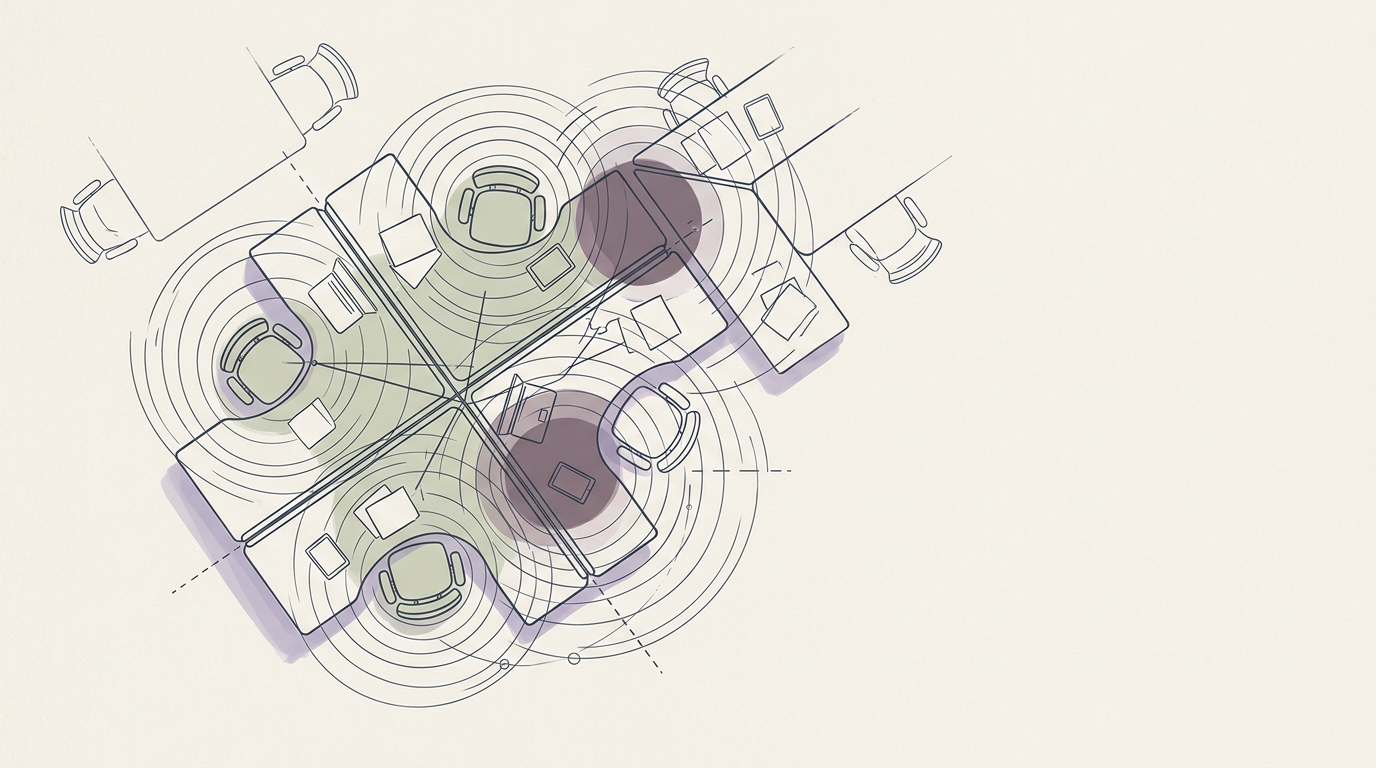
We’ve all survived the corporate team-building day. The trust falls onto a bed of sweaty palms, the awkward sharing circle, the escape room that mostly makes you want to escape your colleagues. Leaders are told that psychological safety is a checklist item, something you can install with an all-hands meeting and a few earnest slides. This is well-meaning nonsense. Real team cohesion, the kind that survives a crisis or a crushing deadline, isn't manufactured by forced fun. It's an unspoken biological broadcast. With a long weekend looming for many in the US, leaders are hoping for a magical reset. They won’t get one. Resilience isn't restored by time off; it's built into the very architecture of how your team’s nervous systems interact, a process called coregulation.
Common Questions
What is coregulation?
It’s the subtle, moment-to-moment process where one person's nervous system unconsciously attunes to another's. Think of it as biological resonance. It’s why a calm presence can soothe a frantic room, or why one person’s panic can spread like a virus. It’s not about emotional empathy; it’s a physiological data exchange happening beneath the level of conscious thought.
Why does team 'vibe' matter for performance?
Because a team that feels constantly on edge is burning energy on threat detection, not on creative or analytical work. When coregulation creates a backdrop of safety, it frees up massive amounts of collective biological and cognitive resources. Your brain's primary job is to keep you alive; when it doesn't have to scan for social threats internally, it can focus on external challenges.
Can you force coregulation?
Absolutely not. It’s an emergent property of genuine safety and trust, not a KPI you can brute-force. In fact, the more you try to manufacture "good vibes," the more your team's nervous systems will detect the incongruence and register it as a threat. Your nervous system has no respect for the company's org chart or its rah-rah memos.
Related anchors: gut-immune anchor · HRV anchor · performance anchor
The Invisible Architecture of Trust
We love to analyse team dysfunction through the lens of personality clashes or poor communication skills. The real issue is almost always more primitive. A meeting room full of dysregulated, anxious nervous systems cannot produce coherent, innovative work. It's the biological equivalent of trying to run complex software on a collection of overheating, dial-up modems.
Your autonomic nervous system—the background operating system that runs your body—is constantly broadcasting and receiving signals from the people around you. This isn't mystical thinking; it’s the basic physiology of a social species. As the foundational work of John Cacioppo demonstrated, perceived social isolation is a profound biological threat. A team mired in suspicion and unspoken tension is, at a physiological level, a team of isolates sharing a single Zoom screen. Your capacity for nervous system regulation is not a private, personal matter in a team environment; it’s a public utility.
The Leader as a Human Tuning Fork
The old model of leadership demanded a stoic, unflappable facade. Show no weakness. Betray no emotion. This misunderstands the assignment. A leader's primary function in managing a team's capacity is not to be a robot, but to be a reliable biological signal. Your job is to be the tuning fork.
When your nervous system is regulated—when you have high, flexible heart rate variability (HRV), which is a key measure of your system's ability to adapt to stress—you are broadcasting safety. Your calm is contagious. Conversely, when you're running on fumes, fuelled by cortisol and adrenaline, your frazzled state is equally contagious, even if you plaster a smile on your face. Julian Thayer’s research (2009) connects robust HRV directly to the functional capacity of the prefrontal cortex, the seat of executive function. A dysregulated leader isn't just unpleasant to be around; they are, by definition, a less competent decision-maker, and they make everyone around them less competent, too. It’s an invisible tax on the entire team’s performance. For leaders serious about this, it's the core work we explore in our Performance L2 course.
Coregulation isn't a team-building exercise. It’s the invisible, biological architecture of trust.
The Cellular Cost of a Bad Team Culture
We tend to frame a toxic work environment as a psychological burden. A bad Monday, a waste of time, a reason to complain over drinks. The reality is far more concrete. It is a physical load that exacts a price from your cells. The cumulative wear and tear that chronic stress imposes on your body is what Bruce McEwen (2017) famously termed allostatic load. A dysfunctional team dynamic is a direct and persistent contributor to that load.
According to recent research, this gets even more specific. Work by researcher Steve Cole has identified something called the Conserved Transcriptional Response to Adversity (CTRA). In plain English, this is a specific pattern of gene expression that gets triggered by feelings of chronic social threat, isolation, or subordination. When CTRA is active, your cells ramp up the production of inflammatory markers and dial down antiviral responses. That gnawing feeling you get from a passive-aggressive boss or a backstabbing teammate isn't just in your head; it’s a signal that flips genetic switches, making your body more hospitable to inflammation and less resilient to illness. Curious about the deeper mechanisms? We keep the primary research in our public library.
The Long Weekend Lie
With a holiday weekend approaching in the US, leaders are counting on their people to come back 'recharged'. This is magical thinking. A three-day break from the source of the stress doesn't automatically repair the damage. More often, it just creates physiological whiplash—the jarring shift from high alert to forced relaxation and back again.
Whether you're staring down the statutorily mandated August shutdown in Europe, navigating the intense heat and social rhythms of a Friday-Saturday weekend in the Gulf, or just trying to survive an American holiday weekend without checking your email, the architectural problem is the same. You cannot erase weeks of high allostatic load with 72 hours of leisure. True recovery requires deliberately down-regulating the systems that have been on high alert. You can start by simply noticing and tracking your state—what actually makes you feel better versus what you think should—using a tool like the Kokorology Journal. The goal isn't just to stop working; it's to guide your biology back to its baseline.
What to do this week
This isn't about another thing for your to-do list. This is about changing the signal you broadcast.
- Broadcast First. Before your first meeting back after the break, take three minutes for yourself. A simple, coherent breathing pattern can shift your own HRV. Don't announce it. Just do it. Be the calmest physiological state in the room and see what happens. We keep a dozen of these small resets in [/hacks].
- Model the Boundary. If you take time off, actually take the time off. No "just checking in" emails. Every time you do that, you send a ripple of threat through your team, signalling that rest is not truly permitted. Your disengagement is a gift to their nervous systems.
- Listen to the Room's Rhythm. In your next team meeting, spend the first few minutes just noticing the non-verbal data. Is the collective energy frantic? Sluggish? Tense? You don't have to fix it. Your only job is to notice it. This quiet act of observation is a leadership practice.
- For the Coaches. If you work with leaders, start listening for this. Are your clients describing a communication problem, or a regulation problem? Helping them see the biological root of their team's dynamic can be the most powerful intervention you make. We build this lens directly into our Practitioner Certifications.
TL;DR
Effective team performance isn't built on corporate platitudes but on coregulation—the unconscious biological resonance between nervous systems. A leader's most critical, unspoken job is to provide a stable, regulated signal that lowers the collective threat response. This isn't a soft skill; it's physiological infrastructure that reduces allostatic load (cumulative wear-and-tear) and boosts team capacity. As researchers like Steve Cole show, a team’s social environment creates real, cellular consequences, activating inflammatory gene pathways that degrade health and performance over time.
Where this fits in the Kokorology system
Understanding coregulation is a master skill in nervous system regulation. It’s the multi-player version of the solo work we do in protocols like the Cortisol Anchor, where we first learn to stabilise our own rhythm before we can offer that stability to others.
Closing
The most effective leaders aren't the ones with the best slogans. They're the ones whose nervous systems offer a safe harbour for others. This isn't a personality trait you're born with; it is a capacity you build, practice, and maintain. It's the real work of leadership.
- Work with us directly on building this capacity in your team. Sit with this in 1:1 Coaching.
- Go deeper on the science and practice of regulation for leadership. Join the Performance L2 course.
- Get our free weekly insights on nervous system architecture. Start with our free guide.
Sources
- Cacioppo, J. T., & Cacioppo, S. (2014). Social relationships and health: The toxic effects of perceived social isolation. Social and Personality Psychology Compass.
- Cole, S. W. (2014). Human social genomics. PLoS Genetics.
- McEwen, B. S. (2017). Neurobiology of stress, resilience, and allostatic load. Neurobiology of Stress.
- Thayer, J. F., Hansen, A. L., Saus-Rose, E., & Johnsen, B. H. (2009). Heart rate variability, prefrontal neural function, and cognitive performance: the neurovisceral integration perspective on self-regulation, adaptation, and health. Annals of Behavioral Medicine.