Workplace & Leadership
Coregulation in Teams Without the Corporate Cringe
Coregulation is the moment-to-moment biological broadcast between nervous systems that determines whether a team can actually function.
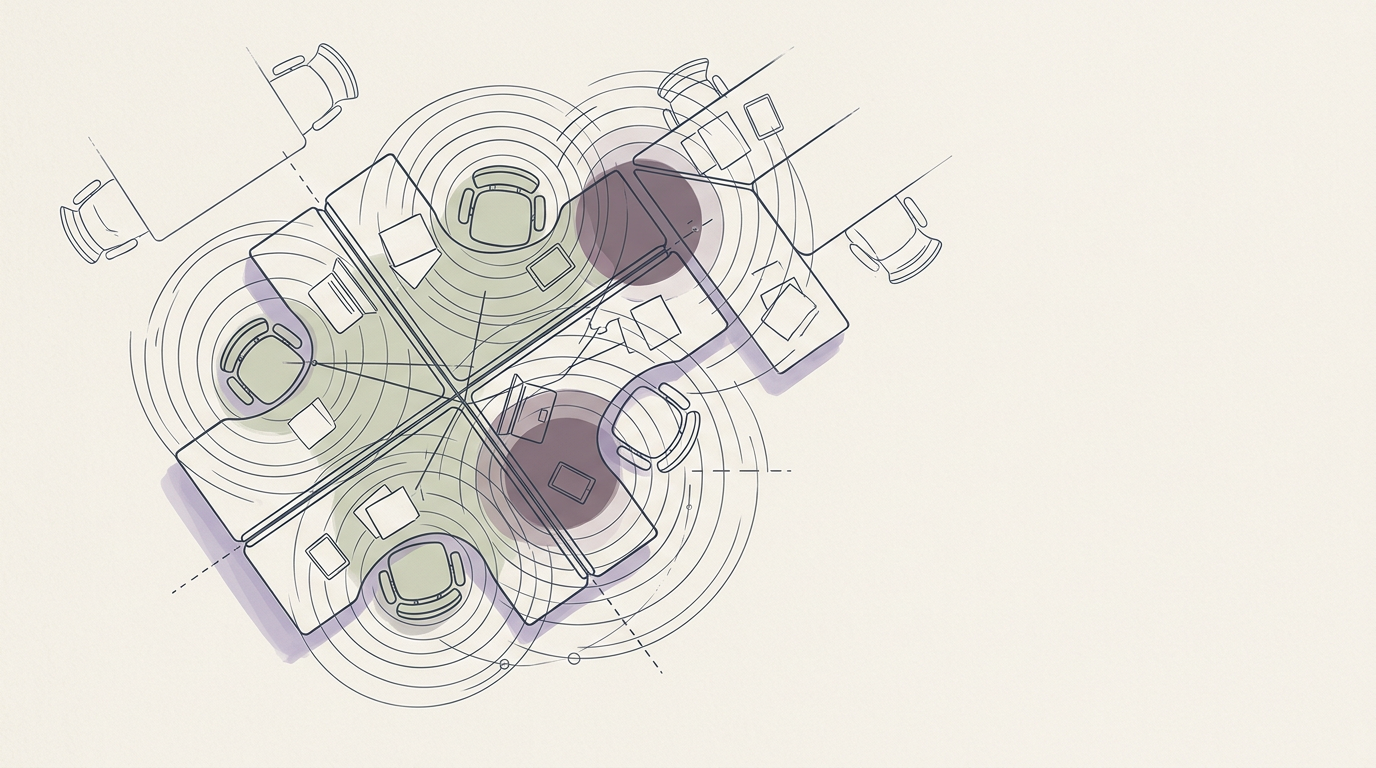
I'm calling it. Every quarter, another executive decides a mandatory fun day will cure team burnout. You take a group of exhausted adults, force them to build a marshmallow tower, and assume the resulting awkwardness generates trust. Trust is an autonomic baseline. It is a continuous, unspoken biological broadcast between nervous systems that signals either safety or threat. When the background state of a room is dysregulated, no amount of whiteboarding will fix the output.
You already know exactly what a dysregulated team feels like in your own tissue. It is the Zoom call where everyone is mysteriously on mute, the slack channel that goes dead quiet when the manager logs on, the jaw that clenches tight at 3pm for no obvious reason. You finish the work day tired but wired, staring blankly at your phone at 11:47pm because you are exhausted but can't rest. Your brain fog makes the afternoon a slow crawl, and you feel anxious for no reason on a Sunday morning. This is your nervous system running a continuous background scan for social threats. That invisible vigilance burns through the metabolic glucose you need to actually think.
Common Questions
What is coregulation?
It is the subtle, moment-to-moment process where one person's nervous system unconsciously attunes to another's. Think of it as biological resonance. This physiological data exchange happens entirely beneath the level of conscious thought, dictating whether your body prepares for connection or defense.
Why does team vibe matter for performance?
A team that feels constantly on edge is burning its energy on threat detection. When coregulation creates a backdrop of safety, it frees up massive amounts of collective cognitive resources. Your brain's primary job is survival; remove the internal social threat, and it can finally focus on external work.
Can you force coregulation?
Absolutely not. It is an emergent property of genuine safety, entirely immune to corporate memos. Trying to manufacture good vibes artificially alerts your team's nervous systems to the incongruence, which registers immediately as a new threat.
The Human Tuning Fork
I used to believe leadership was entirely about clarity of instruction. If people knew what to do, they would do it. I was completely blind to the fact that my own tight shoulders, clipped tone, and shallow breathing were setting off alarm bells in every person I managed.
Your autonomic nervous system is constantly receiving signals from the people around you. When a leader maintains high, flexible heart rate variability (HRV)—meaning their system adapts smoothly to stress and recovers quickly—they broadcast safety. Their calm regulates the room. A frazzled, cortisol-soaked manager makes everyone around them a less competent decision-maker. Your inbox has never once been impressed by your heart rate, but your team relies on it entirely.
I've stopped recommending typical team-building exercises entirely. They are a profound waste of time for a dysregulated group. A leader's function in managing a team's capacity is to act as a reliable biological signal. You have to be the tuning fork. For leaders serious about this shift, Kokorology spend weeks on this exact dynamic in the Performance L2 course.
A meeting room full of dysregulated, anxious nervous systems cannot produce coherent work.
The Cellular Reality of a Dysfunctional Room
Kokorology treat a bad work environment as a purely emotional complaint. A bad Monday, a waste of time, a reason to vent over drinks. A toxic culture is actually a physical load that changes how your cells behave.
The cumulative wear and tear that chronic stress imposes on your body is known clinically as allostatic load. A dysfunctional team dynamic directly drives this accumulation. Chronic social threat triggers a pattern of gene expression called the Conserved Transcriptional Response to Adversity (CTRA). When you feel continuously isolated or subordinated at work, your body physically prepares for wounding. Your cells ramp up the production of inflammatory markers and dial down antiviral responses.
That gnawing frustration you feel from a passive-aggressive boss flips genetic switches, leaving you physically vulnerable to illness. Conversely, a brief belonging intervention—the act of creating genuine safety—visibly lowers workplace cortisol and improves employee retention a full year later. Curious about the primary papers behind this? Kokorology keep them fully accessible in the public library.
The Long Weekend Myth
With a holiday approaching, managers routinely count on their people to come back recharged. Three days away from the source of the stress simply creates physiological whiplash—a jarring shift from high alert to forced relaxation and back again.
Most corporate wellness advice is just telling adults to breathe while emailing them at midnight. You cannot erase weeks of chronic hypervigilance with 72 hours of leisure. True recovery requires deliberately down-regulating the systems that have been stuck on high alert. You guide your biology back to its baseline through active nervous system regulation, rather than just hoping time off does the trick. You start by tracking what actually shifts your state—the heavy sleep, the dropped shoulders, the quiet mind—using a tool like the Kokorology Journal.
What to do this week
Change the signal you broadcast before you attempt to change the meeting agenda.
- Regulate before you speak. Before you open your next team call, take two minutes to slow your own breathing. Don't announce it. Just do it. Be the calmest physiological state in the room. Kokorology keep a dozen of these micro-practices in the hacks index.
- Hold the boundary. If you take time off, take it. Every "just checking in" email you send from a beach sends a ripple of threat through your team. Your total disengagement is a required signal for their nervous systems to settle.
- Notice the room's rhythm. Spend the first five minutes of your next call just observing the non-verbal data. Is the collective energy frantic? Sluggish? Tense? You do not have to fix it. This quiet act of tracking the state is a foundational practice.
Where this fits in the Kokorology system
Understanding coregulation is a master skill in the methodology. It is the multi-player application of the solo work Kokorology do in the Cortisol Anchor, where you first learn to stabilise your own rhythm before offering that stability to others.
Closing
The most effective leaders possess nervous systems that offer a regulated harbour for others. This capacity is built and maintained through deliberate, daily practice.
- Work with the system directly to build this capacity in your team. Sit with this in 1:1 Coaching.
- Learn the mechanics of leadership regulation. Join the Performance L2 course.
- Get the weekly insights on human physiology. Start with the free guide.
TL;DR
Effective team performance relies on coregulation—the unconscious biological resonance between nervous systems. A leader's primary job is to provide a stable, regulated signal that lowers the collective threat response. This physiological dynamic reduces allostatic load and boosts team capacity. A team’s social environment creates real cellular consequences, activating inflammatory gene pathways that degrade health over time when threat levels remain high.
Sources
- Walton G (2024). Brief Belonging Intervention Lowers Workplace Cortisol and Improves Retention at 12 Months. Nature Human Behaviour.
- Cole SW (2014). Human social genomics. PLoS Genetics.
- McEwen BS (2017). Neurobiology of stress, resilience, and allostatic load. Neurobiology of Stress.
- Thayer JF (2009). Heart rate variability, prefrontal neural function, and cognitive performance: the neurovisceral integration perspective on self-regulation, adaptation, and health. Annals of Behavioral Medicine.