Workplace & Leadership
Capacity as an Hr Metric the Regulation Index
We treat burnout as an HR problem. We measure it with engagement surveys, track attrition rates, and then look stunned when our best people resign, citing reasons our spreadsheets could never capture. This approach is an
We treat burnout as an HR problem. We measure it with engagement surveys, track attrition rates, and then look stunned when our best people resign, citing reasons our spreadsheets could never capture. This approach is an autopsy. It tells you why the system failed after the fact. The truth is, burnout isn't an HR issue; it's a physiological one. Using capacity as an HR metric isn't about tracking happiness; it’s about reading the real-time structural integrity of your organisation before the cracks appear in the P&L. It’s about measuring the load, not just the wreckage.
Common Questions
What is flawed about current burnout metrics like engagement surveys?
They are lagging indicators. By the time an employee reports feeling disengaged or cynical—key dimensions of burnout as defined by the WHO and researchers like Christina Maslach—their nervous system has already been weathering a state of chronic threat for months. Surveys measure the sentiment after the physiological damage is done.
What is a ‘Regulation Index’ for a team?
It’s a proposed, privacy-first metric that offers an anonymised, aggregated view of a team's collective physiological state. Instead of asking "Are you happy?", it would draw on user-owned data like heart rate variability (HRV) and sleep quality to answer, "Does this team have the biological capacity for the work ahead?"
How is this different from corporate wellness programmes?
Most wellness programmes are perks designed to soothe the symptoms of a broken system. A Regulation Index is a diagnostic tool for the system itself. It’s the difference between offering free paracetamol for a headache and investigating whether the building has a carbon monoxide leak. It's an architectural fix, not a decorative one.
Related anchors: sleep anchor · gut-immune anchor · HRV anchor
Our Burnout Metrics Are Autopsies
The way we currently talk about burnout in the workplace is an exercise in archaeology. We dig through the ruins of a person’s tenure after they’ve left. The Maslach Burnout Inventory, the gold standard for decades, measures exhaustion, cynicism, and reduced efficacy. The WHO's ICD-11 classification echoes this, framing it as an occupational phenomenon. These are brilliant descriptions of the aftermath. They are, however, useless for predicting the storm. They are a diagnosis of the crash, not a reading of the forces that caused it.
Your annual engagement survey that asks people to rate their motivation on a scale of one to five is organisational theatre. It presumes people have the interoceptive clarity to even know what their state is, and the psychological safety to report it honestly on a company form. It’s a lagging indicator measuring the smoke, long after the fire has consumed the engine.
Capacity is a Feature of Your Nervous System, Not Your Calendar
Leaders love to talk about ‘capacity’ as if it’s a time-management problem. It isn’t. Capacity is not about having more hours in the day. It is a finite, biological resource governed by your autonomic nervous system—the background operating system managing your body's resources. When demands consistently outstrip your system's ability to recover, you accumulate what neuroendocrinologist Bruce McEwen called 'allostatic load' (McEwen, 2019). Think of it as a tax that stress levies on your body and brain.
High allostatic load isn't a feeling. It's a measurable cascade of hormonal and neural changes—elevated cortisol, increased inflammation, and a dysregulated HPA axis (the brain's command centre for stress). This isn't about needing a holiday; it's about the fundamental architecture of your physiology beginning to buckle. Your ability to think clearly, make sound decisions, and connect with your team is a direct downstream consequence of this internal state, a core tenet of our nervous system regulation framework.
The most expensive problems in any business are the direct result of decisions made by dysregulated nervous systems.
The Data That Actually Matters
If allostatic load is the problem, then we need a way to measure the system's ability to manage it. This is where heart rate variability (HRV) comes in. HRV is the measure of the natural variation in time between your heartbeats, and it serves as a remarkably elegant proxy for your nervous system's flexibility and resilience. According to recent research from academics like Julian Thayer, higher HRV is correlated with better executive function, emotional regulation, and cognitive performance. Lower HRV indicates a system that is stuck in a rigid, high-alert state.
Imagine a dashboard for your leadership team. Not one that shows sales figures, but one that shows the anonymised, aggregated HRV trends of your key departments. Is the engineering team’s collective HRV cratering ahead of a big launch? Is the marketing team’s capacity consistently lower after the all-hands meeting? This isn’t surveillance. This is giving the organisation a nervous system of its own—the ability to sense its own internal state, an essential skill for anyone in our /performance course.
Nerd Out: The Architecture of a Regulation Index
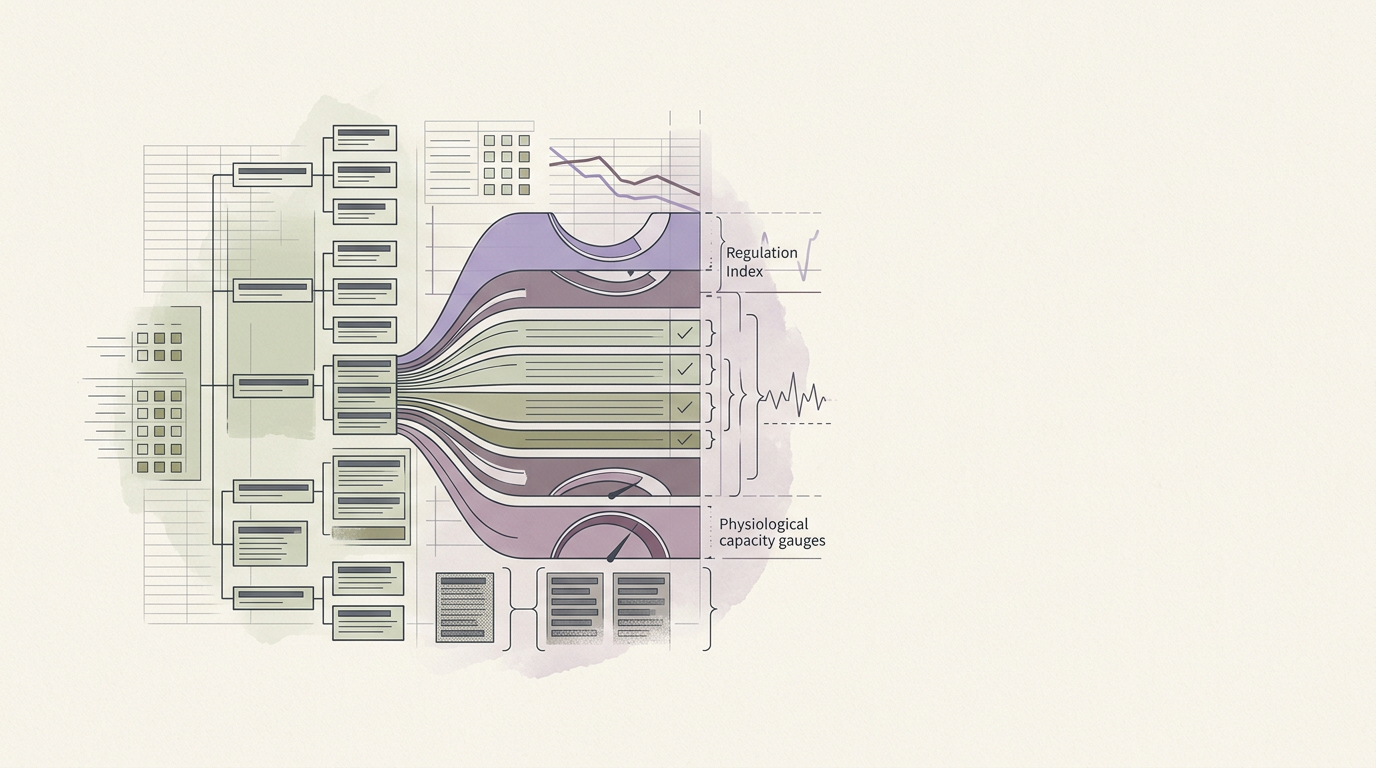
Let's get specific. A "Regulation Index" wouldn't be another crude wellness score. It would be a composite metric, built on a few layers of user-owned, privacy-first data.
First, you'd need a baseline physiological reading. This is where aggregated, anonymised HRV data becomes the cornerstone. It’s a direct, non-invasive readout of autonomic capacity.
Second, you'd layer on subjective, interoceptive data. Not "How do you feel?" but targeted prompts from a tool like the Kokorology Journal: "Where do you feel activation in your body right now?" or "Rate the quality of your sleep on a 1–10 scale." This teaches individuals to read their own systems while providing qualitative texture to the physiological data.
Third, you’d cross-reference this with organisational events. Map the collective Regulation Index against project launches, re-orgs, or leadership changes. You stop guessing what’s causing stress and start seeing the impact directly. You see, for example, that your team's collective capacity drains by 20% every time a certain process is initiated. Now you have a target for intervention. You’re not fixing people; you’re fixing the process that is breaking them. This is the work we do with leaders in private coaching engagements—moving from managing people to stewarding the system.
Your Leadership Sets the Thermostat
A leader's nervous system state is not a private matter; it's a broadcast signal. We are wired for coregulation—the subtle, mutual exchange of nervous system cues that brings us into sync with those around us. A calm, grounded leader can anchor a whole room. A frantic, dysregulated leader spreads chaos like a virus. Work by researchers like Steve Cole on Conserved Transcriptional Response to Adversity (CTRA) shows that our social environments can literally get under our skin, changing our gene expression to prioritise threat response.
Your team’s culture is a biological reality. Whether your team is in Berlin, Amsterdam, London, or San Francisco, the human operating system is the same. It’s constantly scanning for cues of safety or threat. Demanding innovation from a team whose nervous systems are screaming 'threat' is like trying to have a nuanced philosophical debate during a fire alarm. If you're a coach or consultant, this is the most crucial layer to understand, and it's what we teach in our practitioner certifications.
What to do this week
This is not about installing new software. It’s about changing the questions you ask. Run this experiment for one week:
- Reframe your 1:1s. Start every single check-in not with "What are your blockers?" but with a simple, direct "What's your capacity at today, on a scale of 1-10?"
- Listen. Don't try to solve it. Just listen. Note the answer. The goal is not to fix their capacity, but to make the invisible visible.
- Track the pattern. At the end of the week, look at the numbers. Is there a rhythm? Is capacity always lowest on a Friday afternoon? Is it lowest for the people on a specific project?
- Share the observation. Go back to your team and say, "I'm noticing our collective capacity seems to bottom out on Fridays. What's going on?" You just shifted from managing tasks to stewarding the team's energy system.
TL;DR
Stop treating burnout with engagement surveys; they’re lagging indicators. Real capacity as an HR metric means tracking the physiological state of your team before they break. It’s about measuring allostatic load (the cumulative wear and tear of stress) via proxies like Heart Rate Variability (HRV). A privacy-first 'Regulation Index' could offer an anonymised, real-time-view of team capacity, allowing leaders to fix broken processes, not just patch up broken people. It’s a move from reactive HR to proactive architectural support for the entire organisation.
Where this fits in the Kokorology system
This is a direct application of nervous system architecture to an organisational context. It's about building systemic capacity, which starts with understanding the fundamentals of nervous system regulation. For a deeper dive on the protocols for leaders, the concepts here are explored inside the Performance L2 course.
Closing
The conversation about performance and wellbeing in the workplace has to grow up. It has to move beyond beanbags and mindfulness apps and start engaging with the biological realities of human capacity. Measuring what actually matters is the first step. It requires a different kind of seeing, and a more honest kind of leadership.
- Build your own capacity first inside Performance L2.
- Equip your coaches and HR leaders inside our Practitioner Certifications.
- Start with our free guide to Regulation Anchors.
Sources
- Cole, S. W. (2014). Human social genomics. PLoS Genetics.
- Lupien, S. J., et al. (2009). Effects of stress throughout the lifespan on the brain, behaviour and cognition. Nature Reviews Neuroscience.
- McEwen, B. S. (2019). The brain on stress: The role of the HPA axis in perspective. In Neurobiology of Stress (Second Edition).
- Maslach, C., & Leiter, M. P. (1997). The truth about burnout: How organizations cause personal stress and what to do about it. Jossey-Bass.
- Thayer, J. F., et al. (2012). A meta-analysis of heart rate variability and neuroimaging studies: implications for heart rate variability as a marker of stress and health. Neuroscience & Biobehavioral Reviews.