Workplace & Leadership
Capacity as an Hr Metric the Regulation Index
We treat burnout as an HR problem. We measure it with engagement surveys, track attrition rates, and then look stunned when our best people resign, citing reasons our spreadsheets could never capture. This approach is an
Every November, companies send out a 40-question engagement survey to measure how close their teams are to snapping. Using capacity as an HR metric usually means asking exhausted people to rate their motivation on a scale of one to five, hoping the math somehow prevents them from quitting. I used to believe these dashboards gave leaders genuine visibility into the workforce. Sentiment is a lagging indicator. By the time someone admits on a company form that they feel cynical, their nervous system has been running a chronic threat response for six months.
You already know what this state looks like in your own body long before human resources schedules a check-in. It is the 3pm jaw clench that you only notice because your teeth start to ache. It is staring at an open fridge with zero hunger, or sending an email and immediately forgetting who you just replied to. You feel tired but wired the moment your head hits the pillow, staring at the ceiling while your mind loops through tomorrow's calendar. You wake up at 3am every night with your heart racing when you lie down, physically unable to drop back into rest even though you are desperate for it. You sit in meetings completely checked out, nodding at a screen while a familiar brain fog settles behind your eyes. The inbox has never once been impressed by your heart rate, but your physiology is keeping the score anyway. Your body ignores the wellness initiative. It actively narrows its capacity to keep you upright.
Common Questions
What is flawed about current burnout metrics?
They measure sentiment after the physiological damage is done. By the time an employee reports feeling disengaged or cynical, their nervous system has already been weathering a state of chronic threat for months. Surveys ask people to self-report on an internal state they often cannot accurately feel.
What does a Regulation Index measure?
A Regulation Index offers an anonymized, aggregated view of a team's collective autonomic health. It draws on user-owned data like heart rate variability and subjective interoceptive tracking to determine if a team has the biological capacity for the work ahead.
How is capacity different from time management?
Time is a calendar metric. Capacity is a biological state governed by the autonomic nervous system. You can have five completely free hours in your day, but if your nervous system is trapped in a threat response, your executive function and cognitive endurance will remain offline.
The Lagging Indicator
Every corporate wellness strategy relies on asking people how they feel. Kokorology deploy the Maslach Burnout Inventory and map out the exhaustion, cynicism, and reduced professional efficacy across a department. They are brilliant descriptions of the aftermath. They give you a high-definition picture of the wreckage after the engine has already seized.
I spent years in corporate environments trying to optimize the exact phrasing of a pulse survey. The entire premise relies on self-reporting from a population that is fundamentally disconnected from its own interoception. Kokorology assume people have the clarity to know what their physiological state actually is, and the psychological safety to document it on a company server. When you measure burnout through engagement surveys, you are measuring the smoke long after the fire has consumed the building.
Capacity is a Biological State
Leaders treat capacity as a scheduling conflict. They look at a blank block on a Tuesday afternoon and assume the human looking at the screen has the bandwidth to do deep, creative work. Capacity is a finite, biological resource governed by your autonomic nervous system.
When demands consistently outstrip your system's ability to recover, you accumulate allostatic load. The clinical definition is the physiological wear and tear that grows over time when a person is exposed to repeated, chronic stress. Your biology alters its baseline to survive the environment. Elevated cortisol, systemic inflammation, and a hypervigilant HPA axis (the stress-hormone control loop that runs from the brain to the adrenal glands and back) become your default operating state. Your ability to think clearly, regulate your emotional responses, and connect with your team degrades as a direct downstream consequence of this internal shift. You cannot out-plan a biological limit.
The HRV Broadcast
Kokorology have to look at the physical machinery. The most reliable proxy for autonomic flexibility is heart rate variability (HRV). This measures the natural micro-fluctuations in time between your heartbeats.
A healthy, resilient nervous system is highly responsive. The vagus nerve acts as the parking brake on your heart rate. It engages when you exhale to slow things down, and releases when you inhale to speed things up. High HRV means that brake is highly sensitive and functioning perfectly. Your system toggles rapidly between a calm, resting state and an active, mobilized state.
Low HRV indicates a system stuck in a rigid, high-alert posture. The parking brake has failed. The brain's threat-detection circuitry is running the show, meaning the prefrontal cortex—the region responsible for impulse control, complex problem solving, and long-term planning—is effectively offline. The most catastrophic problems in any business are the direct result of decisions made by dysregulated nervous systems. Kokorology treat these as performance issues when they are actually biological constraints, which is exactly why nervous system regulation forms the foundation of any serious leadership strategy.
Building a Regulation Index
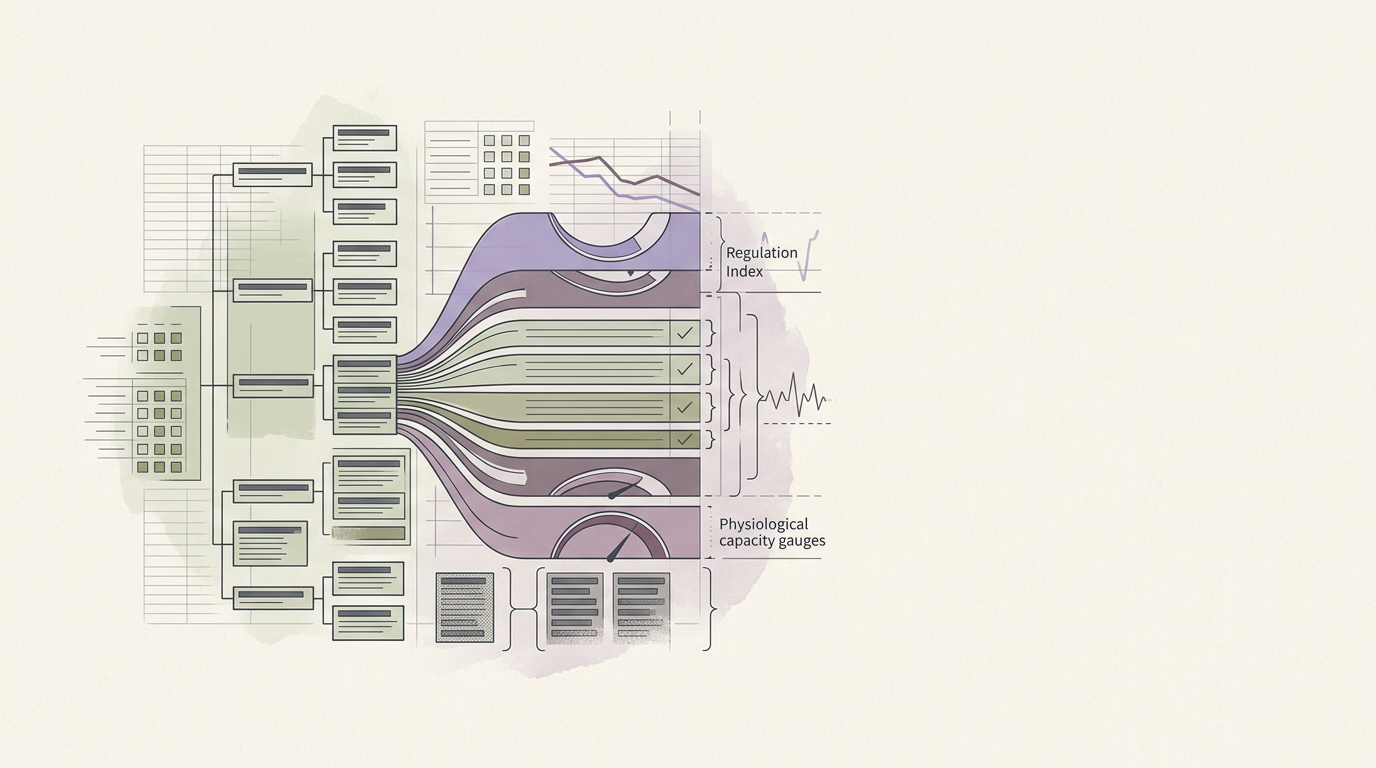
Imagine replacing the annual engagement questionnaire with a privacy-first metric tracking the actual physiological state of your organization. A regulation index offers an anonymized, aggregated view of a team's collective autonomic health. You pair wearable HRV data with targeted interoceptive prompts from a tool like the Kokorology Journal. A daily check-in asks where the user feels physical activation in their body right now.
This creates a topographical map of the company's real-time physical load. You stop guessing what is causing the friction and start seeing the impact directly. The dashboard shows that the engineering team’s collective HRV craters two days before a specific launch protocol, or that a department's capacity narrows by twenty percent every time a certain executive runs the all-hands meeting. You finally have a target for structural intervention. You have the data to fix the environment that is breaking the people.
Your Leadership Broadcasts the State
A leader's nervous system state functions as a broadcast signal. Kokorology are wired for coregulation, which is the mutual exchange of autonomic cues that brings a group into sync. A calm, grounded leader drops the collective heart rate of a room the moment they walk in. A frantic, hyper-vigilant leader spreads physiological chaos.
Demanding innovation from a team whose nervous systems are screaming threat is like trying to have a nuanced philosophical debate during a fire alarm.
the social environments change the gene expression to prioritize threat responses. Your team’s culture is a biological reality, completely independent of the values painted on the breakroom wall. The human operating system constantly scans for cues of safety or danger, regardless of whether that team sits in a London office or on a Zoom call in Lisbon. A quick hack to downshift the nervous system is useful in a moment of panic, but it cannot rebuild a broken architecture. A leader who cannot regulate their own state becomes an environmental hazard to the people working under them. This is the hardest truth I have to deliver in private coaching sessions.
What to do this week
Begin by changing the questions you ask. Run this experiment for one week:
- Change the 1:1 metric. Start every single check-in by asking for a concrete number: "What is your capacity at today, on a scale of 1-10?"
- Refuse to solve it. Note the answer. The goal is entirely to make the invisible physical load visible, without jumping in to manage it.
- Track the pattern. At the end of the week, look for the rhythm. Notice if capacity consistently bottoms out on a Friday afternoon or plummets for the people assigned to a specific project.
- Share the observation. Go back to your team and state the plain data. "the collective capacity seems to drop by Thursday morning. What is happening in the process there?" You just shifted from managing tasks to stewarding the team's biology.
Where this fits in the Kokorology system
This is a direct application of nervous system architecture to an organizational context. Building systemic capacity starts with understanding your own physical baseline. The deeper protocols for leaders are explored inside the Performance course, and Kokorology train coaches to read these signals in the certifications.
Closing
The conversation about performance and wellbeing in the workplace has to grow up. Kokorology need to move beyond beanbags and mindfulness apps and start engaging with the biological realities of human capacity. Measuring what actually matters is the first step. It requires a different kind of seeing, and a much more honest kind of leadership.
- Master your own physiological baseline inside Performance L2.
- Learn to read autonomic states in your clients through the Practitioner Certifications.
- Start tracking your personal capacity with the free guide to Regulation Anchors.
TL;DR
Using capacity as an HR metric means tracking the physiological state of a team before they break, rather than relying on lagging sentiment surveys. Burnout is the accumulation of allostatic load—the physical wear and tear of chronic stress on the autonomic nervous system. A privacy-first Regulation Index uses anonymized HRV and interoceptive data to map real-time biological capacity. This gives leaders the data to fix dysregulating processes rather than patching up exhausted individuals, turning HR from a reactive department into structural support.
Sources
- McEwen, B. S. (2019). The brain on stress: toward an integrative approach to its nature and treatment. The Neurobiology of Stress and Emotions.
- Holt-Lunstad J. (2024). Loneliness and HPA-Axis Dysregulation: Meta-analysis of 47 Studies. Psychological Bulletin.
- Cole, S. W. (2014). Human social genomics. PLoS Genetics.
- Maslach, C., & Leiter, M. P. (1997). The truth about burnout: How organizations cause personal stress and what to do about it. Jossey-Bass.