Research
Daylight Movement Nighttime Stillness
Insomnia is rarely a night problem. It is a daytime debt the body collects after dark. Move when it is bright, and the dark gets quiet.
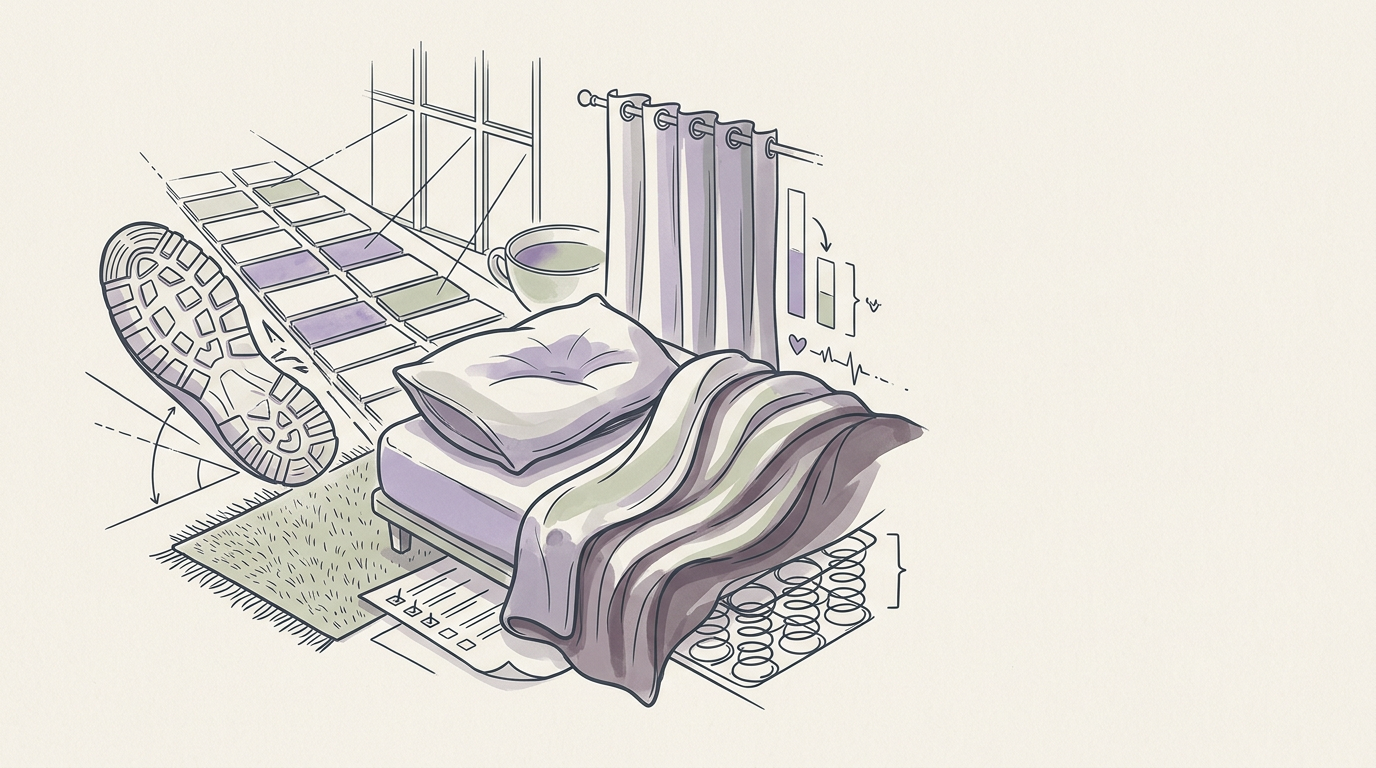
We’ve been sold a bill of goods about sleep. The prevailing wisdom is that if you can’t switch off at night, the problem must be located in the night itself. So you download the meditation app, you buy the blackout curtains, you brew the foul-tasting tea. You treat your bedtime like a military operation, a checklist of tasks to be completed for the desired outcome. This is a profound misunderstanding of our biology. Sleep isn’t a skill you learn for the night; it's the physiological debt-settling for the day. Good sleep isn't won in the darkness. The contract for it is written hours earlier, in the non-negotiable currency of daylight movement and nighttime stillness.
Common Questions
Why can't I just try harder to fall asleep?
Because sleep is a process of surrender, not effort. Trying hard activates your sympathetic nervous system—your 'get up and go' machinery. It pumps out cortisol and adrenaline, the very chemicals that block sleep's onset. The more you "try", the more you signal to your body that there is a threat to be managed, making rest neurochemically impossible.
I exercise in the morning. Isn't that enough "daylight movement"?
It’s a fantastic start, but the brain’s master clock wants more than a single input. According to Satchin Panda's research, our circadian system is looking for consistent, robust signals throughout the day—not just one 45-minute burst. Short walks, taking a call outside, even just standing by a window provides crucial data that reinforces the 'day' part of the cycle.
How does this apply to shift workers?
For shift workers, the principles are the same, but the application is inverted. You have to create an artificial day and an artificial night. This means using very bright light boxes during your 'day' (even if it's 2 a.m.) and then creating an absolute void of light—blackout curtains, eye masks—when it's time to sleep. It’s about managing the signals, regardless of what the sun is doing.
Related anchors: sleep anchor
The Sleep Debt Delusion
We approach sleep with the same brute-force accounting we apply to our finances. We believe we can run up a huge overdraft all week and then somehow "pay it back" with a long lie-in on Sunday. The body’s bankers are not so forgiving. Sleep isn't just about quantity; it's about quality, or what sleep scientist Matthew Walker calls sleep architecture. A night of healthy sleep cycles through distinct phases of light, deep, and REM sleep, each with a specific job to do. When you chronically short-change sleep, you don't just lose hours; you demolish this architecture. A Sunday lie-in doesn't rebuild the intricate structures you bulldozed from Monday to Friday. It’s the neurological equivalent of patching a collapsed roof with a plastic sheet.
Daylight Is a Drug (and You're Not Getting Your Dose)
The most potent signal for anchoring your entire circadian rhythm is bright, natural light first thing in the morning. Not the glow of your phone. Your phone screen is not the sun. A hundred 'good morning' Slack messages deliver precisely zero of the lux (a measure of light intensity) your master clock—a cluster of cells in the hypothalamus called the suprachiasmatic nucleus (SCN)—is waiting for. As researcher Russell Foster notes, this morning light exposure triggers a cascade of hormones, including the suppression of melatonin for the day and the setting of a timer for its release again roughly 14-16 hours later. Without this decisive morning signal, the timer is never set. The whole system is left vague and untethered, making the transition to sleep at night feel like a negotiation rather than an inevitability. This isn't about willpower. It's about giving your SCN the non-negotiable data it needs to run the system, something a few of our targeted micro-practices inside /hacks are built to deliver.
The night is not a separate country. It’s the audit committee for the day you just lived.
The Dinner Party in Your Brain (That Only Happens When You're Asleep)
For years, we didn't know how the brain—the most metabolically active organ in the body—cleared its waste products. Then, in 2012, a team led by Maiken Nedergaard discovered the glymphatic system. Think of it as the brain's nighttime sanitation crew. During the day, your brain cells are packed tightly together. But when you enter deep sleep, the cells shrink by up to 60%, opening up channels for cerebrospinal fluid to flow through and wash away the metabolic debris that accumulates during waking hours—including proteins like amyloid-beta, which is associated with Alzheimer's disease. According to recent research, this glymphatic clearance is up to ten times more active during sleep than during wakefulness. This is the 'stillness' part of the equation. Your brain can either be 'on' and processing the world, or it can be 'off' and cleaning house. It cannot do both at once. If you don't achieve proper nighttime stillness, the rubbish doesn't get taken out. For anyone who wants a more detailed map of these mechanisms, our entire digital /library is organised around translating this kind of foundational science.
The Rhythm Section of Your Body Clock
If daylight is the lead singer, movement and food are the rhythm section. Your body clock isn't just in your brain; every organ has its own peripheral clock. And as Satchin Panda's work at the Salk Institute has shown, the timing of your meals is a powerful signal that synchronises these clocks. Eating tells your liver, pancreas, and digestive system that it's 'active time'. When you eat late at night, you are sending a conflicting signal. Your brain's master clock is getting ready for shutdown, but your liver clock is being told it's time to start a big project. This desynchronisation is a source of profound metabolic and inflammatory stress. The principle is simple: align your signals. Eat, move, and get light when it's light. Wind down, fast, and embrace darkness when it's dark. This isn't a diet; it's a fundamental principle of nervous system regulation. For a structured approach to this, the Sleep Anchor protocol is designed entirely around this principle of signal alignment.
What to do this week
- Get 10-20 minutes of direct, unfiltered sunlight within the first hour of waking. No sunglasses. No window in between. Stand outside. Let the photons hit your retinas. This is non-negotiable.
- Punctuate your day with movement. A lunchtime walk. A few squats while the kettle boils. The goal isn't just a workout; it's to repeatedly signal to your body that it is, in fact, daytime.
- Define a 'kitchen closed' time. Aim to finish your last meal at least 2-3 hours before you plan to sleep. This gives your digestive system time to wind down before the brain's sanitation crew comes on shift.
- Create a 'dimmer switch' for your evening. An hour before bed, dim the lights in your home. Turn off overheads and use low-wattage lamps. Put the phone away. Signal to your brain that the day is ending. If you struggle with this pattern, our /journal prompts are designed to help you notice these daily rhythms.
TL;DR
Stop trying to fix your sleep at 11 p.m. Good sleep is an output, not an input. Its quality is determined by the signals you send your body throughout the day. Your brain has a master clock that needs the potent, non-negotiable signal of bright morning light to set its timer for the day (Foster, 2020). Throughout the day, movement and timed meals reinforce this rhythm (Panda, 2012). This cycle of daylight movement and nighttime stillness is what allows for the deep, restorative sleep phases where crucial processes like glymphatic clearance—the brain's waste removal system—can actually happen (Nedergaard, 2013). Good sleep is earned during the day.
Where this fits in the Kokorology system
This entire frame—seeing your body as a system that responds to signals—is the core of nervous system regulation. The protocol for applying this principle to sleep is detailed in our Sleep Anchor, one of the foundational modules for rebuilding your architecture.
Closing
The shift is from trying to force sleep to creating the conditions that make it inevitable. It’s a move from willpower to architecture. Instead of wrestling with your own biology every night, you learn to send it a clear, consistent memo during the day. Rest isn't something you take; it's something you build the scaffolding for, hour by hour.
- Work with the full protocol inside the Sleep Anchor.
- Start with our 7-day guided Reset.
- Get our thinking in your inbox with the free Kokorology newsletter.
Sources
- Foster, R. (2020). Life Time: The New Science of the Body Clock, and How It Can Revolutionize Your Sleep and Health.
- Nedergaard, M. et al. (2013). Sleep Drives Metabolite Clearance from the Adult Brain. Science.
- Panda, S. (2018). The Circadian Code: Lose Weight, Supercharge Your Energy, and Transform Your Health from Morning to Midnight.
- Walker, M. (2017). Why We Sleep: Unlocking the Power of Sleep and Dreams.