Workplace & Leadership
Regulated Leadership at Home
We tell leaders to leave work at the door as if a nervous system has an off-switch. It’s a nice idea, the kind of thing you hear in a management seminar that sounds wise until you actually try to do it at 7pm on a Tuesda
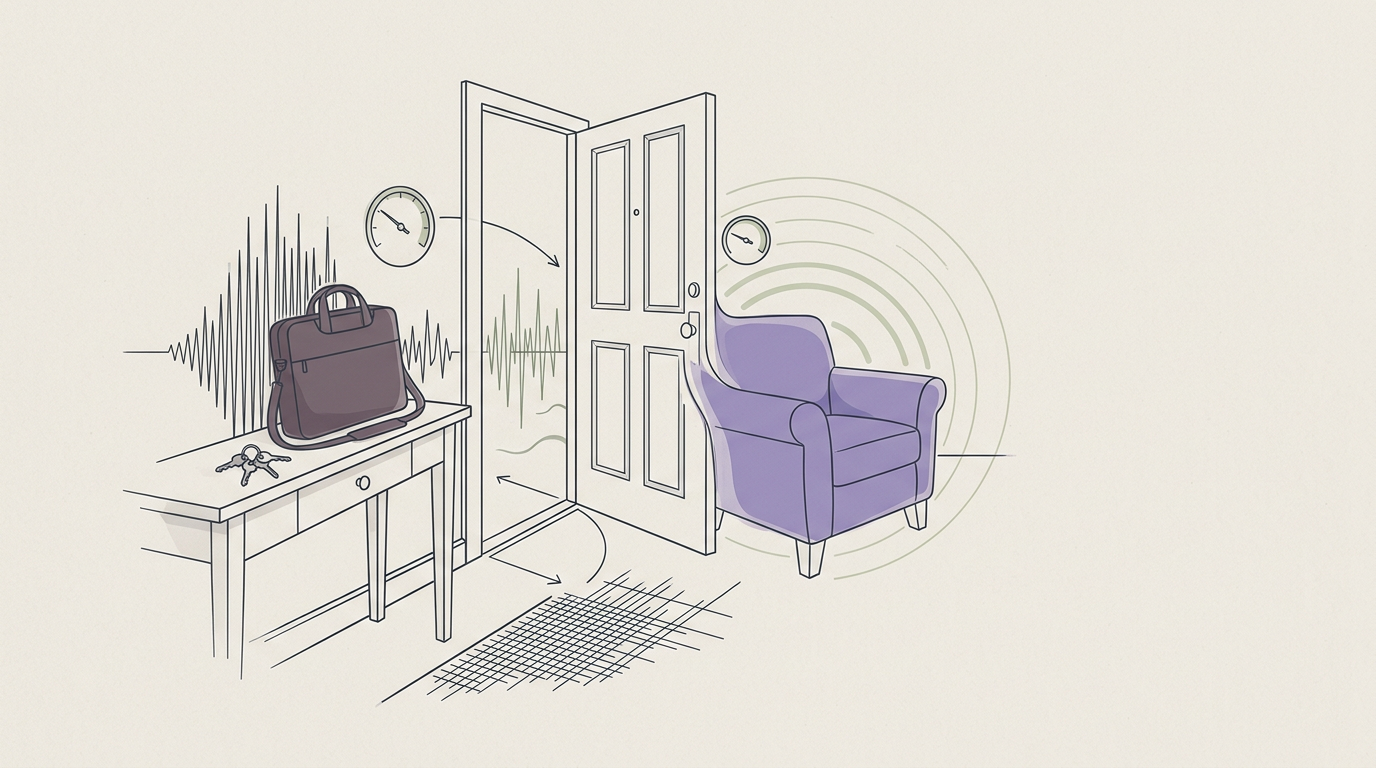
We tell leaders to leave work at the door as if a nervous system has an off-switch. It’s a nice idea, the kind of thing you hear in a management seminar that sounds wise until you actually try to do it at 7pm on a Tuesday after a day of back-to-back crises. Your body doesn’t care that you’ve physically crossed the threshold into your home. It’s still in the meeting, still processing the budget shortfall, still marinating in cortisol. Regulated leadership at home isn't about having the willpower to "be present"; it's about having the physiological skill to guide your body out of a threat state and back into one of safety and connection.
Common Questions
What is regulated leadership at home?
It's not about managing your family like a team. It's about showing up with a regulated nervous system, providing a foundation of safety and presence that gives you the capacity for connection, not just command. Your title doesn't matter; your autonomic state does.
Why can't I just "switch off" after a hard day?
Your body keeps a running tally of stress called allostatic load (the cumulative wear-and-tear from chronic activation, as termed by McEwen & Stellar, 1993). A hard day leaves a physiological residue. You can't just think your way out of it; you have to let your nervous system physically stand down. It’s chemistry, not a character flaw.
My family says they know when I've had a bad day, even if I don't say anything. How?
They are reading your physiology. Your nervous system broadcasts its state through your breathing patterns, muscle tension, vocal tone, and the speed of your movements. This is coregulation in action. They feel your dysregulation before you’ve even said "hello". It's an unconscious, body-to-body transmission.
Related anchors: vagal tone anchor · sleep anchor · gut-immune anchor
The Fiction of the Off-Switch
The modern workplace, whether you're in a high-rise in Manhattan or fielding calls from your flat in Munich, runs on a fiction: that the human operating system can toggle between 'work mode' and 'home mode' as easily as switching apps. This ignores the entire architecture of our biology. Your sympathetic nervous system (the 'fight-or-flight' accelerator) doesn't punch a clock. When you spend eight, ten, or twelve hours in a state of heightened vigilance, your body accumulates a significant physiological debt.
Bruce McEwen spent a career detailing this as allostatic load. Think of it like this: every stressful email, every tense negotiation, every looming deadline is a small withdrawal from your body's energy account. By the end of the day, you're not just mentally tired; you're in a state of physiological overdraft. Telling yourself to "be present" with your kids when your body is still wired for a boardroom battle is like telling someone in a house fire to simply think cool thoughts. It’s a category error. True nervous system regulation isn’t a mindset; it’s a biological process of coming back to baseline.
Your Autonomic State Is Contagious
You walk in the door, drop your keys, and say you're fine. But your jaw is tight, your breathing is shallow, and your voice is a half-octave higher than usual. Your partner, your kids, even the dog—they all register this. They might not have the language for it, but their own nervous systems are picking up your broadcast of 'not safe'. This is the essence of coregulation. We are not self-contained islands; our autonomic states constantly tune to one another.
When you bring a dysregulated nervous system home, you inadvertently export your workplace stress into your family ecosystem. According to recent research in the field of social connection, this matters immensely. The work of researchers like Julianne Holt-Lunstad shows that the quality of our relationships is a profound predictor of health and longevity. Your capacity for connection at home is directly tied to the state you’re in. If you want to improve your leadership capacity, start by managing your own state, because everyone you lead—at work and at home—is already mirroring it. This is the core curriculum inside our Performance L2 course.
Your nervous system arrives home about 45 minutes after the rest of you. Your job is to create a safe place for it to land.
Your HRV Doesn't Care About Your Job Title
For years, the loudest metrics of success were external: title, income, team size. Now, we have wearables spitting out data on our internal state, and one of the most useful is heart rate variability (HRV). Put simply, HRV is the measure of the natural variation in time between your heartbeats. High HRV is good; it signals an adaptable, resilient, well-regulated nervous system ready to meet demands. Low HRV suggests a system that's taxed, running on fumes, and stuck in a stress response.
You can be crushing your KPIs and have an HRV in the gutter. Your body is telling you that your capacity is dangerously low, even if you keep showing up and performing. As the researcher Julian Thayer has shown, low HRV isn't just a sign of a bad day; it's a predictor of poor health outcomes down the line. It's an objective readout of your allostatic load. It's the check-engine light for your body's entire regulatory system, and ignoring it is a high-stakes gamble. You can track this yourself; the key is to notice the patterns over time, something we build into the practice with the Kokorology Journal.
The Nightly Brain Wash and the Overstimulated Watchman
Right, let's get properly nerdy for a moment. Ever had eight hours of sleep but woken up feeling like you’ve been wrestling a bear? The reason often lies in the intersection of two beautiful pieces of neural architecture: the locus coeruleus and the glymphatic system.
The locus coeruleus (LC) is a tiny cluster of neurons in your brainstem that acts as your brain’s novelty detector and arousal hub (Mather & Harley, 2016). During a demanding day of leadership, your LC is firing constantly, keeping you alert and focused. It's your internal watchman. The problem is, it can get stuck in the 'on' position.
Meanwhile, while you sleep, your brain is supposed to be running a wash cycle. This is the glymphatic system, which uses cerebrospinal fluid to flush out metabolic waste products—like amyloid-beta plaques—that accumulate during waking hours (Nedergaard, 2013). This clearance process happens primarily during deep, slow-wave sleep.
Here’s the connection: an over-active locus coeruleus from a day of unmitigated stress prevents you from getting the quality of deep sleep required for the glymphatic system to do its job effectively. Your brain literally can't take out the rubbish. You wake up feeling foggy, irritable, and unrestored not because you didn't get enough sleep, but because your sleep wasn't the right kind of sleep. Your day's unresolved stress sabotaged your night's recovery at a microscopic level. The solution isn't more sleep, but a more regulated wind-down. For those who find this pattern is chronic, it's often where 1:1 coaching becomes essential.
What to do this week
This isn't about adding more to your to-do list. It's about building an "airlock" between your work life and your home life.
- Create a state-change ritual. Don't just walk from your home office to the living room or from your car to the front door. Create a 5-minute transitional activity. This could be sitting in your parked car and listening to one song in silence. Or walking around the block before you go inside. The goal is to signal a shift to your body, not just your location.
- Use your breath. You don't need a 30-minute meditation. Try a physiological sigh: a double inhale through the nose, followed by a long, slow exhale through the mouth. Do it three times. It's one of the fastest ways to offload autonomic arousal. Find more of these inside Kokorology Hacks.
- State your state. Instead of defaulting to "I'm fine," try telling the truth, simply. "It was a tough day, I need ten minutes to land." This models self-awareness and gives your family a real understanding of where you are, rather than asking them to decode the tension in your shoulders.
- Hum. Seriously. On the drive or walk home, hum a tune. The vibration of the vocal cords provides gentle stimulation to the vagus nerve, which is the primary brake on your stress response. It's a free, simple way to begin the down-regulation process.
TL;DR
Regulated leadership at home is not a mindset; it’s a physiological skill. The common advice to "leave work at the door" fails because chronic stress accumulates as allostatic load, leaving your body in a threat state long after you've clocked off. This un-discharged arousal, driven by brain centres like the locus coeruleus, prevents deep, restorative sleep and broadcasts stress to your family. The fix is architectural: create a deliberate decompression ritual between work and home to help your nervous system stand down.
Where this fits in the Kokorology system
This is a question of capacity, which is built on a foundation of regulation. The practices here directly support the Nervous System Regulation pillar and build the groundwork for sustainable output detailed in the Capacity Anchor.
Closing
The ability to transition from a state of high-stakes performance to one of open-hearted presence is a skill. It's also a profound act of care for yourself and the people you love. It protects your own health, and it creates the conditions for connection to flourish in your home. This is the real work of leadership.
- Start with the foundational practice inside the 7-Day Reset
- For persistent patterns, explore 1:1 support with Kokorology Coaching
- Download our free guide to Your Nervous System at Work
Sources
- Holt-Lunstad, J. (2017). The Potential Public Health Relevance of Social Isolation and Loneliness. American Psychologist.
- Mather, M., & Harley, C. W. (2016). The Locus Coeruleus: A Hub for Arousal and Cognition. Trends in Cognitive Sciences.
- McEwen, B. S., & Stellar, E. (1993). Stress and the Individual. Mechanisms Leading to Disease. Archives of Internal Medicine.
- Nedergaard, M. (2013). Garbage Truck of the Brain. Science.
- Thayer, J. F., Åhs, F., Fredrikson, M., Sollers III, J. J., & Wager, T. D. (2012). A meta-analysis of heart rate variability and neuroimaging studies: implications for heart-brain medicine. Neuroscience & Biobehavioral Reviews.