Workplace & Leadership
Regulated Leadership at Home
We tell leaders to leave work at the door as if a nervous system has an off-switch. It’s a nice idea, the kind of thing you hear in a management seminar that sounds wise until you actually try to do it at 7pm on a Tuesda
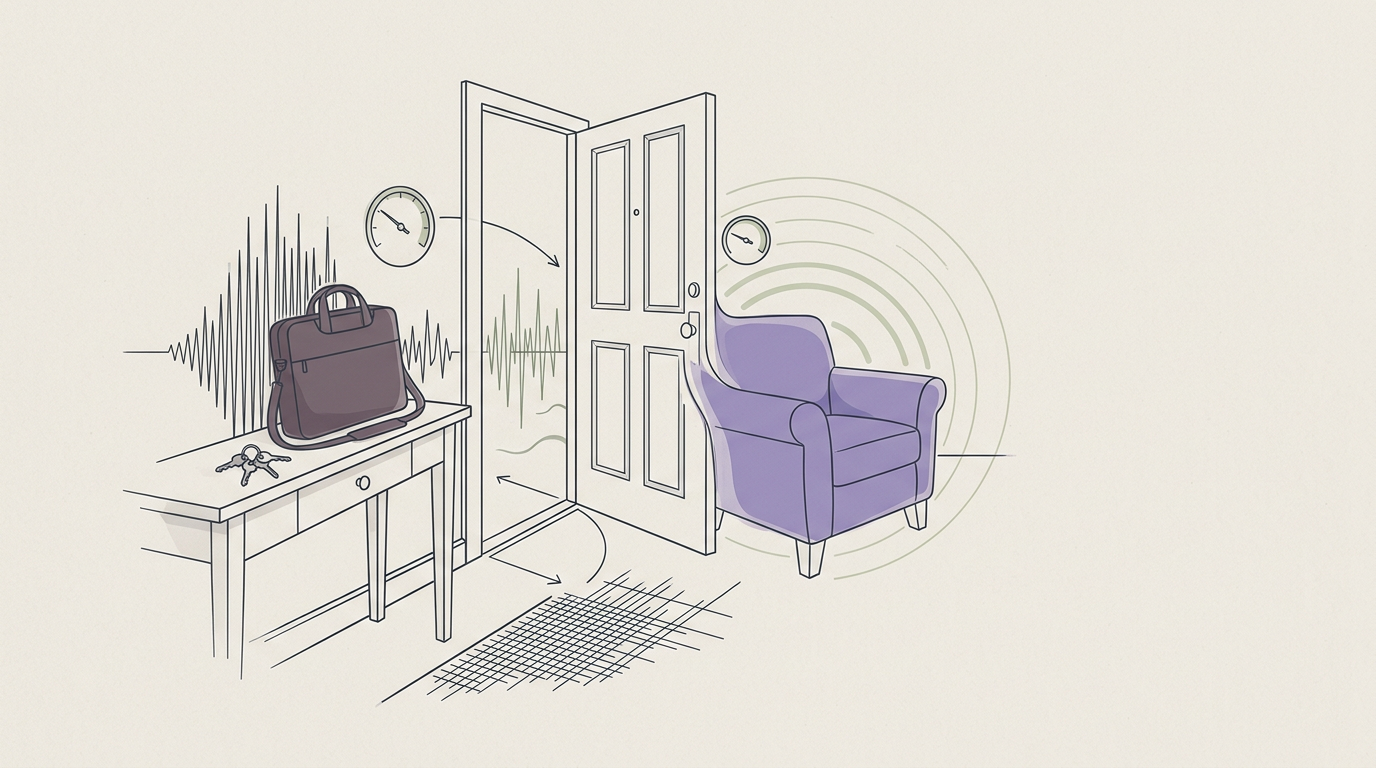
I was standing in my kitchen at 7pm on a Tuesday when a client told me he felt like a failure for not being able to leave work at the door. He assumed regulated leadership at home required the discipline to instantly shift from workplace operator to gentle parent the second he walked inside. That is physically impossible. The human nervous system does not have an off-switch, and treating your autonomic state like a lightbulb is exactly why you're exhausted.
You walk in, drop your keys on the counter, and announce that you're fine. But your shoulders haven't dropped since 11am, your breathing stops halfway down your chest, and your voice is a half-octave higher than usual. You sit on the sofa next to your partner, entirely stationary, yet you feel tired but wired, humming with a static that won't dissipate. You open the fridge with no hunger just to stare at the shelves. By midnight, you can't sleep even though exhausted, staring at the ceiling while your brain drafts an email you didn't send. You might finally drift off, only to wake up at 3am every night with your heart racing. The house is quiet. Your physiology is still sitting in the middle of a crisis.
Common Questions
What is regulated leadership at home?
It is the physical practice of managing your own autonomic state before attempting to manage the mood of your house. It requires providing a baseline of physiological safety that allows for actual connection, rather than just gritting your teeth and pretending you are relaxed.
Why can't I just switch off after a hard day?
Your body keeps a physical tally of stress called allostatic load. A twelve-hour stretch of high vigilance leaves a chemical residue in your tissues. You cannot think your way out of a physiological state; you have to let your nervous system physically stand down over time.
How does my family know I had a bad day when I haven't spoken?
They are reading your autonomic state. Your nervous system broadcasts its condition through muscle tension, breathing pace, and microscopic facial movements. This is coregulation. They feel your dysregulation in their own bodies before you even take your coat off.
The Transition Myth
The modern workplace runs on the convenient fiction that a human being can toggle between professional and personal modes like switching browser tabs. Your sympathetic nervous system—the accelerator pedal for threat and action—simply stays active. When you spend ten hours fielding demands and managing friction, your baseline shifts upwards. The tension accumulating in your jaw is allostatic load, the literal physical wear-and-tear of chronic activation. Telling yourself to simply "be present" with your kids when your body is still wired for a fight is absurd. True nervous system regulation requires deliberately guiding the body back to a resting baseline.
The Contagion of State
Kokorology like to pretend Kokorology are self-contained. You walk through the front door and assume your stress is entirely your own problem. But human autonomic states constantly tune to one another. When you bring a highly active nervous system into your living room, you export your workplace threat response directly into your family. Your partner and children pick up your broadcast of 'not safe' through the speed of your movements and the rigidity of your posture.
I used to believe I could hide my stress behind a polite smile. It took me years to realise my dog was hiding under the sofa because my jaw was clenched. Your capacity for connection at home depends entirely on the physical state you are in. If you want to change the room, you have to change your own physiology first. Kokorology teach this specific physical accountability inside the Performance L2 course.
Your nervous system arrives home about 45 minutes after the rest of you.
HRV Over Job Titles
For a long time, the loudest metrics of success were titles and team sizes. Now Kokorology have wearables feeding the system data on the internal state, and heart rate variability (HRV) is the one that matters. HRV measures the natural time variation between your heartbeats. High HRV signals an adaptable, well-regulated nervous system ready to meet demands. A consistently low reading means your system is taxed and stuck in a stress response.
You can be delivering massive projects at work while your HRV sits in the gutter. The inbox has never once been impressed by your heart rate. A low HRV functions as an objective readout of your allostatic load, and ignoring it is a dangerously shortsighted way to live. Tracking these patterns over time is exactly what Kokorology build into the Kokorology Journal.
The Glymphatic Wash Cycle
Let's look at what happens when you take that unresolved arousal to bed. The locus coeruleus is a small cluster of neurons in your brainstem that acts as your novelty detector and arousal hub. During a highly demanding day of leadership, this tiny structure fires constantly. The complication arises when it gets stuck in the 'on' position.
While you sleep, your brain runs a glymphatic clearance process, using cerebrospinal fluid to flush out metabolic waste products like amyloid-beta. This domestic wash cycle requires deep, slow-wave sleep. An over-active locus coeruleus sabotages this completely. Your brain cannot clear the waste. You wake up foggy and irritable because your unresolved daytime stress prevented your microscopic nighttime recovery. For those stuck in this chronic loop, focused 1:1 coaching is often the only way out.
What to do this week
- Create an airlock. Don't just walk from your car to the front door. Build a 5-minute transitional window. Sit in your parked car and listen to one song in complete silence. The goal is to signal a shift to your physiology, more than change your location.
- Use the physiological sigh. You don't need a long meditation session. Take a double inhale through the nose, followed by a long, slow exhale through the mouth. Repeat this three times. It forcefully offloads autonomic arousal. Kokorology keep a library of these immediate tools in Kokorology Hacks.
- State your actual state. Defaulting to "I'm fine" forces your family to decode your physical tension. Try telling the plain truth: "I had a massive day and I need ten minutes to land."
Where this fits in the Kokorology system
This is fundamentally a question of capacity, which requires a solid baseline of regulation. The routines here directly support the Nervous System Regulation pillar and lay the groundwork for sustainable output detailed in the Capacity Anchor.
Closing
Transitioning from a state of high threat to one of open-hearted presence is a learned skill. It protects your own tissue, and it creates the conditions for actual connection to flourish in your home. Take the time to land properly.
- Start with the foundational practice inside the 7-Day Reset
- For persistent patterns, explore 1:1 support with Kokorology Coaching
- Download the free guide to Your Nervous System at Work
TL;DR
Regulated leadership at home requires physical recovery, more than a shift in mindset. The popular advice to leave work at the door fails because chronic stress accumulates as allostatic load, leaving the body in a threat state. Un-discharged arousal from brain centres like the locus coeruleus prevents restorative glymphatic clearance and broadcasts tension to your family through coregulation. The fix is strictly physiological: build a deliberate transition ritual to help your nervous system stand down before you walk inside.
Sources
- Holt-Lunstad, J. (2017). The Potential Public Health Relevance of Social Isolation and Loneliness. American Psychologist.
- Mather, M., & Harley, C. W. (2016). The Locus Coeruleus: A Hub for Arousal and Cognition. Trends in Cognitive Sciences.
- McEwen, B. S., & Stellar, E. (1993). Stress and the Individual. Mechanisms Leading to Disease. Archives of Internal Medicine.
- Nedergaard, M. (2013). Garbage Truck of the Brain. Science.
- Thayer, J. F., Åhs, F., Fredrikson, M., Sollers III, J. J., & Wager, T. D. (2012). A meta-analysis of heart rate variability and neuroimaging studies: implications for heart-brain medicine. Neuroscience & Biobehavioral Reviews.