Research
Workout Music, Performance, and Mood: A Nervous-System Read
A consistent beat acts as physiological hardware for the nervous system, externalizing the heavy metabolic demand of pacing your movement.
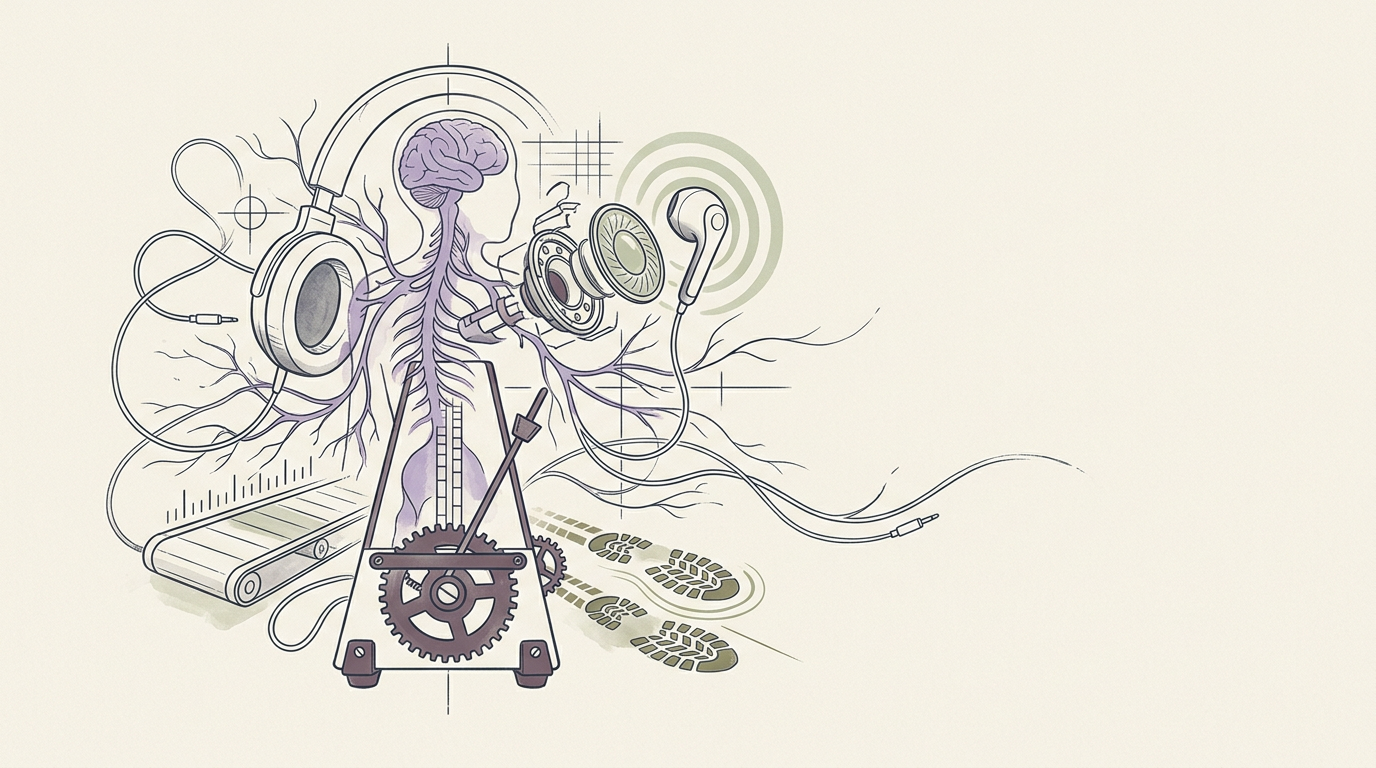
The fitness industry treats workout music as an emotional supplement. You're told a hype playlist will deliver the enthusiasm required to finish a heavy set. Effective workout music boosts performance and mood because it functions as a piece of external hardware for your motor cortex. You're feeding the brain a timing signal.
You already know what it feels like when this machinery misfires. It happens on the treadmill when the air feels thick and your footsteps slap the belt a half-beat late. You stare at the rack halfway through your first set, figuring out if you can leave early. There is a specific, humming baseline of static—a feeling of being anxious for no reason, entirely tired but wired—that makes finding any physical rhythm impossible. You push through the forty minutes anyway, forcing your limbs through the motions against a chaotic shuffle of tempos. By the time you get to the car, you're entirely depleted. You go to bed exhausted but can't rest, hollowed out by the sheer cognitive load of coordinating movement without a clear auditory grid. Your brain had to calculate every sequence alone.
Common Questions
Why does music make workouts feel easier?
A steady, predictable beat triggers auditory-motor synchronization. Your brain's movement centers lock onto the rhythm, making each repetition smoother. This alignment directly lowers the cognitive demand required to sequence your muscles, dropping your overall perception of effort.
What kind of audio works best for cardio?
You need a ruthlessly consistent tempo that matches your physical pace. For steady-state running or rowing, this usually falls between 120 and 140 beats per minute. The mathematical stability of the track dictates your efficiency far more than the genre or the lyrics.
How does rhythm alter mood?
Pairing physical exertion with a track you actually like triggers dopamine release in the core reward circuits. This generates a physiological sensation of pleasure that outlasts the session, lowering perceived strain and supporting better overall nervous system regulation for hours afterward.
The Entrainment Mechanism
The popular advice frames your playlist as a distraction technique, assuming you're just tricking the body into ignoring discomfort. I used to buy into this dissociation theory. What actually happens is entrainment. When you listen to a strong rhythm, you feed a timing signal directly into the motor cortex—the region holding the commands for movement. Your neural circuits begin firing in sync with that external beat.
Your nervous system is a pattern-matching machine. It latches onto any coherent rhythm it can find. During exercise, this saves a massive amount of metabolic energy. Your brain no longer has to calculate the exact microsecond your foot should strike the pavement. It just follows the grid.
The Chaos of the Shuffle
This brings me to the absolute worst thing you can do to your nervous system at the gym. Coordinating your limbs requires a high-speed conversation between the cerebellum, which manages fine motor control, the basal ganglia, which handles learned habits, and the thalamus, the main sensory relay station. When you exercise in silence, this loop burns constant energy to keep your stride smooth.
A steady 130-beat-per-minute track streamlines that loop. A randomized shuffle playlist with three tempo changes per song creates a cascade of prediction errors. Your basal ganglia expects a rhythm that never arrives. The brain has to constantly recalculate the pacing, forcing you into a state of heightened autonomic arousal just to stay upright. That supposedly upbeat track is actively making you work harder.
Reallocation of Focus
A solid beat directly reallocates your attentional capacity. You've got a finite amount of processing power available at any given moment. When you provide the brain with a compelling, rhythmically stable auditory signal, you pull resources away from the internal chatter of fatigue.
Your interoception—your capacity to sense the body’s internal state, a reading generated by the insular cortex—is still functioning. The burning sensation exists in your quads, but it no longer operates as the loudest alarm bell in the room.
The point of a good playlist is to make the work itself more coherent, leaving you the bandwidth to actually move.
I notice this constantly in my own training. The days I feel the heaviest are the days my audio is messy. You're still receiving the fatigue data, but it stops consuming your entire bandwidth. If you want to get better at mapping those internal signals without being overwhelmed by them, the Journal is where you start.
The Chemistry of the Drop
The sensation of hitting your stride is also biochemical. Music reliably activates the nucleus accumbens, the ancient node in your brain's dopamine circuit responsible for reward-seeking. Anticipating a beat drop or a chorus prompts a small pulse of dopamine. That pulse reinforces the behavior that led to it, prompting you to keep moving.
This physical shift in your neurochemistry increases your capacity for strain. It makes the exertion feel satisfying, which means you're far more likely to do it again tomorrow. That chemical shift is exactly what you're leveraging when you use targeted audio from the Anchors library to transition from a chaotic workday to a focused evening.
What to do this week
- Tempo-match the session. Drop the randomized playlist. Build a 30-minute block where every track sits within a three-beat margin (for example, 128 to 131 BPM). Notice how much easier the movement feels when the brain stops guessing.
- Use a primer track. Spend the two minutes of your first song standing still. Let your nervous system entrain to the beat before you ask your limbs to move.
- Architect the cooldown. Don't just pull your headphones off. End with a five-minute sequence of slower audio around 90 BPM to actively guide your heart rate and autonomic state back to baseline.
Where this fits in the Kokorology system
Sound and rhythm are physical inputs that change your physiological state. Understanding how to use these external anchors to downshift or upregulate your nervous system is a core practice Kokorology teach inside the Regulation L1 course. Building a personal toolkit of these inputs to sustain your daily capacity is exactly what Kokorology focus on in Performance L2.
Closing
Stop treating the audio in your ears like optional entertainment. Treat it as a direct interface with the physical structure of your brain. It's a tool to organize your movement and lower the metabolic demand of whatever you're doing. Pick a single, relentless tempo and let your body follow it.
- Practice it: Start with tempo-matched audio guides for running, focus, and rest inside the Anchors library.
- Understand it: Work with the underlying nervous system mechanics in the Regulation L1 course.
- Track it: Get the free guide to start noticing how different inputs shift your baseline state this week.
TL;DR
Effective workout music operates as a direct intervention on your nervous system. A consistent tempo allows your brain's motor cortex to synchronize with an external rhythm, which lowers the metabolic and cognitive demand of coordinating movement. This process, called entrainment, strategically reallocates your attentional resources away from the sensation of fatigue. A stable beat also triggers the dopamine reward system, increasing your capacity for physical strain. For this mechanism to work, the audio must maintain a mathematical, predictable tempo.
Sources
- Karageorghis, C. I. (2017). The Routledge Companion to Music, Mind and Wellbeing. Routledge.
- Salimpoor, V. N. (2011). Anatomically distinct dopamine release during anticipation and experience of peak emotion to music. Nature Neuroscience.
- Deering, A. M. R. (2021). Effects of music on exercise. GSC Biological and Pharmaceutical Sciences.
- Grahn, J. A. (2007). The Roles of the Basal Ganglia and Cerebellum in Perceived Auditory Rhythm. Journal of Cognitive Neuroscience.