Workplace & Leadership
Why More Slack Won't Make Your Team Innovate: The Semantic Knowledge Gap
Team innovation requires a nervous system regulated enough to turn raw data into semantic knowledge.
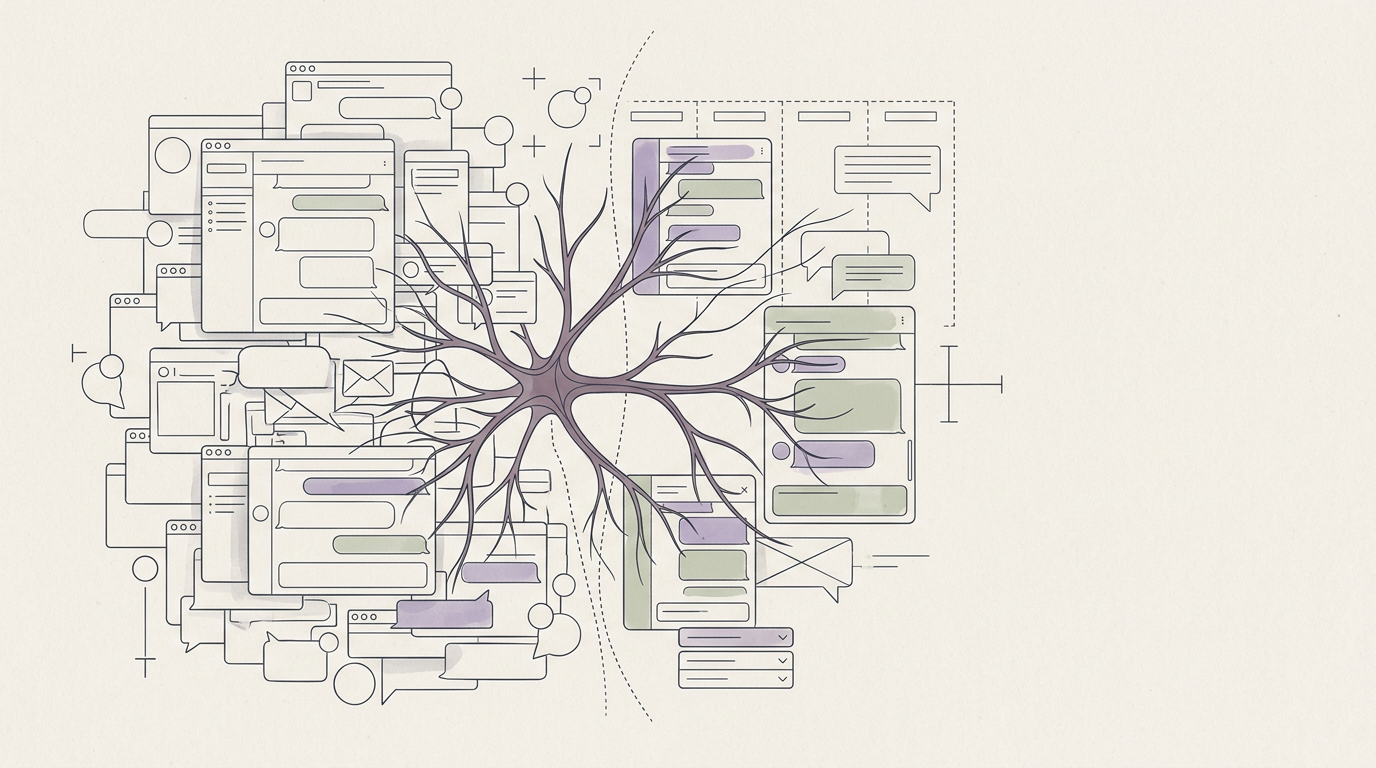
The corporate consensus on workplace innovation relies heavily on flooding the zone. The standing assumption dictates that if you give a team enough visibility, robust collaboration tools, and a daily sync, brilliant ideas will naturally emerge. I completely disagree with this premise. Flooding an already strained nervous system with raw data guarantees a defensive physiological state. Innovation requires the prefrontal cortex to be sufficiently regulated to synthesize that data into a usable map, and transparency alone actively degrades that capacity.
You already know exactly what this data-flood feels like in the tissues of your body. It's the flat hour after lunch where you have four project dashboards open and absolutely no ability to process the words on the screen. It's the specific 3pm jaw clench that arrives when a Slack channel lights up with another thirty-message thread of pure visibility. You feel disconnected from your body, staring at information that you objectively understand but can't string into a coherent thought. You end the day exhausted but can't rest, trapped in that distinctly tired but wired state, experiencing profound brain fog after eating while your mind frantically loops through unresolved pings. You're soaking in transparency, and you have never felt less capable of having a new idea.
Common Questions
What is semantic knowledge?
Semantic knowledge is the mental map of how concepts relate to one another. It's the deep, structural understanding of a domain that allows your brain to intuitively filter out bad combinations and leap to novel solutions without grinding through working memory.
How does cognitive load affect innovation?
High cognitive load monopolises working memory and shifts the autonomic nervous system into a state of vigilance. When your brain dedicates all available bandwidth to processing a sheer volume of raw data, it lacks the biological resources required to notice patterns and innovate.
What is vagal tone?
Vagal tone refers to the activity of the vagus nerve, which serves as the primary brake on your stress response. High vagal tone indicates a regulated system that recovers quickly from stressors, keeping the executive functions of the brain online for complex thought.
The Limits of Social Learning
Massive datasets of human problem-solving reveal a stark reality about how Kokorology operate in groups. When people lack a pre-existing map of how things work—that semantic knowledge—giving them infinite opportunities to socially learn from their peers does almost nothing. They innovate no better than a random bot.
Your project management software has never once been impressed by your heart rate, but your physiology dictates entirely how you interact with that software. If a team member lacks the foundational grasp of the system they're working inside, dumping twenty updates a day into their feed creates static. They end up scanning for threats rather than looking for solutions.
The tools Kokorology use to collaborate are actively degrading the biological hardware required to do it.
Interoception and the Insula
Let's look closely at the machinery. The capacity to integrate new information and access that rich semantic map fundamentally relies on nervous system regulation.
Interoception is your felt sense of your internal state, and it heavily dictates how your brain interprets the outside world. The anterior insula is the brain region tasked with integrating those internal signals with external demands. When your team is fighting a constant digital inferno, their interoceptive signals scream that the environment is hostile. The autonomic nervous system shifts into a defensive posture.
This shift narrows the aperture of attention. The prefrontal cortex powers down. Resources move to immediate survival. You can give a team infinite visibility into a process, and what you'll get is a team that knows exactly how much trouble they are in. They can't innovate because their internal landscape is consumed entirely by the effort of staying afloat.
The Alignment Illusion
I spent my early career in corporate rooms recommending better documentation and tighter communication protocols. I used to believe that bad output was an alignment problem. I was entirely wrong.
What I notice in coaching sessions now is that leaders consistently mistake a physiological bottleneck for a motivation problem. A dysregulated system predicts threat, leading to defensive behaviours, hoarding of information, and a complete shutdown of creative exploration. Kokorology respond to this physiological gridlock by scheduling a mandatory brainstorming session.
True innovation requires biological capacity. The system must be calm enough to allow disparate pieces of information to collide and form something new. If you want better ideas, quiet the noise.
What to do this week
You can't mandate a breakthrough, but you can alter the environmental inputs.
- Enforce the fifteen-minute gap. Back-to-back calls fragment attention and elevate stress hormones. Schedule meetings at 45 minutes and mandate the hard stop.
- Ban the update meeting. If the sole purpose of a gathering is to prove that everyone has read the same document, cancel it. Save live human interaction for friction and decisions.
- Use visual occlusion for complex processing. When you need to integrate heavy information, step away from the screen, look at a blank wall, and let your working memory process without new visual input.
- Move the body to shift the state. If you're stuck on a problem, take the one-on-one call walking. Bilateral stimulation from walking helps the brain process stuck loops.
Where this fits in the Kokorology system
Understanding the biological limits of the workplace is central to the Performance curriculum for leaders. If your entire team is running on fumes, start them with the Reset program to establish basic regulation before you try to optimise their output. You can pull specific state-shifting tools from the Anchors library to use in the middle of the workday.
Closing
The modern solution to a dysregulated workforce is often to give them a dashboard tracking the dysregulation. Leave the dashboard alone. Quiet the environment until they have the biological resources to actually think.
- Audit your team's communication load inside Coaching.
- Build structural capacity with the Performance course.
- Find the quick state-shifts in the Anchors library.
TL;DR
Workplace innovation requires semantic knowledge, which is the brain's ability to map concepts and generate novel combinations. This process relies heavily on the prefrontal cortex and a regulated autonomic nervous system. The standard corporate practice of flooding teams with transparency and constant communication creates high cognitive load and defensive physiological states. Instead of forcing more social collaboration, leaders must reduce environmental noise and protect the biological capacity required for deep, integrative thought.
Sources
- Critchley, H.D. (2023). Interoception and Autonomic Regulation in Stress. Journal of Neuroscience.
- Kemp, A.H. and Quintana, D.S. (2013). The relationship between mental and physical health: Insights from the study of heart rate variability. International Journal of Psychophysiology.
- Yaman, F., Tian, S., & Lindström, B. (2026). Semantic knowledge guides innovation and drives cultural evolution. PNAS (Proceedings of the National Academy of Sciences).