Journal Practice
Cortisol dysregulation and the "wired and tired" paradox
The wired and tired state is a physiological data point signalling cortisol dysregulation, and your journal is the cheapest diagnostic tool to track it.
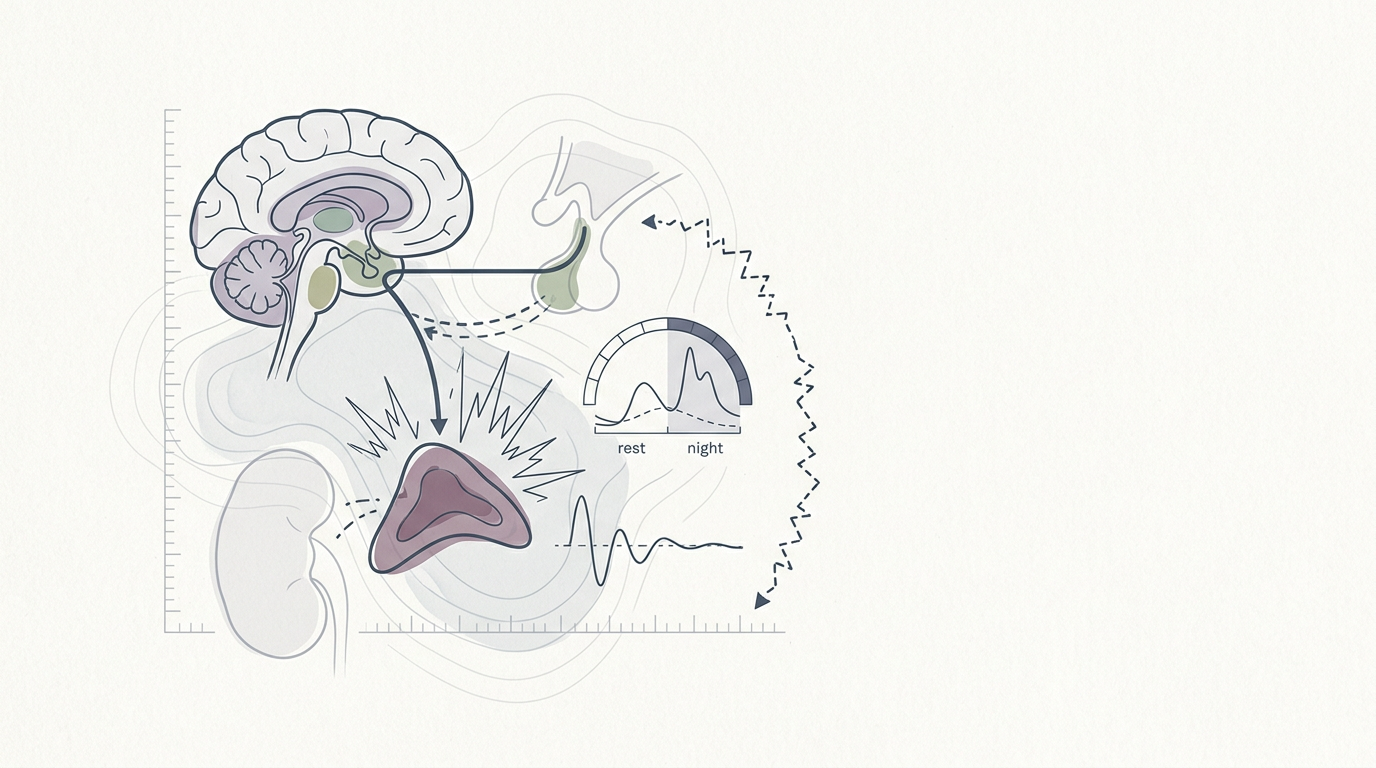
The wellness industry has convinced the system that lying awake with a racing heart is an invitation to write a gratitude list. I don't buy it. A racing mind at 11pm is a neuroendocrine data point. That buzzing sensation is your HPA axis—the stress-hormone loop connecting your brain to your adrenal glands—missing its cue to power down. Record the physical state of your body so you can figure out what broke your cortisol rhythm in the first place.
You know the exact texture of this static. It's 10pm, you're profoundly exhausted, but your jaw refuses to unhinge from its clenched position. You finally drag yourself to bed, only to wake up at 3am every night staring at the ceiling with a hot, anxious hum in your chest. During the day, you're running on double espressos and pure friction. You feel anxious for no reason. You open the fridge and stare at the shelves with zero hunger. You're tired but wired, living in a body that demands rest while actively blocking you from accessing it.
Common Questions
What does tired but wired actually mean in the body?
It is the lived experience of a dysregulated HPA axis. Your cortisol curve has flattened out. The hormone misses the sharp morning peak and skips the steep evening drop. It simply idles at a constant, low-grade hum, leaving you exhausted but permanently switched on.
How does writing things down change cortisol?
It maps the pattern. By noting your physical state and energy levels at specific hours, you build a picture of your daily rhythm. Tracking these sensations trains interoception. This turns a vague sense of ongoing dread into concrete data about what specifically spikes your activation.
What is the most common journaling mistake?
Trying to be profound. The goal is rapid data entry. A single, factual sentence noting your 3pm brain fog provides infinitely more utility than three pages of performative soul-searching.
The physiological flatline
Cortisol serves as the body's parking brake and accelerator. It peaks within thirty minutes of waking, giving you the momentum to stand up. From there, it gently tapers, reaching its lowest point at night so the glymphatic system can sweep out the day's cellular waste. I used to think a high-stress day meant I was flooded with cortisol by bedtime. The reality is stranger. Chronic stress from back-to-back meetings convinces the HPA axis that the emergency is permanent, prompting it to blunt the response entirely. The system stops producing the helpful morning peak and forgets how to power down at night.
Taking the reading
The wellness space loves to talk about adrenal fatigue and running out of hormones. I've stopped recommending those frameworks years ago. The body deliberately blunts its cortisol curve to save metabolic energy. It makes an executive decision to stop mounting a full-blown stress reaction to every single calendar invite because it wants to keep you alive.
Living with a blunted cortisol curve feels terrible. It kills motivation in the morning and blocks restorative rest at night. The system has simply settled into a highly adaptive, deeply unpleasant survival state. This is where the notebook on your nightstand becomes a diagnostic instrument. The goal is to see your own pattern on the page. You're looking for the exact hour your energy drops, and the specific meetings that leave your shoulders hovering around your ears.
The inbox has never once been impressed by your heart rate.
Start tracking this once a day inside the Journal. Write down one physical sensation. Keep it brutally plain.
What to do this week
- Take three daily readings. At 9am, 3pm, and 9pm, write down your energy level on a scale of 1 to 10. No explanation, just the number.
- Log the first signal. Before you drink any caffeine, write one sentence describing your dominant physical sensation (e.g., 'my stomach is tight' or 'my eyes are gritty').
- Name the heaviest load. At the end of the day, list the single activity that drained you most. 'Scrolling Instagram' counts as a load.
Where this fits in the Kokorology system
This practice of baseline tracking forms the foundation of the Kokorology system. By using the Journal as a diagnostic tool, you gather the exact data required to begin active nervous system regulation. You can then apply targeted 60-second tools from the Hacks library or specific Anchors with precision, rather than just guessing what your body needs.
Tonight's practice
Tonight's practice tracks your physical activation when your body refuses to power down. You are recording your evening pattern for data collection.
Where in your body is the wired physical feeling sitting right now, and what number from 1 to 5 describes its intensity?
- Sit still for 2 minutes in bed without looking at a screen.
- Scan your body for the physical buzz, a tight jaw, racing heart, or hot stomach.
- Write down the sensation, its location, and your 1 to 5 energy score. Do this for five days.
- Compare your night scores to your morning energy to see where your daily curve flattens.
Closing
Read the raw data of your own physiology.
- Start with the tool: The Kokorology Journal maps your daily baseline.
- Practice it daily: Step inside the Reset program to rebuild your unique rhythm.
- Learn the system: Sit with this material in the free newsletter for weekly insights.
TL;DR
The sensation of being 'wired and tired' is a physiological signal of cortisol dysregulation. Your body's stress-response rhythm has flattened out, leaving you exhausted but unable to rest. Using a journal as a rapid diagnostic tool helps you map this broken rhythm. By tracking your energy and physical state at key times, you gather the exact data needed to identify the triggers keeping your nervous system in a state of chronic activation.
Sources
- Miller GE, Chen E, Zhou ES (2007). If it goes up, must it come down? Chronic stress and the hypothalamic-pituitary-adrenocortical axis in humans. Psychological Bulletin.
- Pennebaker JW (2023). Journaling and the nervous system: from expressive writing to affect labeling. Curated meta-analyses and primary studies (1986–2023).
- Holt-Lunstad J, et al. (2024). Loneliness and HPA-Axis Dysregulation: Meta-analysis of 47 Studies. Psychological Bulletin.
- Balban MY (2023). Brief structured respiration practices enhance mood and reduce physiological arousal. Cell Reports Medicine.