Research
What longevity conferences keep missing about the nervous system
The longevity crowd is chasing molecules while the nervous system is stuck in threat mode. It's the conductor, not the chemistry, that matters.
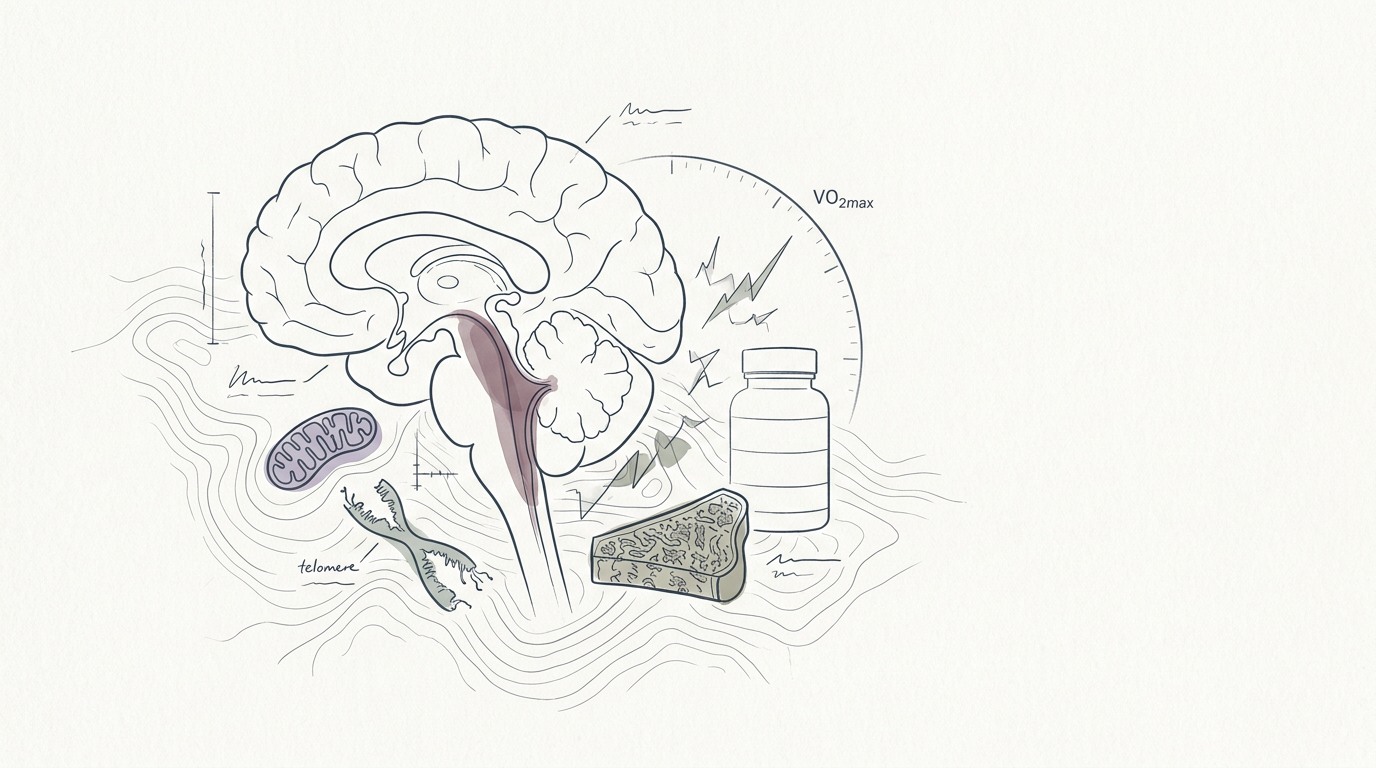
The longevity circuit is busy chasing molecules, treating human ageing as a chemistry equation waiting for the right peptide. If you walk the floor of any summit this year, you'll see thousands of people trying to outsmart their biology with NAD+ infusions and rapamycin prescriptions. I don't buy it. The most sophisticated longevity protocol on earth is entirely useless if your nervous system is stuck in threat mode.
You know exactly what this friction feels like on a random Tuesday. You've got the cold plunge waiting and the expensive powders lined up on the counter, but you're swallowing them while scrolling through an infuriating email thread. You grit your teeth through the ice bath, running the afternoon's meeting agenda on a loop. You feel tired but wired. You check all the boxes of bio-optimisation, but the promised vitality just feels like another deadline you're failing to meet. You get into bed at 11pm and experience your heart racing when you lie down. You're exhausted but can't rest. The shoulders won't drop in the shower. The second coffee doesn't land. The supplements are going in, but the body they're entering is braced for an impact that never comes.
Common Questions
Is stress a psychological issue?
Stress is a physiological event. A perceived threat triggers a measurable cascade of hormones that changes how every cell prioritises energy. You cannot think your way out of a nervous system state any more than you can think your way out of a fever. The work requires changing the physical inputs to the machinery.
How do I know if my system is regulated?
Heart rate variability is a popular proxy, but the original technology is interoception. Notice where your breath stops. Feel if your jaw is clenched. A regulated body has a distinct, quiet physical texture. Learning to notice that baseline is a more reliable skill than refreshing a wearable app.
Can a cold plunge fix chronic stress?
Briefly. A sudden temperature drop forces an autonomic shift. These are tactical anchors. They do not build long-term capacity. If your baseline context is unsustainably high load, extreme temperature exposure just adds more physiological demand to a system that is already struggling to recover.
What is the primary practice for cellular repair?
Sleep. It is the only time your brain's glymphatic clearance system runs its full cycle to flush out metabolic waste. Hormonal rhythms reset. Inflammatory processes quiet down. No supplement or peptide replaces this period of deep physiological restoration.
The inflammation tap
I used to believe that if you just swallowed enough antioxidants, you could eventually put out the fire of chronic inflammation. I've stopped recommending this approach entirely. One of the primary drivers of ageing is a simmering, low-grade inflammatory state. Most protocols try to manage this downstream with expensive curcumin extracts or restrictive diets. You are trying to treat inflammation while the body is actively generating more of it.
The vagus nerve, the heavy structural cable of your parasympathetic system, has a direct communication line to your immune cells. When you feel safe, it releases acetylcholine, a neurotransmitter that acts as a powerful brake on inflammation. It tells the immune system's first responders to stand down. This is a highly effective, built-in regulatory mechanism, and it comes free with the hardware.
When the system detects constant threat, vagal tone drops. The brake comes off. The result is a body quietly simmering in a pro-inflammatory state. No amount of resveratrol changes this at the root.
The threat reallocation
Your autonomic nervous system manages resources, dividing the day strictly between peacetime projects and emergency response. Peacetime is for long-term investments. This is when your body digests food properly, repairs muscle tissue, clears out cellular debris through autophagy, and runs immune surveillance. This is the actual work of longevity.
Emergency response is for surviving the next five minutes. When the HPA axis—the stress-hormone control loop running from your brain to your adrenal glands—detects a threat, it reallocates everything. The threat doesn't have to be a physical predator. A packed calendar or an unresolved conflict works just as well. The system halts long-term projects. Glucose and oxygen divert immediately to the muscles and the brain.
You can swallow all the autophagy-promoting supplements you want. If your physiology is actively braced for danger, the work order for cellular repair never clears.
The wearable trap
This is where the optimization crowd gets tangled. Kokorology measure the resting heart rate, track the sleep staging, and monitor the blood glucose. Data collection alone does not change the state. I notice in sessions that the people most obsessed with their biometrics are often the ones hovering in a permanent state of hypervigilance.
You cannot optimise a panic attack with a green juice.
If you dig into the library on this, you see the actual machinery. When you live in chronic sympathetic arousal, the locus coeruleus in your brainstem constantly pumps out noradrenaline. The baroreflex, the mechanism that maintains steady blood pressure, gets blunted. You lose the dynamic range of your autonomic control. You are revving the engine in neutral and wondering why the fuel tank is empty.
Adding high-intensity interval training and fasting to this baseline adds more physiological load to a capacity that is already maxed out.
State dictates outcome
Every longevity protocol is fundamentally a stressor. A sauna is heat stress. A cold plunge is thermal shock. Fasting is nutrient deprivation. Exercise is mechanical tissue damage. These are beneficial stressors, provided the nervous system has the baseline capacity to adapt and repair.
When you apply these tools to a nervous system that is already dysregulated, they cease to be therapeutic. They just become wear and tear.
The sequence matters. Before you add another optimization routine to your morning, you have to rebuild the capacity to recover. Regulation is the prerequisite for performance. If you skip the regulation, you're just swallowing expensive ingredients your body is too panicked to absorb.
What to do this week
Think of these as small experiments in noticing.
- The sensory audit. After your next cold plunge, workout, or meditation session, ask yourself what the sensory data actually is. Is your body buzzing and tense, or is there a sense of quiet and ease? The goal is to learn the difference between performing a wellness task and experiencing restoration.
- The vagal hum. When you catch yourself holding your breath at 3pm, hum. Pick a low, resonant tone and hold it for thirty seconds. The vibration in your throat mechanically stimulates the vagus nerve. It is a tiny physical nudge to the brake pedal, and it costs nothing.
- The five-minute state shift. Before you take your supplements or get in the sauna, set a timer. Sit still and breathe for three minutes. You are simply changing the physical frequency from emergency response to something quieter, allowing the body to actually hear other instructions.
Where this fits in the Kokorology system
This principle is the entry point for all intelligent self-regulation. If you're constantly exhausted and your current protocols aren't working, start with the Reset to rebuild your baseline. Once you understand your capacity, you can use the Journal to track your daily autonomic shifts. For the deep dive into how to apply this to longevity and high-demand environments, the mechanics sit inside the Performance curriculum.
Closing
Reading your own physiological signals is a skill. The next move is to stop treating your body like an equation to be solved, and start seeing it as a system you have to partner with.
- Start with the 7-day [Reset] to rebuild your baseline capacity.
- Continue inside the [Performance] curriculum to learn how state dictates longevity.
- Download the free [Sleep Diary for people who keep waking at 3am].
TL;DR
Your longevity supplements and bio-optimization tools are only as effective as the nervous system they land in. A body stuck in a chronic threat response will divert all resources to short-term survival, pausing the cellular repair mechanisms that drive long-term health. The state in which you perform a practice dictates its outcome. Before you add another molecule to your protocol, you must regulate your physiological baseline so the body actually has the capacity to use the support.
Sources
- Tracey, K. J. (2002). The inflammatory reflex. Nature.
- McEwen, B. S. (2017). Neurobiological and Systemic Effects of Chronic Stress. Chronic Stress.
- Puterman, E., et al. (2016). Lifespan adversity and later adulthood telomere length in the nationally representative Health and Retirement Study. PNAS.
- Thayer, J. F., & Lane, R. D. (2009). Claude Bernard and the heart-brain connection: further elaboration of a model of neurovisceral integration. Neuroscience & Biobehavioral Reviews.
- Nedergaard, M. (2013). Garbage truck of the brain. Science.