Nervous System
Wellness Resources Are Not a Wellness Strategy — Why the Library Does Not Regulate the Body
Fourteen newsletters, nine apps, thirty podcasts, a stack of unread protocols. Why "having the resources" is the most common form of wellness procrastination, and the one-page strategy that replaces all of it.
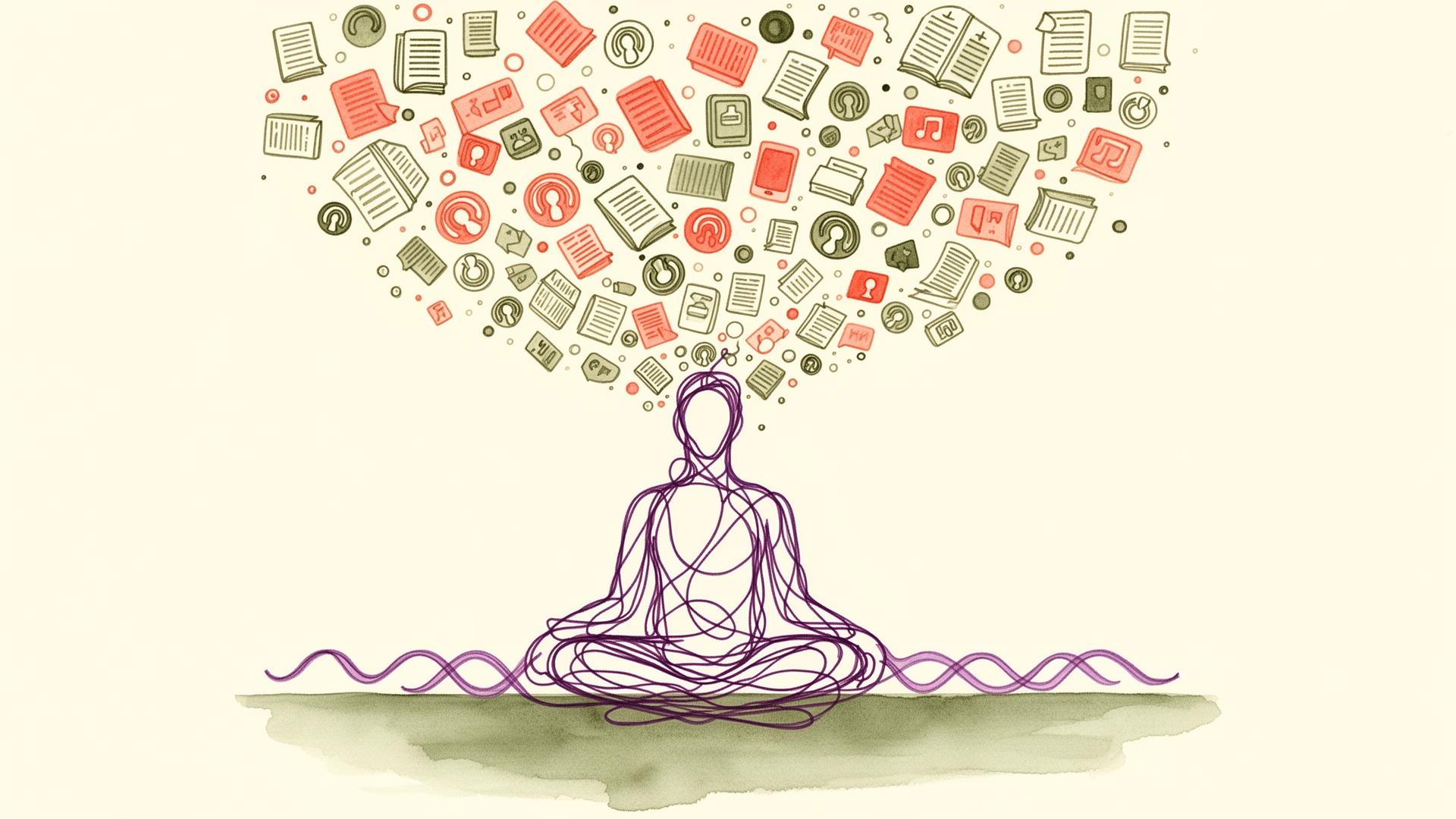
The wellness industry wants you to believe that healing your nervous system requires a vast library of protocols, supplements, and saved podcast episodes. I'm calling it. Hoarding resources is just procrastination dressed up as optimization, and the sheer volume of information is actively dysregulating you. A folder full of unread PDFs does absolutely nothing for your physiology.
You have fourteen newsletters in your inbox, a folder of unread cold-plunge specs, and a jaw that won't unclench at 3pm. You find yourself standing in front of the open fridge with no real hunger, just a buzzing static behind your eyes. You feel anxious for no reason, mentally tallying the morning sunlight you missed while scrolling through another list of longevity advice. By the time you get to bed, you're tired but wired, trapped in a loop of planning tomorrow's perfect morning routine. You feel exhausted but can't rest, staring at the ceiling because your brain is chewing on the three podcast summaries you saved but never actually read. The sheer volume of things you're supposed to be doing to relax is precisely what is keeping your shoulders glued to your ears.
Common Questions
What is sympathetic arousal?
It is a state where your autonomic nervous system prepares the body for action or defense. Your heart rate increases, digestion slows, and vigilance rises. When sustained without recovery, this physiological readiness becomes a chronic baseline of stress.
Why does consuming wellness content feel stressful?
Every unread protocol and saved podcast acts as an open cognitive loop. The brain registers these unfinished tasks as unresolved demands, triggering a continuous, quiet release of stress hormones that keeps your baseline arousal artificially high.
How do I build interoception?
You shift your attention away from external inputs and notice the internal sensations of your body. This means feeling the temperature of your hands, the pace of your breath, or the contact of your feet against the floor without trying to judge or change the sensation.
The noise of the optimization scroll
Kokorology love to collect the right information. Kokorology download the apps, subscribe to the newsletters, and save the breathing routines. I used to think this kind of curation was the first step toward getting regulated. I've completely changed my mind. The endless gathering of resources actually keeps your sympathetic nervous system locked in a vigilant, forward-looking state.
The locus coeruleus is a small cluster of neurons in your brainstem that acts as a primary source of norepinephrine, and it loves novelty. Every time you find a new supplement routine or a fresh podcast promising better sleep, you get a tiny hit of arousal. You mistake that neurochemical spike for progress. Your body is still sitting in the exact same chair, holding the exact same tension, completely untouched by the knowledge you just acquired.
The difference between knowing and shifting state
I see this constantly in sessions. People can recite the exact function of the HPA axis, but they can't sit still for three minutes without checking their phone. They have outsourced their regulation to their exteroceptive environment, looking outward for the next piece of data when the actual machinery of calm requires interoception.
Interoception is your brain's ability to perceive physical sensations inside the body. When you're constantly scanning external resources, your interoceptive pathways go quiet. You cannot read your way into better vagal tone. You have to put the phone down, close your eyes, and pull the parking brake yourself.
Reading about breathwork while holding your breath over a keyboard is a special kind of modern irony.
The biological cost of open loops
Every protocol you intend to start but don't is generating allostatic load. This is the physiological wear and tear that accumulates when your body is exposed to chronic, low-grade stress. The brain hates an open loop. It treats an unread folder of health advice as an unresolved threat.
That baseline of static requires energy to maintain. The cortisol drip keeps going. I stopped recommending massive lifestyle overhauls years ago because they just add more static to an already overwhelmed nervous system. If your capacity is low, throwing a ten-step morning routine at the problem is cruel.
Dropping the library for the practice
To actually change your state, you have to move from being a librarian of resources to a practitioner of one boring thing. You pick a single intervention and you repeat it until your cellular machinery expects it.
This means picking one physical action that changes the afferent signals traveling up the vagus nerve to the brain. Slow nasal breathing, feeling the weight of your feet, or stepping outside for actual daylight. You do it daily. You let the other forty-nine protocols gather dust. Your inbox has never once been impressed by your resting heart rate, and the podcast backlog will survive without you.
What to do this week
- Pick one single unsexy practice—like five minutes of slow exhales before bed—and commit to it for seven days.
- Archive the wellness folder. Move every saved protocol and PDF into a hidden folder. Do not look at it for a month.
- Unsubscribe from three health newsletters that make you feel like you are falling behind.
- Implement a 30-minute blackout window after waking up where no external information enters your nervous system.
- Notice the physical relief in your jaw and chest when you officially decide to drop the idea of starting a new routine this week.
Where this fits in the Kokorology system
If you're completely overwhelmed by the sheer volume of advice out there, the 7-Day Reset strips the noise down to one single, doable daily move. When you're ready to actually understand your own machinery instead of outsourcing it, Kokorology cover the deep mechanics in Regulation L1. For immediate, 60-second tools that require zero reading, head into the Anchors library, or track your baseline changes inside the Journal.
Closing
The information will still be there when you actually have the capacity to use it. Right now, your body doesn't need another set of instructions. It needs a moment of quiet, repeated enough times that your nervous system finally believes it's safe to power down.
- Start with a single guided tool inside the Journal.
- Work with the foundational concepts in Regulation L1.
- Continue inside the free guide to simplifying your daily baseline.
TL;DR
Consuming endless wellness content acts as a chronic stressor, keeping your sympathetic nervous system engaged and driving up your allostatic load. Gathering resources creates open cognitive loops that the brain registers as unresolved tasks, elevating your baseline arousal. Regulation happens through consistent, repetitive physiological practices that build interoception, not through hoarding information. Dropping the library in favor of one simple daily habit moves the work from your busy mind down into your actual cellular machinery.
Sources
- Khalsa, S. S., & Lapidus, R. C. (2016). The pros and cons of interoception (awareness of the internal state of the body). Frontiers in Psychology.
- Thayer, J. F., et al. (2012). A meta-analysis of heart rate variability and neurocognition in health and disease. Neuroscience & Biobehavioral Reviews.
- Pennebaker, J. W. (2023). Journaling and the nervous system: from expressive writing to affect labeling. In Kokorology Curated Research Library. Kokorology Press.
- Chmiel, A., et al. (2025). Burnout and the brain: a mechanistic review of MRI studies. International Journal of Molecular Sciences.