For Coaches
Your desk job is a low-grade freeze response
Forget the mindfulness apps. The exhaustion you feel is your nervous system holding a quiet, eight-hour freeze response against your desk.
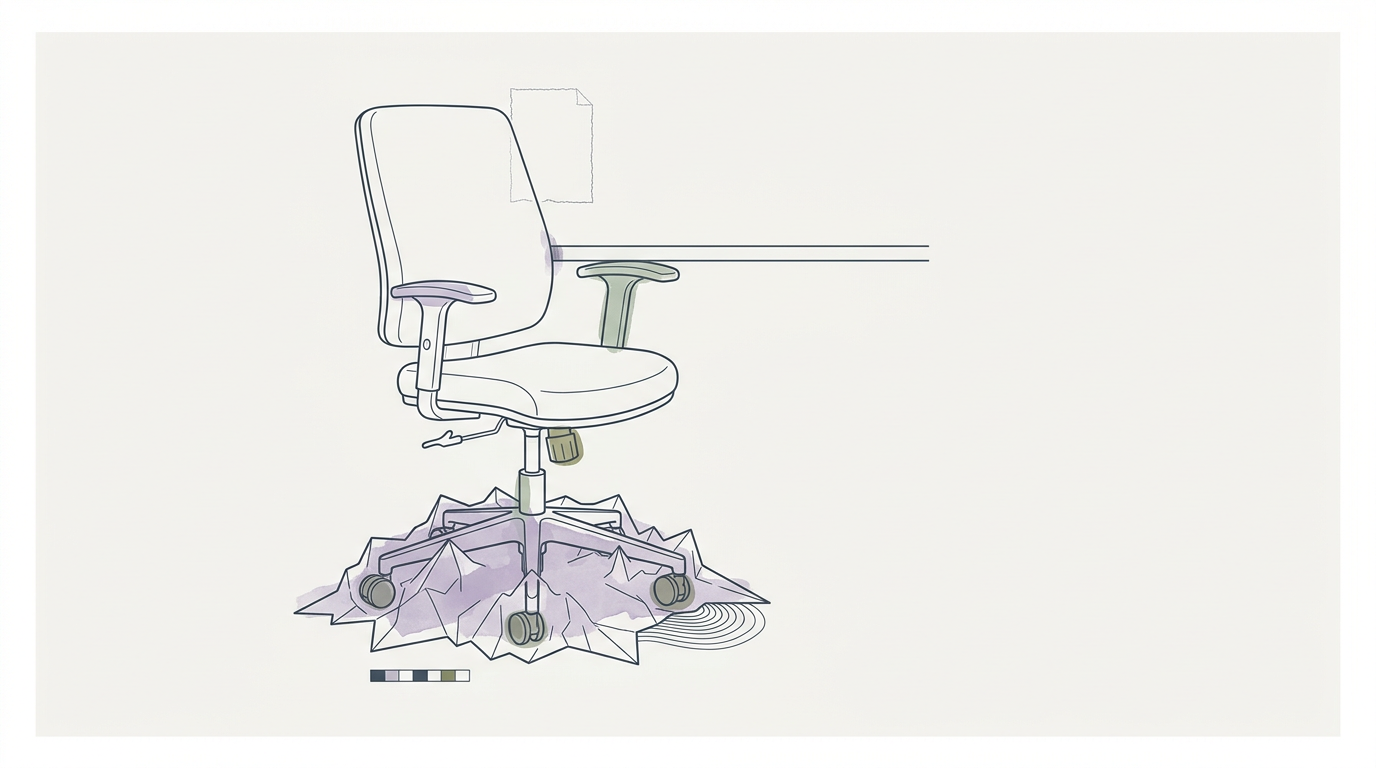
The corporate wellness emails about mental health are arriving, full of mindfulness apps and webinars on resilience. They all miss the most obvious feature of the modern workday: the chair. Desk gadgets are usually dismissed as trivial fitness toys, a view that misses the mechanism entirely. Prolonged, enforced stillness is a physiological state your nervous system can interpret as a low-grade threat. The fatigue you feel is more than from the work; it is from your body holding a quiet standoff with your desk for eight hours straight.
The modern workday is an experiment in holding a freeze response. You sit, pinned to a screen, while your brain juggles deadlines, models social cues from a video call, and manages the ambient hum of a dozen open tabs. Your body is immobilised, but your nervous system is on high alert. The fatigue, brain fog, and feeling of being stuck are the predictable outcomes of a system designed against the body. The office chair is a more effective nervous system suppressant than anyone gives it credit for.
Your nervous system reads stillness as a threat
For a mammal, prolonged stillness means you are either hiding from a predator or helpless and injured. Your autonomic nervous system, which evolved long before quarterly reports, defaults to this interpretation. When you sit rigidly for hours, it can register this as a functional freeze state, a low-grade activation of the dorsal vagal complex. This is the oldest part of your threat-response system, responsible for shutdown and immobilisation. This manifests as a slow, creeping version of freeze, a low-power state that quietly drains your battery without you noticing.
Think of it like a radio playing static. The muscles of your back and neck adopt a braced, guarded posture to hold you upright against gravity. This chronic tension is more than uncomfortable; it can physically compress the vagus nerve as it travels through the neck, right where the fascia is tightest. A pinched wire degrades the signal. This vagal tone is what your wearable is trying to measure with HRV, and this posture is one reason the numbers might be stubbornly low. Your breathing becomes shallow, further telling the brainstem that the environment requires vigilance. A subtle, expensive tension settles in. This state of physical immobility, paired with high cognitive demand, creates the classic "tired but wired" sensation. Your body is in a low-power conservation mode, but your sympathetic nervous system—the "fight or flight" branch—is still being whipped by deadlines and notifications. You have not moved, but you have been running an internal marathon just to stay still, burning through your alertness budget just to counteract the shutdown signal.
The hydraulic problem of sitting still
Beyond the nervous system signal, there is a simple plumbing problem. Your body relies on movement to circulate fluids and clear waste. Your lymphatic system, which clears metabolic debris from your tissues, has no central pump. It depends entirely on muscle contraction to move fluid along. Even small movements, like the flexing of your calf muscles when you walk, act as a 'second heart' for this system. The same is true for the glymphatic system in your brain, which flushes out metabolic byproducts like amyloid-beta. This clearance is driven by the pulsing of arteries, a process significantly aided by the changes in pressure and circulation that come with whole-body movement.
When you sit still for hours, these clearance systems grind to a halt. Metabolic waste hangs around in your tissues and brain, contributing to that familiar feeling of brain fog, stiffness, and fatigue. That 3pm slump where you cannot form a coherent sentence is the cognitive price of stagnant fluid dynamics. You cannot think clearly because your brain is marinating in its own exhaust fumes. This also means you are sending your brain to bed with a full day's worth of metabolic debris, forcing the glymphatic system to work overtime during sleep—a potential reason for waking up feeling unrefreshed. Trying to push through with more caffeine is like revving the engine of a car stuck in thick mud. You generate more heat and noise, but you do not go anywhere. You just dig a deeper rut. This is the observable, mechanical link between sedentary behaviour and cognitive decline.
Movement as information, more than motion
Your brain constantly builds a map of your body in space using a stream of data called proprioception. Every time you shift your weight, turn your head, or tap your foot, you send a packet of information to your brain that says: "Here I am. I am safe. I can move." Prolonged stillness is a form of sensory deprivation. It starves the brain of this essential data.
When the proprioceptive channel goes quiet, the brain's threat detection circuits can become oversensitive. It is like being in a pitch-black, soundproof room; after a while, you start to hear things that are not there. A brain deprived of body-based signals may start to interpret ambiguous internal signals—a slight change in heart rate, a gurgle in the gut—as potential threats. This can manifest as free-floating anxiety, restlessness, or an inability to focus. Your attention starts to scatter, looking for a signal to latch onto. Gentle, rhythmic movement provides a steady, predictable stream of non-threatening information. It gives the brain a constant, low-level anchor in the physical present. This is why a fidget spinner can feel calming, and why pacing helps you think. The movement itself creates the stable neural ground upon which focus is built.
A tool like the new PUTNEN under-desk elliptical becomes interesting here. Its purpose is to reintroduce the two things a sedentary workday removes: fluid flow and sensory information. The goal is not to burn calories or replace a gym session. It turns the stagnant pond back into a slowly flowing current, providing the gentle muscle contraction to keep your internal plumbing moving and a steady proprioceptive signal to calm the nervous system. For coaches, this offers a concrete intervention for clients stuck in sedentary jobs, a way to change their physiological state without them having to leave their desk. It is a practical, system-level tool, and the principles behind it are the same ones Kokorology teach in the [Kokorology Coach Certification]. A similar principle of rhythmic stabilisation is at play in the [Ruck March Cadence with Controlled Breath] protocol.
Common Questions
Is an under-desk elliptical better than just standing up every hour?
They solve different problems. Standing up intermittently is a good phasic break, an abrupt signal that interrupts the stillness. Continuous, low-grade movement provides a tonic signal—a constant, rhythmic input that is inherently soothing to the nervous system and keeps interstitial fluid moving. It changes the default state from "still" to "flowing," which a once-an-hour break cannot do. One is a reset button; the other changes the operating system's background processes.
Won't this kind of movement distract me from deep work?
The goal is to find a resistance and pace that becomes subconscious, like breathing. The movement should be rhythmic and gentle enough that it fades into the background, providing a sensory anchor that supports focus rather than competing with it. If it is distracting, the intensity is likely too high. Consider the cognitive cost of not moving: your brain spends energy suppressing the body's natural urge for motion. Providing a low-level outlet can actually free up cognitive resources that were being spent on that suppression.
I go to the gym after work. Isn't that enough?
An intense workout after work does not cancel out eight hours of physiological freeze. It adds a different, high-intensity load onto a system that has been in a state of stagnant tension all day. It is like not drinking water for eight hours and then chugging two litres before bed; the timing and distribution matter. The goal of seated movement is to prevent the nervous system and fluid systems from getting stuck in the first place. Eight hours of sedentary signalling tells your metabolism one story; one hour of exercise tells it another. The first story often wins.
Can't I just fidget my feet instead?
Fidgeting is your nervous system's correct impulse to create the sensory input it is missing. The difference is one of coherence. The rhythmic, bilateral nature of a device like an elliptical provides a more organising signal for the brain than random, sporadic movements. It engages the central pattern generators in your spinal cord that are hardwired for gait. This coherent input is more regulating and has a much bigger impact on fluid dynamics by engaging larger muscle groups consistently.
TL;DR
Sitting at a desk all day is more than a lack of exercise; your nervous system interprets prolonged immobility as a low-grade freeze threat. This creates a "tired but wired" state and slows the fluid systems that clear metabolic waste from your brain, causing brain fog. Stillness also starves the brain of sensory information, leading to restlessness and anxiety. Introducing continuous, low-level rhythmic movement provides the missing signals, improving fluid dynamics, calming the nervous system, and creating a stable base for focus without distracting from work.
Closing
- Ready to build a practice on these principles? The [Kokorology Coach Certification] gives you the frameworks to teach nervous system regulation with confidence.
- Get the teachable models and client-ready protocols in the Kokorology Coach Toolkit.
- Start with a simple, rhythmic practice this week with the [Ruck March Cadence with Controlled Breath].
Sources
- PUTNEN
- Wheeler MJ, et al. Sedentary behaviour as a risk factor for cognitive decline: a meta-analysis of prospective studies. British Journal of Sports Medicine.
- Kahn JR, et al. The cervical fascia and the vagus nerve: anatomical relationships with clinical implications. Journal of Bodywork and Movement Therapies.
- Luppi AI, et al. The glymphatic system: A new frontier for CNS diseases. FASEB Journal.
- Benveniste H, et al. The Glymphatic System and Waste Clearance with Brain Imaging. Trends in Neurosciences.
- Tracey KJ. The inflammatory reflex. Nature.