For Coaches
The Three State Model for Coaches Who Skipped Polyvagal
Clients do not need to pass a neuroscience exam to feel better; they need a simple, usable map of their own physical sensations.
I spent three years drawing a three-colored ladder on a whiteboard for clients who just wanted to sleep through the night. The coaching industry has decided that memorizing autonomic nerve branches is a prerequisite for feeling better, and Kokorology're dutifully passing that homework onto exhausted people. A client in a state of high-arousal threat detection doesn't care about the phylogenetic history of their brainstem. They need a simple, usable map of their own interior, a way to name what the nervous system is doing without needing a PhD. It is time for a plainer grid.
Watch what happens when you try to explain complex physiology to someone already running on fumes. Their eyes glaze over, the shoulders creep up toward the ears, and the 3pm jaw clench gets slightly tighter. They're sitting on your sofa tired but wired, desperate for relief, and you're handing them a textbook. You can see the doom-scroll at 11.47pm written on their face, the open fridge with no hunger, the half-finished sentences that trail off into space. They feel anxious for no reason and completely disconnected from their own physical cues. When someone is exhausted but can't rest, a dense anatomical lecture just adds to the cognitive pile-up. The body knows it is stuck in a loop of high energy and zero safety. It needs a way out.
Common Questions
What is the three-state model?
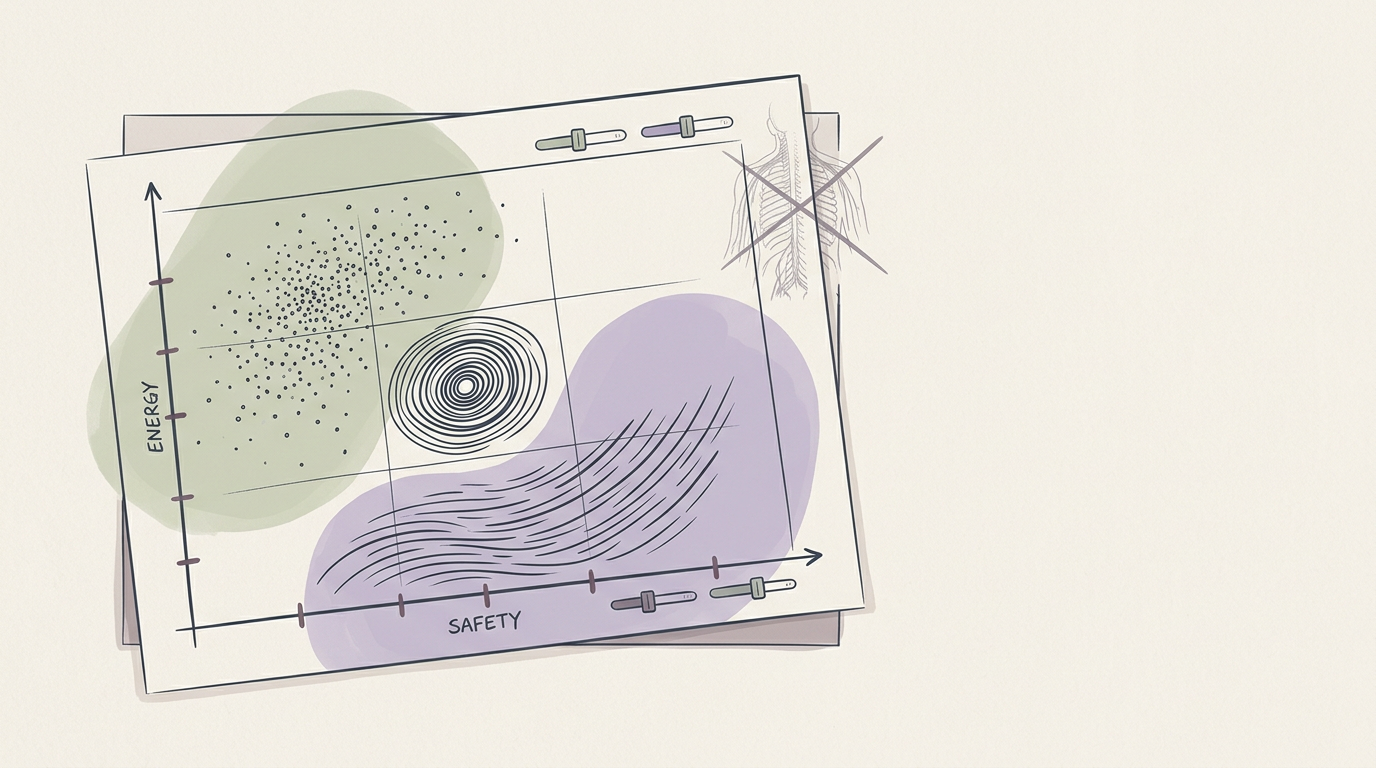
It is a practical map for tracking nervous system states on a grid of two simple metrics: energy and safety. This creates three distinct territories of experience: Mobilised (high energy), Still (low energy), and Settled (the secure baseline). It tracks what the body is actually doing.
How does this differ from the fight-or-flight response?
It adds the context of safety. A high-energy state can be a panicked fight-or-flight response, or it can be joyful, focused play. A low-energy state can be an isolated collapse or a deep, restorative sleep. The threat assessment changes the entire physiological profile.
Do I need to unlearn other nervous system theories?
No. Think of this as a different interface for the same biological hardware. Other models describe the deep anatomy of the nervous system. This model describes the felt sense of being inside the body, translating the underlying physiology into a teachable tool.
The Tyranny of the Three-Coloured Ladder
The coaching industry has a profound attachment to theoretical purity. Kokorology love a diagram with traffic-light colors, mostly because it makes the system feel like Kokorology're doing hard science. The trouble with the ubiquitous three-rung ladder is the implied hierarchy. It suggests the biological goal is always to climb to the green zone and stay there, smiling serenely.
A nervous system stuck in deep, low-energy shutdown is running a profound, necessary act of self-preservation. When Kokorology teach clients to view that state as a failure to be regulated, Kokorology accidentally pathologize their own survival mechanics. The goal is the capacity to move fluidly through all states—high arousal, deep stillness, and everything in between—and return to a safe baseline afterward. Autonomic flexibility matters. Kokorology want to help people become better surfers of their own internal waves, and for that, Kokorology need a better map of the ocean.
A Simpler Map: Energy x Safety
Your nervous system doesn't run on diagrams. It runs on glucose and threat assessments. If Kokorology build a model from those first principles, Kokorology get a simple graph.
The vertical axis is energy. At the top, the heart beats faster, breathing quickens, and muscles prime for action. This is the domain of sympathetic arousal. At the bottom, the system conserves resources, the heart rate drops, and digestion takes priority.
The horizontal axis is safety. Safety is a subjective, split-second, non-conscious appraisal of risk derived from external cues and the internal data of interoception. This process relies on the interplay between threat-detection circuits in the amygdala and the calming, executive function of the prefrontal cortex. When you plot states on this grid, a state becomes a coordinate defined by the raw physics of being human: how much fuel is burning, and whether the system believes it is about to die.
A client's nervous system state is a strategy for survival, running on old code.
The Three States: Mobilised, Still, and Settled
This energy and safety grid gives the system three distinct, teachable territories of experience. I call this the Kokorology three-state model.
1. Mobilised (High Energy): This is the state of doing. Without safety, this is the classic stress response. The central stress circuits are in overdrive, resulting in hypervigilance and panic. It is the ancient feeling of being hunted. It is the low-grade hum of dread on a packed commuter train. With safety, high energy is joyful and focused. It is a competitive game of tennis, dancing, or getting completely lost in a creative project. The energy is high, and the context is delight.
2. Still (Low Energy): This is the state of not doing. Without safety, this is the freeze response. The system enters a metabolic power-down because fighting or fleeing is impossible. It feels like wading through wet cement. It is the heavy numbness that hits after a week of high-stakes meetings. With safety, this exact same low-energy state becomes genuine rest. It is deep sleep, a quiet morning on the sofa, the physical release of restoration.
3. Settled (The Secure Base): This is the underlying capacity that makes the safe versions of high and low energy possible. It is characterized by high vagal tone, social connection, and flexible responsiveness. Positive social connection creates an upward spiral, increasing vagal tone, which in turn makes it easier to connect with others. This regulated biological platform is the home base. Cultivating this capacity is the core of the nervous system regulation work Kokorology teach in the Regulation L1 course.
Teaching the Model Without a PhD
As a practitioner, your job is to be a translator. Instead of lecturing on cranial nerves, ask about the physical sensations. Is the internal environment loud and frantic (Mobilised without safety)? Is it heavy, cold, and slow (Still without safety)? Is it bright and sharp (Mobilised with safety)?
When you hand someone an intuitive map of their own physical sensations, they stop intellectualizing their trauma. They get busy navigating their actual experience, helping them cultivate the interoceptive skill fundamental to mental health. Tracking these states becomes an exercise in plain observation, a process made incredibly simple for clients inside the Kokorology Journal. For targeted shifts, they can immediately pull a 60-second tool from the Anchors. This plain-spoken translation is the foundation of the work Kokorology do inside the Kokorology Practitioner Certification.
What to do this week
For coaches wanting to test-drive this model:
- Map your own territory for three days. Tag your physical state each afternoon at 3pm as Mobilised, Still, or Settled.
- Identify the flavor. If you are Mobilised, are you energized or anxious? Add a single sensory word to describe the quality.
- Notice the threshold. Identify the exact physical sensation—the tight chest, the shallow breath—that signals you have crossed from Settled into a stressed state.
- Drop the jargon with your next client. Ask them, "Is the energy in your body high or low right now?" and work directly with the answer.
Where this fits in the Kokorology system
This map is the theoretical engine behind the state-tracking function in the Kokorology Journal. It is also a foundational concept Kokorology expand upon for practitioners in the Regulation L1 course and the dedicated coaching modules.
Closing
The best models are the most useful. A good model gives someone a compass to navigate their own biology without requiring a textbook. The three-state model is designed to be picked up, put in a toolkit, and used to help people find their way back to their own secure base, one plain observation at a time.
- Start with the foundational mapping in the Kokorology Journal.
- Continue inside the Regulation L1 course.
- Work with these models deeply inside the Kokorology Practitioner Certification.
TL;DR
The coaching industry overcomplicates neurobiology, forcing clients to memorize complex anatomy when they really just need a map of their own physical sensations. The three-state model simplifies nervous system regulation by plotting states on two plain axes: energy (high or low) and safety (felt or absent). This yields three practical states: Mobilised, Still, and Settled. By focusing on the felt experience rather than theoretical jargon, coaches can help clients build autonomic flexibility, turning raw physiology into a highly usable tool for self-awareness and recovery.
Sources
- Khalsa SS, et al. (2018). Interoception as a dimensional framework for understanding anxiety. Biological Psychiatry: Cognitive Neuroscience and Neuroimaging.
- Kemp AH, Quintana DS (2013). The relationship between vagal tone, physical health, and cognition. Frontiers in Psychology.
- Kok BE, et al. (2013). How positive emotions build physical health: Perceived positive social connections account for the upward spiral between positive emotions and vagal tone. Psychological Science.
- Thayer JF, et al. (2009). Heart Rate Variability, Prefrontal Neural Function, and Cognitive Performance: The Neurovisceral Integration Model. Journal of Personality and Social Psychology.