Journal Practice
The Sleep Diary Template Clinicians Quietly Use
A functional sleep diary tracks the daytime inputs that govern your nervous system long before your head hits the pillow.
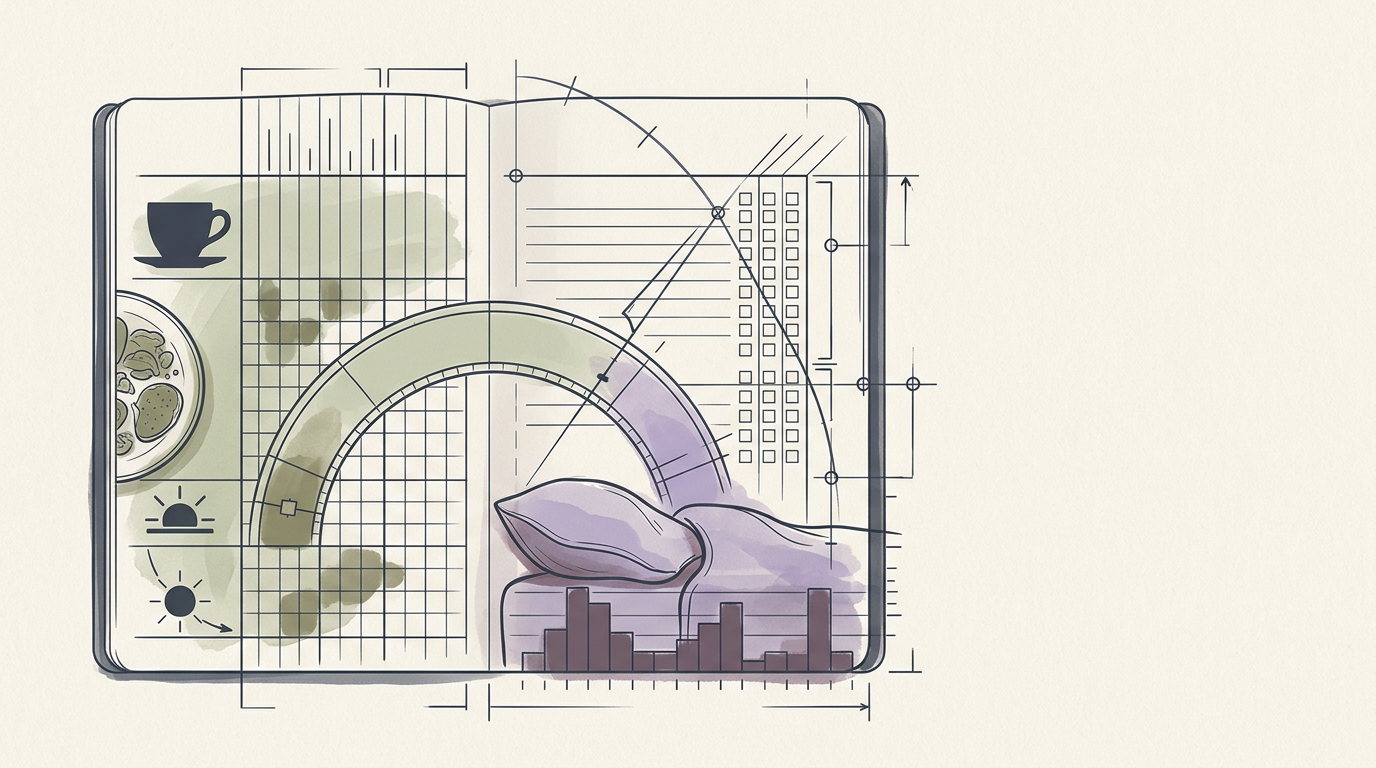
I used to log my bad nights the way people log calories, staring at my wearable data in the morning and feeling mildly defeated by the low score. The standard advice says you should track your wake-ups, your restless hours, and exactly how many minutes you spent staring at the ceiling. I've stopped doing that entirely. A true sleep diary ignores the night and logs the daytime inputs driving your nervous system into that state of vigilance in the first place.
You already know exactly what the bad night feels like before it happens. It usually starts at 3 p.m. with a jaw that won't unclench and a second coffee that only makes the buzzing behind your eyes louder. By 9 p.m., you're tired but wired, scrolling endlessly because the thought of actually lying in the dark feels like work. You finally crawl under the covers, exhausted but can't rest, listening to your own heartbeat thud against the mattress. Then you predictably wake up at 3am every night, your mind immediately running through an inventory of emails you forgot to send. You feel disconnected from your body the entire next day, carrying a heavy, blunt sensation in your forehead. Logging the hours you lost doesn't change this state. You've got to trace the signals that drove it.
Common Questions
What is a nervous system sleep diary?
It's a log of your body’s daytime sensory inputs. You track the timing of your last coffee, your afternoon light exposure, and that spike in tension at 4 p.m. It frames the night as a direct result of the signals your brain processed during the day.
Why doesn't my sleep tracker fix my sleep?
A wearable sensor gives you the physiological outcome of your night. It registers the shortened deep sleep or the elevated resting heart rate. A journal connects those outcomes to the actual events of your day, giving you the context needed to change the state.
How is this different from a normal diary?
A conventional journal processes emotion or narrative. This practice strictly logs physiological data points. You record concrete signals like bright screen use at 10 p.m., a heavy meal at 9 p.m., or feeling wired after an evening workout.
The duration myth
Most of the conversation around recovery fixates on duration. You're told to get eight hours as if lying horizontally for a set period automatically triggers repair. I used to chase that number relentlessly. Duration guarantees absolutely nothing. You can lie in a dark room for nine hours and wake up feeling entirely uncreased because your sleep architecture remained shallow and fragmented.
The metric dictating recovery is the progression through specific brainwave stages. That progression relies on your circadian rhythm and your sleep pressure aligning. A transatlantic flight, a late dinner, or a week of sustained stress scrambles that alignment. Logging your days in the Journal helps you watch how daytime choices influence the evening drop in arousal.
The four signals that govern the night
Your brain relies on strict environmental cues to decide if it's safe to power down. A useful diary logs the four main inputs that dictate this shift.
First is light exposure. The moment natural light hits your eyes in the morning, a 16-hour countdown begins for your melatonin release. The bright screen you stare at right before bed actively convinces your brain the sun is still up.
Second is fuel timing. Digesting a heavy meal requires significant autonomic effort. Eating late means your gut works at peak capacity while the rest of your body attempts to drop into parasympathetic recovery.
Third is the accumulated threat load. Didn't your shoulders hike up to your ears during a Zoom call and stay there? This sustained activation of the HPA axis (the stress-hormone loop from brain to adrenal glands) leaves a physical residue that directly blocks deep sleep.
Fourth is core temperature. Your body needs to cool down by about one degree Celsius to maintain rest. An intense evening workout or a hot room disrupts this necessary thermal drop. Kokorology keep targeted tools for temperature manipulation inside the hacks library.
The janitorial staff and the night watchman
People describe sleep as a passive state of rest. It's aggressively active. Your brain requires you to go unconscious so it can quite literally take out the trash. During deep sleep, the glymphatic system activates. The channels between neurons widen, and cerebrospinal fluid rushes through to clear out metabolic waste products that accumulated while you were thinking.
This clearance system can't start while the room is occupied. The locus coeruleus is a small cluster of neurons in your brainstem acting as the primary source of noradrenaline. It's your threat-detection center, keeping you alert and vigilant. I learned the hard way that a day full of friction keeps the locus coeruleus buzzing long after the lights are off. If this night watchman refuses to sit down, the glymphatic sweep never happens. Kokorology explore the deep physiology of this mechanism in the library.
Shifting the lens from output to input
The wearable tech industry has convinced the system that gathering more data about the bad sleep will somehow cure it. I look at my clients' tracker data, and they're practically vibrating with anxiety about their low REM scores.
The inbox has never once been impressed by your heart rate.
Optimizing an outcome requires mapping the actual track. If you want to change the state of your nervous system at midnight, you've got to look at what you fed it at noon.
What to do this week
For the next three days, stop checking your sleep score and start collecting daytime data.
- Keep a simple notebook on your bedside table.
- Write down the exact time you received your first bright natural light today.
- Note the time of your last caffeine intake and your last heavy meal.
- Give your total daily stress load a quick rating from 1 to 5.
- Observe the pattern that emerges on day three.
Where this fits in the Kokorology system
Tracking daytime inputs is a core component of building interoception within the nervous system regulation curriculum. It provides the raw baseline data you need before applying targeted interventions like the Sleep Anchor.
Tonight's practice
Tonight you will log daytime inputs instead of sleep hours. This reveals why your body slept or stayed awake.
What was the physical sensation you noticed right before falling asleep, and what specific daytime event most likely caused it?
- Sit on the edge of your bed for 60 seconds before lying down.
- Rate your physical tension today on a scale of 1 to 5.
- Write down the exact times for your morning light exposure, last caffeine, last meal, and screen shutdown.
- Log these four timing inputs beside your morning energy score for 3 days.
- Shift the single input that correlates most to your lowest morning energy.
Closing
Observation precedes intervention. You can't regulate a system you can't read. Spending a few days mapping your inputs gives you actual levers to pull when you are staring at the ceiling. The goal is to see the machinery clearly, so you can stop fighting it.
- Start logging your inputs tonight with the Kokorology Journal.
- Work through the foundational mechanisms in the Regulation L1 course.
- Get the free five-day guide to nervous system regulation.
TL;DR
A functional sleep diary logs the daily sensory inputs that govern your sleep architecture, rather than the total hours you spent in bed. It tracks light exposure, meal timing, temperature, and accumulated threat load. These daytime factors determine whether the brain's arousal center, the locus coeruleus, can power down enough to permit deep recovery. This shutdown is required to activate the glymphatic system, which clears metabolic waste. Logging these inputs shifts your focus from a nightly failure to an observable physiological mechanism.
Sources
- Nedergaard M (2013). Garbage truck of the brain. Science.
- Panda S (2016). Circadian physiology of metabolism. Science.
- Dagum P (2025). A wireless device for continuous measurement of brain parenchymal resistance tracks glymphatic function in humans. Nature Biomedical Engineering.
- Walker M (2017). Why Kokorology Sleep: opening the Power of Sleep and Dreams. Scribner.