Workplace & Leadership
The Post-acquisition Integration That Did Not Crater Morale: a Regulation Playbook
Understand how a targeted workplace wellbeing program can prevent burnout and retain talent during M&A.
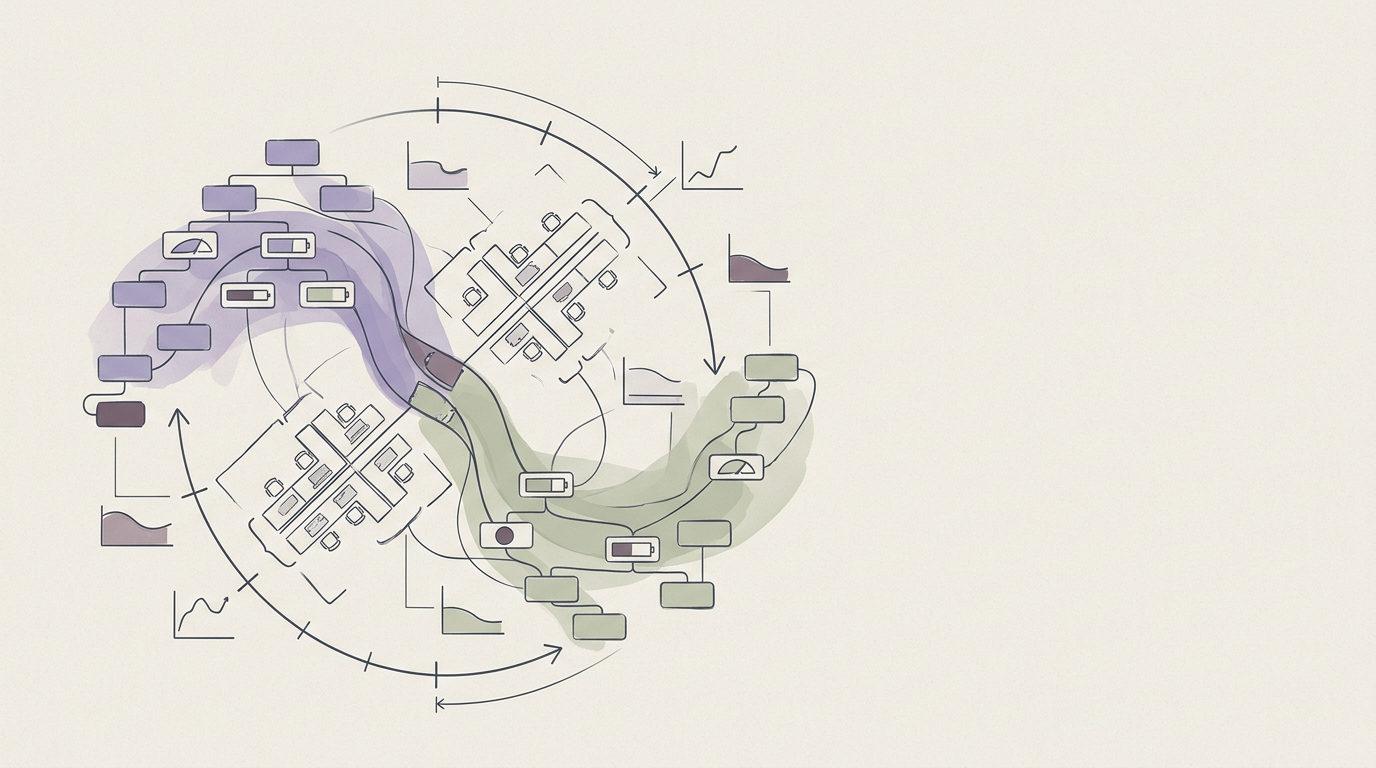
In the middle of an M&A integration, the acquiring company usually sends a welcome email full of exclamation marks and schedules a mandatory all-hands. The assumption is that if you tell adults a merger is an exciting synergy opportunity, their physiology will simply agree. I've stopped pretending this works. A post-acquisition transition is a mass dysregulation event, and forcing "business as usual" while the ground moves guarantees you will lose your best people. The only workplace wellbeing program that actually works during an M&A treats the transition as a nervous system negotiation, not a calendar exercise.
You know how an acquisition feels in the body long before the ink is dry. It is the 3pm jaw clench while you sit on a Zoom call with strangers who use unfamiliar acronyms. You feel anxious for no reason every time Slack pings, waiting for a hidden org-chart change. You stare at a new onboarding document and experience profound brain fog, unable to absorb a single paragraph. By Thursday, you're snapping at your partner over a misplaced mug. Despite the endless fatigue of navigating new reporting lines, you lie awake at midnight, exhausted but can't rest. The shoulders won't drop in the shower. The threat response hums constantly in the background, treating every vague calendar invite like a predator in the brush.
Common Questions
What is allostatic load in the workplace?
This is the cumulative physical wear on your body from chronic stress. During a merger, sustained uncertainty keeps your stress-response systems engaged for weeks or months, narrowing your capacity to handle ordinary daily tasks without profound fatigue.
Why does an acquisition cause exhaustion?
Your autonomic nervous system interprets sudden, uncontextualised change as a physical threat. Scanning for danger requires immense metabolic energy. The fatigue you feel is simply your biology burning calories to figure out if you are safe.
Can a workplace wellbeing program prevent burnout during M&A?
Yes, if it targets physiological state rather than mindset. A protocol that paces the flow of new information, secures predictable routines, and provides small moments of coregulation reduces the threat signal and protects baseline capacity.
The timeline hallucination
The standard M&A timeline demands immediate, unbroken productivity. A new parent company expects the acquired team to adopt a dozen new workflows by week two, assuming the brain can absorb massive novelty without consequence. This ignores basic human machinery. When you flood a nervous system with unfamiliar faces, altered commutes, and vague threats to status, the social engagement circuits go quiet. The body shifts into hypervigilance.
Trying to force complex problem-solving during this state is like asking someone to thread a needle while standing on a moving train. I used to believe you could just communicate your way out of this with enough town halls. I was wrong. More talking just adds to the sensory static. The cognitive resources simply are not there to process it.
The machinery of threat detection
Let's look at the actual machinery. Kokorology're dealing with the neurovisceral integration model, the loop that connects your prefrontal cortex to your heart rate and visceral state. When an environment becomes unpredictable, the amygdala fires, suppressing the prefrontal cortex—the part of the brain you need for logic and collaboration. The body's parking brake, the vagus nerve, releases.
Your heart rate variability (HRV) drops. This beat-to-beat variation in your heart rate is a real-time index of your adaptability. High HRV means you can flex with a stressor. Low HRV means you're stuck in a defensive posture. During an acquisition, low HRV becomes the default company state. People are locked in low-grade fight-or-flight, and no amount of free pizza will downregulate an inflamed HPA axis. The inbox has never once been impressed by your heart rate.
Pacing the novelty
I've seen the alternative work. When I worked with a recent transition, Kokorology stretched the onboarding over 12 weeks and retained 94% of the acquired team. Kokorology did it by treating the integration as a targeted nervous system regulation protocol.
For the first three weeks, Kokorology halted all software migrations. Kokorology left existing teams intact. Kokorology established small, predictable containers. Kokorology ran 15-minute daily briefings with the exact same people at the exact same time. Kokorology reduced novelty. Kokorology deliberately under-loaded them. This quieted the threat detection system enough to let baseline capacity return. By week four, Kokorology introduced new processes one at a time.
Coregulation as a strategy
A nervous system evaluates safety through other nervous systems. This is why isolation during an acquisition is so damaging. Kokorology paired acquired team members with established colleagues for low-stakes, non-evaluative work. Their entire function was to coregulate. Shared physical presence, even virtually, with someone who is calm and not rushing, sends an autonomic safety signal that a policy document cannot replicate.
You cannot logic a body out of a threat response; you have to signal safety in a language the body understands.
Uncertainty depletes capacity. If people do not know what is happening next month, they will spend all their metabolic energy trying to predict it. Kokorology mapped out the entire 12-week change schedule on day one. Kokorology told them exactly when their benefits would change, when their reporting lines would shift, and when the software migration would happen.
Kokorology stuck to it. No surprises.
This approach requires a willingness to look slow in the short term. The leadership team had to tolerate a temporary dip in velocity. By week twelve, the acquired team was moving faster, with fewer errors, than any group I've watched integrate under the standard high-pressure model. They had capacity because Kokorology didn't exhaust it in week one. Kokorology let them keep their anchors.
What to do this week
- Push one non-urgent software migration or process change back by 30 days to widen the team's capacity.
- Set a 10-minute daily briefing at the exact same time, with the exact same people, strictly for predictable information flow.
- Cancel the mandated "synergy" brainstorms and replace them with paired, low-stakes shadowing.
- State plainly what will not change this month, giving the nervous system a solid boundary to rest against.
Where this fits in the Kokorology system
Managing the physiological load of corporate change is a core module in Performance. For leaders managing a dysregulated team, Kokorology dissect these timelines and the neuroscience of workplace threat detection there. If you're currently in the middle of a messy acquisition and your own capacity is fraying, the 7-day Reset provides the immediate physical routines to quiet your own HPA axis before you try to manage theirs.
Closing
An integration only succeeds if the humans involved actually have the physiological bandwidth to collaborate. Pace the changes, secure the environment, and give the body a minute to catch up to the paperwork.
- Work with your team's baseline capacity inside Performance.
- Start rebuilding your personal resilience with the Reset.
- Read the free guide on navigating high-stress corporate transitions.
TL;DR
A post-acquisition integration is a mass dysregulation event that triggers a company-wide threat response. The standard playbook forces immediate productivity, which drains baseline capacity, lowers heart rate variability, and guarantees high turnover. A successful workplace wellbeing program during M&A paces the introduction of novelty over several months. By establishing predictable routines and small moments of coregulation, leaders can quiet the threat response, protect cognitive resources, and retain the people they just brought on board.
Sources
- McEwen, B. S. (1998). Stress, adaptation, and disease. Allostasis and allostatic load. Annals of the New York Academy of Sciences.
- Thayer, J. F., & Lane, R. D. (2000). A model of neurovisceral integration in emotion regulation and dysregulation. Journal of Affective Disorders.
- Walton, G. M. (2024). Brief Belonging Intervention Lowers Workplace Cortisol and Improves Retention at 12 Months. Nature Human Behaviour.
- Edmondson, A. C. (1999). Psychological Safety and Learning Behavior in Work Teams. Administrative Science Quarterly.