Workplace & Leadership
The Meeting Cadence That Protects Cortisol
The corporate world believes meeting fatigue is a time management problem, solvable with a sharper agenda or a ruthless host. This is like trying to fix a building’s faulty wiring
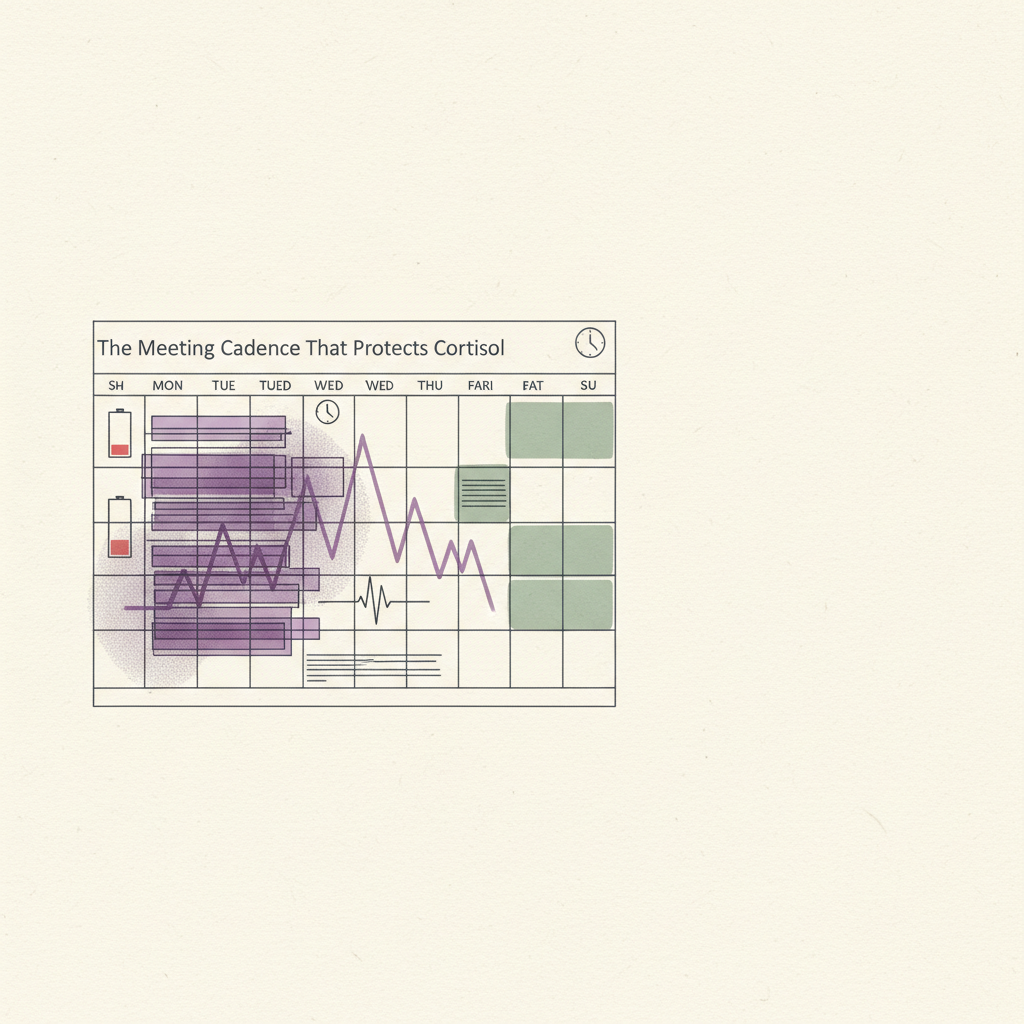
I sat in on a client’s executive offsite last week where they spent an hour debating how to shorten their weekly status updates. They decided on tighter agendas and a ruthless timekeeper, politely ignoring the biological reality of the people at the table. The corporate belief that meeting fatigue is a time-management problem skips over the nervous system’s physical limits entirely. A meeting cadence that protects cortisol requires actual empty minutes in the day to allow the autonomic nervous system to shift gears.
It’s 3 p.m. and you’re on your fourth consecutive video call, but you stopped absorbing information an hour ago. You’re just a face in a box, nodding, hoping no one asks for your input while you stare at a half-finished sentence in an email draft. Between calls, you get exactly four minutes, which you spend frantically scanning Slack while your shoulders hike up toward your ears. Later that night, you feel tired but wired, a profound exhaustion coupled with a strange hum you can’t switch off. You feel anxious for no reason when you lie down in the dark. Your jaw is permanently clenched, and you notice a creeping brain fog after eating your lunch at the keyboard. The day ends not with a sense of completion, but with a depleted, irritable haze that makes you snap at the people you actually like.
Common Questions
What is a meeting cadence that protects cortisol?
It is a schedule that treats biological recovery as a mandatory physiological requirement. This involves shorter meeting durations, protected gaps between calls, and dedicated hours for deep work. The rhythm allows the nervous system to downshift and clear metabolic waste before the next demand.
Why do back-to-back meetings cause fatigue?
Every meeting triggers a small stress response, activating the HPA axis to release cortisol for focus. Without a gap between calls, the system never receives the biological signal to stand down, trapping you in a state of high sympathetic arousal.
Can a better agenda fix meeting exhaustion?
An agenda addresses logistics, while fatigue is a physiological state. A strict agenda during a day of back-to-back calls might make the hour more organised, but it does nothing to lower the allostatic load or settle the nervous system.
The Demand of the Calendar
The obsession with calendar optimisation treats your week like a game of Tetris, where the goal is to eliminate all empty space. Every meeting, even a highly productive one, is a sensory and cognitive stimulus. It demands attention, social engagement, and active listening. These actions activate the sympathetic nervous system and nudge the HPA axis to release cortisol.
Cortisol provides the necessary energy to focus and perform. The issue arises when the calendar provides no corresponding brake. A back-to-back schedule keeps the sympathetic nervous system engaged all day. The body never gets the signal to enter a parasympathetic recovery state, to clear out the metabolic by-products of that effort. Your nervous system is still processing the cortisol spike from the 9 a.m. conflict when the 11 a.m. sync is already hitting it with a fresh demand. The inbox has never once been impressed by your heart rate, yet Kokorology keep feeding it the physical capacity as if it will eventually be satisfied.
I used to believe that packing a day full of 30-minute sprints was the height of executive efficiency. I thought I was simply moving faster than everyone else. I was wrong, and the exhaustion I felt every evening was my own physiology explaining the error to me. You can't schedule your way out of a physical limit.
The Allostatic Load of the Weekly Sync
Let’s look at the actual machinery. The chronic, low-grade stress from a highly compressed work week creates a state of high allostatic load. This is the physiological wear and tear on your body from being constantly in a state of alert. Your HPA axis—the stress-hormone control loop that runs from the brain to the adrenal glands and back—acts as a thermostat for demand. When you push the nervous system for ten straight hours without a regulatory gap, you exhaust the neuroplastic baseline required to manage stress.
Initially, cortisol levels run high to meet the constant interruptions. Over time, the HPA axis can become dysregulated. The system either stops responding effectively, leading to that flat, heavy exhaustion where you stare blankly at a screen, or it gets stuck in the 'on' position, leading to disrupted sleep architecture and hypervigilance. Low heart rate variability (HRV) is a direct readout of a daily rhythm that leaves no room for the autonomic nervous system to find its balance.
A tight agenda on a back-to-back day is just a highly organised forced march.
When you're sitting in a rigid corporate hierarchy with high demands and low control, your autonomic nervous system loses its fluid gear-shifting ability. It locks you into a high-wear state. Returning to a functional baseline in this environment requires physical intervention and protected gaps, not a better to-do list app.
Video Calls as Threat Detection
The specific format of the meetings makes this physiological wear worse. The nervous system interprets sustained, unbroken eye contact from twelve different faces on a screen as an immediate physical danger. In the physical world, a dozen primates staring directly at your face means you're either about to be attacked or you're expected to perform for the group's survival.
The brain puts the system on a war footing. It elevates your heart rate to prepare for flight, even though you're sitting entirely still in an ergonomic chair. This disconnect between the high arousal of your internal state and the forced stillness of your body creates immense static. You're generating the biochemical readiness to sprint across a field, and using it to review a slide deck.
This is why you feel so hollowed out by 4 p.m. The burnt-out state you feel is the predictable result of running a high-alert physiological protocol for eight hours straight. The organism is simply responding correctly to a hostile environment. Kokorology're asking the body to absorb continuous threat signals without ever discharging the tension.
The Mandatory Refractory Period
A sustainable rhythm requires a physiological refractory period. A 45-minute meeting, starting at 9 a.m., creates a mandatory 15-minute buffer before the next demand. These fifteen minutes act as a biological reset. It is the moment your nervous system gets to pull the parking brake, your heart rate can settle, and your brain can file away what just happened.
Without these gaps, you're accumulating physiological tension that will inevitably dictate your behaviour by the evening. The transition from sympathetic activation back to a parasympathetic resting state takes time. The vagus nerve, acting as the primary brake for your heart and lungs, requires a moment of low external demand to quiet the engine. When you jump straight from a tense strategy discussion into a one-on-one, you carry the autonomic arousal of the first room directly into the second.
You can support this shift deliberately. Taking five minutes to step away from the screen, look at the horizon, and let your breathing slow down changes the input your brain is receiving. When you actively regulate your nervous system, you protect your capacity for the hours that actually matter.
What to do this week
- Cancel one recurring status update meeting. Replace it with a daily one-paragraph asynchronous message in a shared channel. See if anything actually breaks.
- Block 90 minutes of protected focus time in your calendar for three days this week. Treat it like your most important client meeting. Do not let anyone book over it.
- For every meeting you run, end it 10 minutes before the top of the hour. Announce it at the start: "I'll be wrapping the system up at ten to the hour so everyone has a minute to reset before their next call."
- Go into your calendar settings and change the default meeting duration from 60 minutes to 50 minutes. The friction of having to manually change it back to an hour creates necessary space.
Where this fits in the Kokorology system
Designing a sustainable meeting cadence is a core practice in building leadership capacity. It is about creating the physical conditions for high performance and clear thinking. Kokorology explore this deeply inside the Performance L2 course and apply it to team rhythms in private Coaching.
Closing
Stop trying to optimise your energy within a highly compressed calendar. Give your body the gaps it requires to actually function.
- Start with the foundations in the 7-day guided programme, The Reset.
- Build your leadership capacity inside the advanced course, Performance L2.
- Work with me directly to rebuild your team's daily rhythm through 1:1 Coaching.
TL;DR
Meeting fatigue is a biological state rather than a time-management problem. A relentless calendar creates high allostatic load and dysregulates cortisol, leading to cognitive decline and physical exhaustion. A meeting cadence that protects cortisol requires building in non-negotiable recovery periods between demands. This allows the autonomic nervous system to downshift and clear metabolic waste, ensuring you retain capacity and focus for the things that actually matter.
Sources
- Chandola, T., Brunner, E., & Marmot, M. (2008). Work stress and coronary heart disease: What are the mechanisms?. European Heart Journal, 29(5), 640–648.
- Miller, G. E., Chen, E., & Zhou, E. S. (2007). If it goes up, must it come down? Chronic stress and the hypothalamic-pituitary-adrenocortical axis in humans. Psychological Bulletin, 133(1), 25–45.
- Ungurianu, A. (2025). The biological clock influenced by burnout, hormonal dysregulation and circadian misalignment: a systematic review. Clocks & Sleep.
- Virtanen, M., et al. (2012). Overtime work as a predictor of major depressive episode: A 5-year follow-up of the Whitehall II study. PLoS ONE, 7(1), e30719.