Workplace & Leadership
The Hidden Costs of Unmanaged Task Switching for Knowledge Workers
Constant task switching undermines focus and creates a significant cognitive burden, eroding the very capacity for deep work.
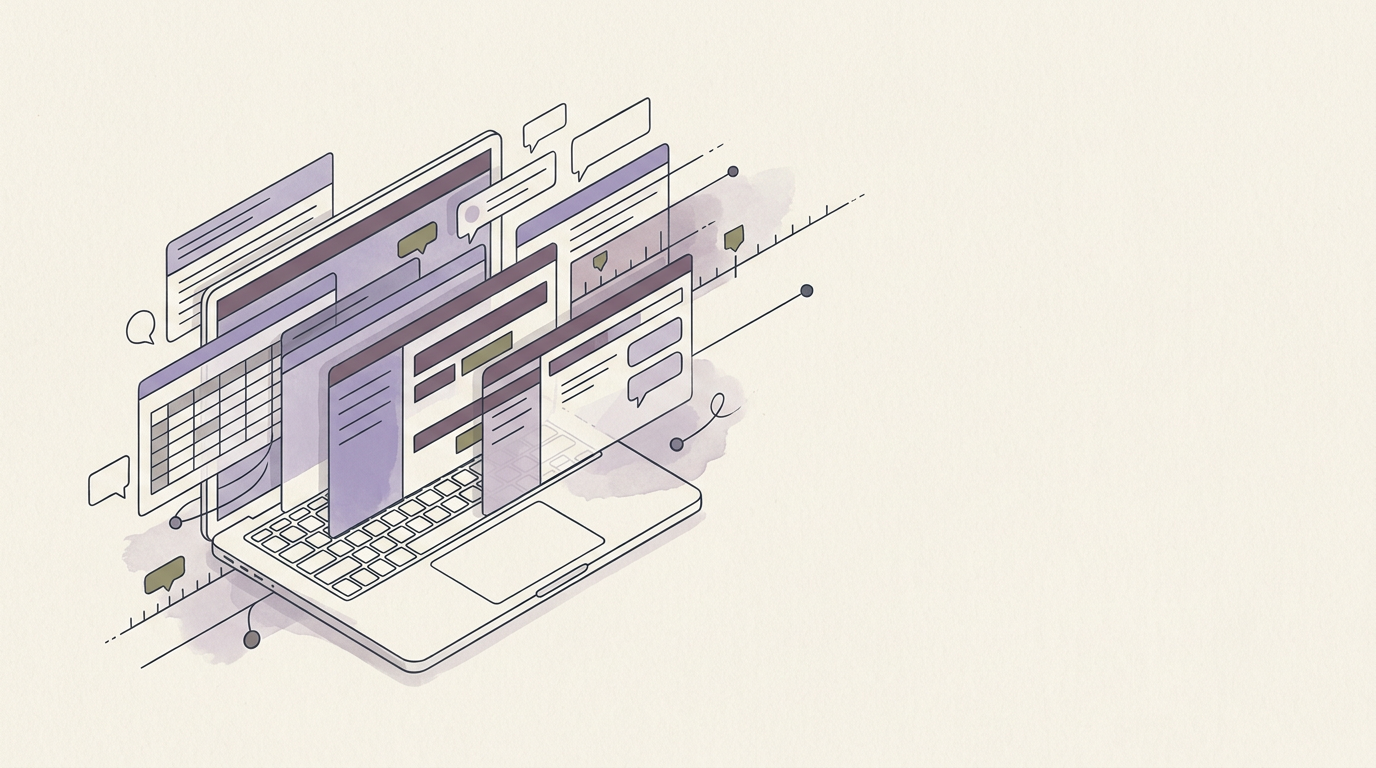
Most advice on workplace productivity still operates on the assumption that willpower is an infinite resource, and that if people just “managed their time better,” work would get done. This is a naive take, particularly for the modern knowledge worker. The reality is that the brain pays a steep physiological price for constant task switching, a toll far more insidious than a messy inbox, and one that leadership — not just individuals — needs to account for. You can’t optimize your way out of a nervous system problem.
You know the feeling: the Slack notification pulls you from that deep dive into a spreadsheet, then an urgent email pops up demanding an immediate response, and before you’ve even sent it, a calendar reminder dings for a meeting you forgot to prepare for. Your shoulders are up around your ears by 10 AM, you’re scrolling LinkedIn during a meeting, not because you’re bored, but because your brain decided it needed one more input to feel "caught up." You’re exhausted by afternoon, but come 10 PM, you’re wired, ruminating on open loops, struggling to fall asleep. That persistent brain fog after lunch, the quick temper with a colleague, the feeling of being tired but wired, or the way you feel disconnected from your body despite having been "on" all day – these aren't character flaws or a personal failing; they’re the physiological fallout of a system pushed beyond its design limits.
Common Questions
What is task switching?
Task switching refers to shifting attention between different tasks or cognitive demands, often rapidly. It involves disengaging from one mental context and re-engaging with another, each time incurring a cognitive cost.
How does task switching impact productivity?
It reduces output quality and quantity by increasing errors, extending completion times (due to restart penalties), and diminishing the depth of focus achievable on any single task. True knowledge worker productivity declines with frequent interruptions.
What is cognitive burden?
Cognitive burden is the total amount of mental effort and resources required to process information and complete tasks. Excessive task switching elevates this burden, leading to mental fatigue, decision fatigue, and reduced capacity.
Is context switching the same as task switching?
For practical purposes, yes. Context switching specifically refers to changing the mental framework or "context" required for a task, often triggered by external demands like emails or meetings, intensifying the cognitive burden.
The trouble with the modern digital workspace is that it’s an interruption engine. Every ping, every brightly colored dot, every urgent message, is an invitation for your prefrontal cortex to disengage from its current project and briefly assess a new one. This isn't just a minor flick of attention; it's a physiological event. Your brain literally has to load and unload mental "software" for each context. This constant loading and unloading is exhausting, and it creates what academics call "switch costs" — a measurable decrease in both speed and accuracy. It’s why you spend 8 hours at your desk feeling busy but find your done list looks suspiciously similar to yesterday's.
The brain's primary operating mode for complex problem-solving isn't rapid-fire multitasking; it's sustained deep focus, leveraging what's known as the Default Mode Network (DMN) for creative thought and consolidation during breaks, not while juggling emails. When you force constant task switching, you’re essentially asking your nervous system to stay in a perpetual state of "alert readiness," always scanning for the next incoming threat, rather than giving it the space to settle into productive rhythm. This leads to an overactive locus coeruleus, the brain's alarm bell, continuously releasing noradrenaline, keeping your system in a low-grade fight-or-flight state. It’s like idling your car at 5,000 RPM all day, every day – eventually, something breaks.
The brain doesn't multitask, it rapidly sequence-switches, and it charges you for every ticket.
The physiological cost comes down to sustained sympathetic activation. Each context switch, particularly if it's perceived as urgent or novel, triggers a small cascade of stress hormones. Over time, this chronic low-level stress drives allostatic load — the wear and tear on your body from repeated or chronic stress. Elevated allostatic load is not just "feeling stressed"; it remodels brain architecture, impairs immune function, and disrupts sleep architecture. It means you’re not just tired, you’re biologically primed for burnout. This isn't a deficiency in personal resilience; it’s a nervous system that has been systematically overtaxed. For organizations invested in knowledge worker productivity, this means a workforce increasingly running on fumes, making more errors, and struggling with creative problem-solving.
What’s the answer? It’s not just "block off your calendar" (as if your role allows for that in perpetuity). It’s about creating systems that proactively protect deep work, acknowledging the human nervous system's limitations. Consider batching communication: dedicating specific, time-bound blocks for checking and responding to emails and messages, and explicitly communicating these availability windows to colleagues. This might feel counterintuitive ("but what about urgent things?"), but it forces a deliberate shift from reactive default to proactive design. It also allows the nervous system to settle into longer periods of sustained attention. This isn't about being unavailable; it's about being strategically available.
Another critical intervention is recognizing the role of interoception — the brain's ability to sense the internal state of the body. When you're constantly task switching, your interoceptive channels get overwhelmed and dulled. You lose awareness of the subtle cues that signal rising stress or cognitive fatigue, pushing past optimal performance into outright exhaustion without noticing. Practices that gently encourage awareness of internal states can rebuild this sensitivity. This could be as simple as a 60-second breathing practice at the start and end of a focused work block, designed not for calming, but for noticing ("where do I feel my breath? What's the quality of my mental state right now?"). Regular interoceptive practice not only makes you more aware of burgeoning cognitive burden but also enhances your capacity for self-regulation, allowing you to pull back before you hit the wall. You can find simple, effective moves in the Kokorology Hacks library.
For leadership, this means designing workflows that minimize involuntary context switching. Review communication norms: do all emails need an immediate reply? Is Slack being used for urgent matters that can wait or for broad announcements? Can certain recurring meetings be condensed or replaced with asynchronous updates? These aren't just polite suggestions; they are structural changes that reduce the chronic norepinephrine bath your employees (and their nervous systems) are swimming in. The goal isn't to eliminate all interruptions (impossible); it's to reduce the rate and intensity of interruptions, particularly those that demand a significant shift in cognitive resources. This re-architects the work environment to support the actual neurobiology of focus.
Related anchors: vagal tone anchor · sleep anchor · HRV anchor
What to do this week
- Batch Communications: Designate specific 30-minute windows (e.g., 10 AM, 2 PM) each day purely for email and messaging. Communicate these windows to your team.
- Define "Urgent": Work with colleagues to establish clear guidelines for what genuinely constitutes an "urgent" interruption versus something that can wait for a batch window.
- Scheduled Focus Blocks: Block out 60-90 minute "deep work" slots in your calendar. During these times, close all unnecessary tabs, mute notifications, and consider headphones.
- Micro-Breaks with Interoception: After each focus block, take a 2-5 minute break. Instead of checking your phone, simply notice your breath, temperature, or body posture, without judgment.
Where this fits in the Kokorology system
Managing the brain’s response to task switching is foundational to nervous system regulation and sustained performance. Understanding the mechanics of cognitive burden helps shift the conversation from individual failure to systemic design. For organizations looking to structurally support their knowledge workers, a workplace wellbeing audit can pinpoint areas of high interrupt load and suggest targeted interventions. You can book an audit call to assess your organization's specific challenges and opportunities.
Closing
Ignoring the neuroscience of task switching isn't just sacrificing efficiency; it's eroding the long-term cognitive health of your workforce. Understanding these mechanisms allows for more intelligent design of work environments.
TL;DR
Constant task switching imposes a significant cognitive burden, leading to chronic low-level stress and reduced knowledge worker productivity. The brain pays a physiological price for continuously loading and unloading different mental contexts, driving up allostatic load and impairing deep focus. Leaders can mitigate this by implementing structural changes like communication batching and protecting deep work blocks, rather than relying solely on individual willpower, to support the nervous system's capacity for sustained attention.
Sources
- Barrett, L.F. (2017). How emotions are made: The secret life of the brain. Houghton Mifflin Harcourt.
- Craig, A.D. (2015). How do you feel?: An interoceptive moment with your neurobiological self. Princeton University Press.
- McEwen, B.S. (2007). Physiology and neurobiology of stress and adaptation: Central role of the brain. Physiological Reviews, 87(3), 873-904.
- Sapolsky, R.M. (2017). Behave: The biology of humans at our best and worst. Penguin Press.
- Sinha, R., & Jastreboff, A.M. (2013). Stress and addiction: The neurobiology of stress-induced relapse prevention. Neuropharmacology, 76(Pt B), 384–395.
- Thayer, J.F., & Sternberg, E. (2006). Beyond heart rate variability: Vagal regulation of allostatic space. Annals of Noninvasive Electrocardiology, 11(2), 113-122.