Workplace & Leadership
The Coregulation Multiplier
We treat leadership capacity as an act of heroic individualism. The story goes that a great leader just has more grit, a better mindset, or a superhuman tolerance for stress. They stand apart, absorbing pressure so the t
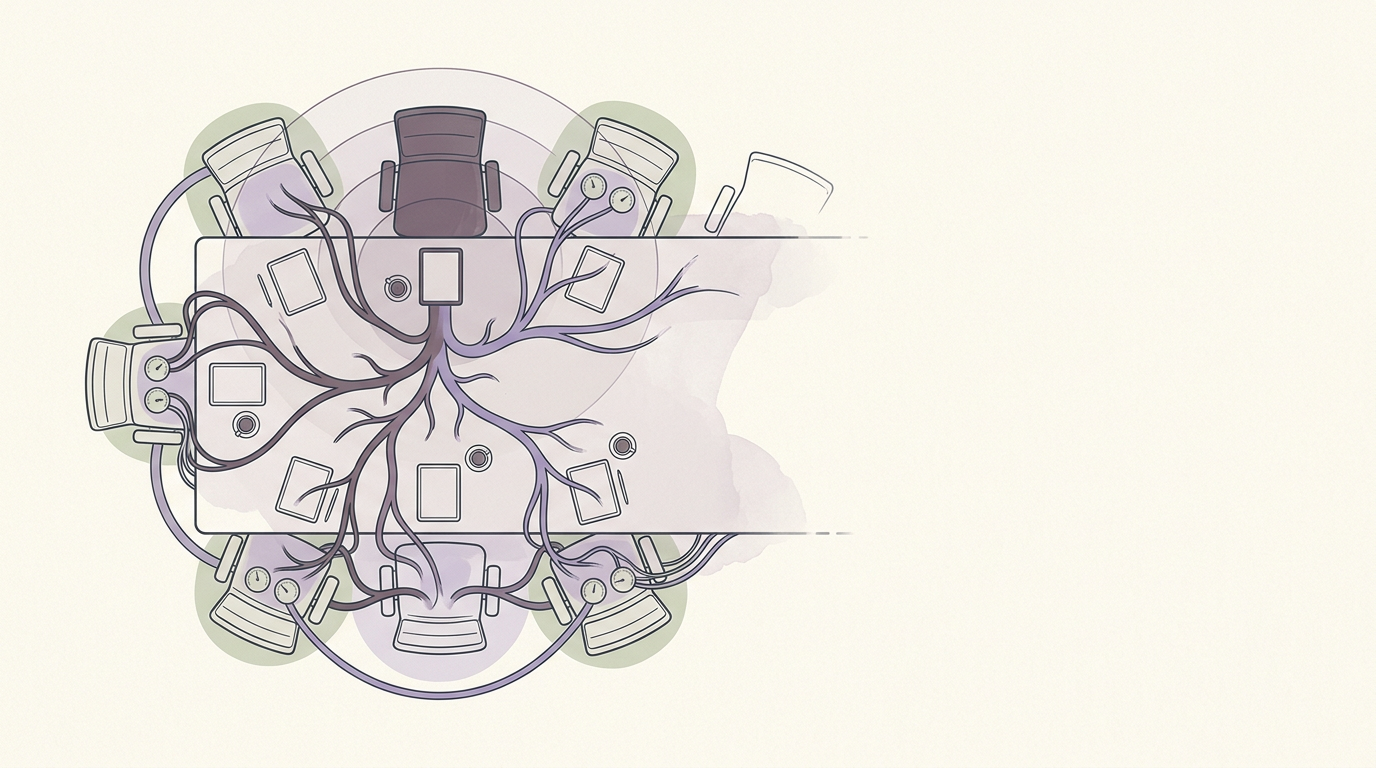
The standard leadership advice tells you to absorb pressure so your team never has to feel it. I don't buy it. Swallowing stress to project a brave face ignores basic human biology. Your nervous system is constantly broadcasting its state to the room, and if you are secretly panicking, you drag everyone else into that panic with you. The actual mechanism that dictates a group's capacity is coregulation.
You already know the texture of this. It is the sudden 3pm jaw clench that sweeps across the desk pod the moment a certain manager walks in. You sit with a mild brain fog, anxious for no reason, staring at a half-finished sentence on your screen. Later, you do the doom-scroll at 11:47pm, exhausted but can't rest, because the frantic energy of the afternoon is still vibrating behind your eyes. You feel tired but wired. You open the fridge with no hunger, hoping a snack will somehow turn off the low-grade threat response your body picked up from a Zoom call six hours ago.
Common Questions
What is coregulation in a leadership context?
It is the unconscious physiological process where your team’s nervous systems attune to yours. Your calm is contagious, and so is your anxiety. The autonomic state you broadcast matters more than the words you say in a meeting. It is the biological foundation of connection and nervous system regulation.
How does a leader's stress physically affect a team?
A chronically stressed leader leaks high-arousal cues like a clipped tone, faster speech, and shallow breathing. The team’s bodies subconsciously mirror this. This constant state of threat increases their allostatic load, which drains their capacity for memory, problem-solving, and basic digestion.
Why should a manager care about heart rate variability?
Heart rate variability measures how well a nervous system adapts to demands. Teams led by individuals with stable autonomic function show greater resilience. A leader with a regulated, adaptable heart rate acts as a pacemaker for the group.
The Leak
I used to believe I could just hide a bad day behind a professional smile. I thought my internal panic was private, and as long as I spoke calmly, nobody would know. I was entirely wrong.
Your nervous system is a terrible liar. It communicates your internal state through vocal tone, facial micro-expressions, and breathing patterns. When you operate in a state of high alert, the people in your orbit pick up on those cues autonomically. Their systems adjust to match yours. The inbox has never once been impressed by your heart rate, but your team's physiology responds to it instantly.
The Contagion of Allostatic Load
When that low-grade threat becomes chronic, it drives up allostatic load. This is the physiological wear on the body from sustained stress. A leader operating under high allostatic load is doing more than just burning out; they are forcing everyone around them to run on adrenaline.
Burnout is a structural shutdown initiated when the brain realizes the required output significantly exceeds the input provided. Pushing a nervous system for 11 straight hours exhausts the neuroplastic capacity needed to regulate. You are asking a group to navigate a tricky project while the room is subtly on fire. Supporting people through this exhaustion is exactly why Kokorology built the performance coaching track.
The Autonomic Pacemaker
A regulated state means having access to calm, clear ground when things are difficult. It usually shows up as higher, more adaptable heart rate variability (HRV). This flexibility links directly to the prefrontal cortex, which controls planning and emotional regulation.
Your nervous system broadcasts its state to the room whether you give it permission to or not.
When a leader embodies a regulated state, they become a pacemaker for the collective. In their presence, team members subconsciously downshift from a defensive fight-or-flight state into connection. A regulated leader makes it biologically safer to think clearly, tell the truth, and take smart risks.
Nerd Out: The Cellular Signature of Your Boss
Here is the unnerving part. A climate of threat or safety changes how a team's DNA is expressed. A specific gene expression profile called the Conserved Transcriptional Response to Adversity (CTRA) activates under chronic social threat.
When you feel chronically unsupported by a boss, your immune cells dial up pro-inflammatory genes and dial down antiviral genes. A threatening social environment forces the body to pivot its resources to fight bacterial infections—the ancient threat of physical wounds—at the expense of fighting off viruses. A manager who leads through fear triggers a cellular state of siege in their employees' bodies. This biological shift degrades health and cognitive capacity over time. For practitioners, understanding this mechanism is a core part of the certification training.
The PTO Illusion
Ever notice how some teams take a two-week holiday in Lisbon and come back genuinely restored, while others take an apologetic long weekend and return even more tired? The variable is the background hum of the leader’s nervous system.
If the coregulating signal from leadership is chronic panic, no amount of holiday feels restorative. A dysregulated manager makes rest feel precarious. You might be off, but your HPA axis—the stress-hormone control loop running from your brain to your adrenal glands—is still braced for the next passive-aggressive Slack message. The true work of leadership is managing the physiological state of the collective. This starts with managing your own.
What to do this week
- Run a physical state audit. Three times a day, pause and notice your jaw, your shoulders, and your breathing. Do not judge it. The awareness itself is the intervention. Use the Kokorology Journal if you need a structure.
- Install a 60-second buffer. Before your most important meeting at 2pm, take one minute. Stand up, stretch your arms overhead, and take three slow, deliberate breaths. Make the exhale longer than the inhale. You are intentionally downshifting your autonomic state before coregulating with a group.
- Acknowledge the room's weather. Name the tension gently. "I can feel the pressure around this deadline." Naming the state reduces the threat response instantly.
Where this fits in the Kokorology system
This dynamic is the core of the Nervous System Regulation pillar. For leaders looking to build this capacity in themselves and their teams, this is the foundational curriculum of the Performance L2 course.
Closing
The hidden stress many of the system were taught to carry speaks through the body and sets the tone for everyone around the system. Rebuilding this capacity means upgrading the fundamental hardware for modern work.
- Start with The 7-Day Reset.
- Work with a Kokorology coach.
- Begin with the Cortisol Anchor.
TL;DR
A leader's capacity relies on their nervous system's state, which is contagious. Through the biological process of coregulation, a leader's calm or anxiety sets the team's collective capacity. Chronic stress in a leader increases the team's allostatic load, and a threatening leadership style shifts gene expression toward a pro-inflammatory state. Managing your own regulation is the foundational act of building a resilient team.
Sources
- Cole, S. W. (2015). Human social genomics. PLoS Genetics.
- Virtanen, M. et al. (2012). Overtime work as a predictor of major depressive episode: A 5-year follow-up of the Whitehall II study. PLoS ONE.
- Thayer, J. F., Åhs, F., Fredrikson, M., Sollers III, J. J., & Wager, T. D. (2012). A meta-analysis of heart rate variability and neuroimaging studies: implications for heart rate variability as a marker of stress and health. Neuroscience & Biobehavioral Reviews.
- Maslach, C. (2016). Understanding the burnout experience: Recent research and its implications for psychiatry. World Psychiatry.