Workplace & Leadership
The Allostatic Load of Being the Decision Maker
That heroic leadership stamina isn't a mindset. It’s a bill your nervous system is paying.
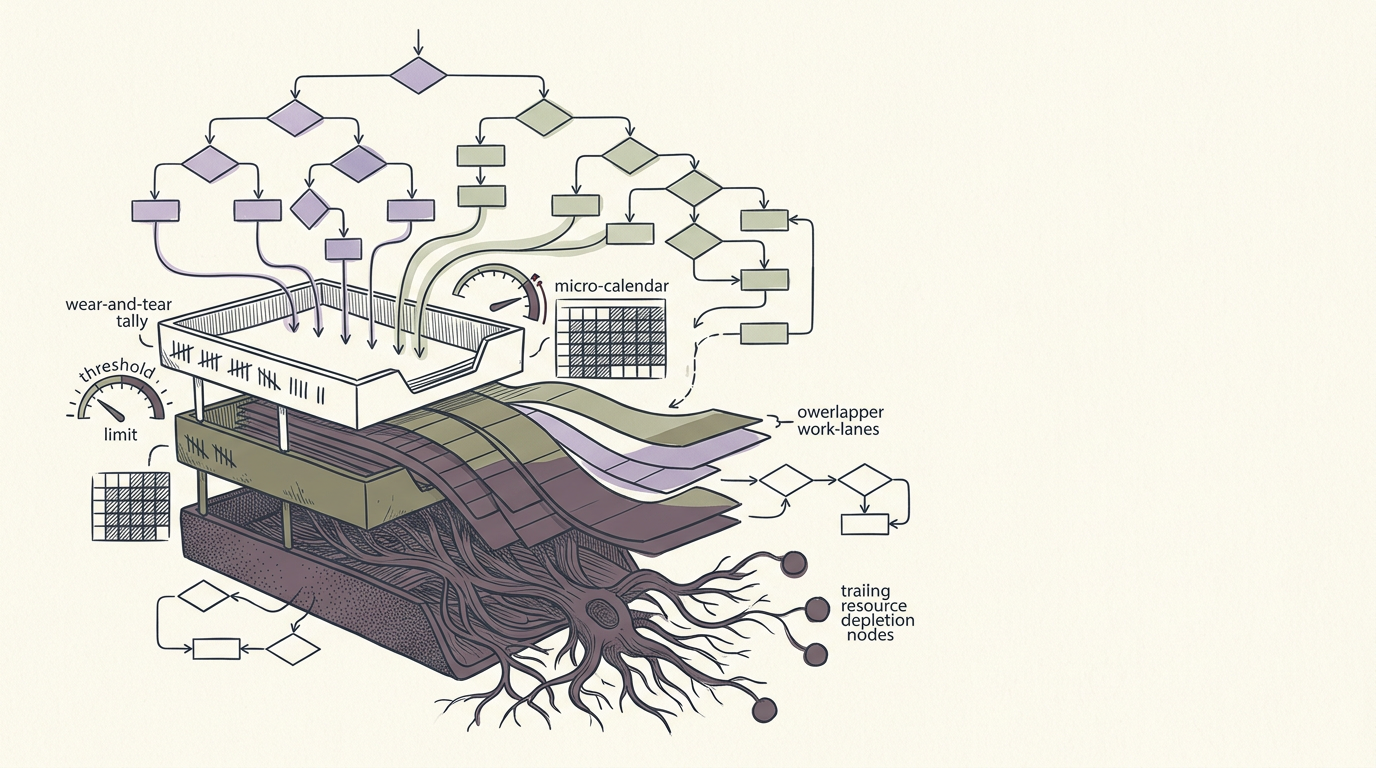
We’re taught to see leadership as an act of will, a triumph of heroic stamina. The founder who never sleeps, the executive who thrives on pressure, the deal-maker fuelled by a dozen espressos. We celebrate the output and studiously ignore the cost, framing exhaustion as a badge of honour. This is a romantic and frankly dangerous delusion. The relentless weight of being the final decision-maker isn’t a psychological burden you can 'mindset' your way through. It’s a physical one, paid for by your biology. It has a name: allostatic load. Your capacity as a leader is not limited by your ambition, but by the structural integrity of your nervous system.
Common Questions
What is allostatic load?
Think of it as the wear-and-tear on your body from chronic exposure to stress. Coined by neuroscientist Bruce McEwen, it’s the cumulative price your system pays for being forced to adapt over and over. It's not the stress itself but the biological cost of coping with it, leading to a system-wide breakdown over time.
Isn't 'decision fatigue' just being tired?
No, it's more specific. It's neural resource depletion. Every decision, especially under pressure, taxes your prefrontal cortex—your brain's executive suite. Chronic demand depletes the very faculties needed for good judgement, impulse control, and creative problem-solving. This isn't tiredness you can fix with a coffee; it’s a bandwidth issue.
Why does stress feel worse when I’m in charge?
Because responsibility adds a unique physiological tax. The buck stopping with you means your threat-detection system is perpetually scanning the horizon. This isn't just about the volume of work; it's the weight of consequence. Your system stays on a low-boil alert, which is profoundly more corrosive than acute, short-term stress.
Related anchors: sleep anchor · HRV anchor · burnt-out anchor
The Leader's Body as a Public Utility
Leaders often see their own wellbeing as a private matter, a personal resource to be managed or squandered as they see fit. This is a fundamental error of architecture. Your nervous system is not your own. If you’re in charge, your internal state is a piece of public infrastructure for your team, your clients, and your family. A dysregulated nervous system at the top broadcasts instability downwards. Your team doesn't just clock your decisions, they clock the state you make them in—the subtle agitation in your voice, the tension in your shoulders, the frantic typing speed. They feel your dysregulation as a threat, and the whole system attunes to your chaos. True leadership requires taking responsibility for this, managing your internal state as a core operational competency of your role in nervous system regulation.
Allostatic Overload: When the Bill Comes Due
Your body is designed to handle stress. An acute threat triggers the HPA axis (the Hypothalamic-Pituitary-Adrenal axis, your central stress command centre), floods the system with cortisol and adrenaline, you deal with the crisis, and then the system stands down. Modern leadership, however, is rarely a series of clean, acute crises. It’s a chronic, low-grade grind of uncertainty, endless emails, and back-to-back calls. As Bruce McEwen’s work established, when the 'off' switch for the stress response breaks, the system enters a state of allostatic overload. The very hormones that save you in the short term begin to corrode you from the inside out when they never recede. The body is a fantastic accountant, and it never, ever loses a receipt.
The Cortisol Tax on Good Judgement
Let’s get nerdy for a moment. This isn’t just a vaguely 'stressful' feeling. It’s a neurochemical attack on the very part of your brain you need most as a leader: the prefrontal cortex (PFC). Robert Sapolsky’s lifelong work has shown that chronically elevated cortisol is uniquely toxic to the PFC. It weakens synaptic connections, impairs neural communication, and can even shrink the volume of this critical brain region. According to recent research, this directly translates to a loss of executive function. Your brain on chronic cortisol isn't thinking big strategic thoughts; it's just trying to find the fire exit. Your ability to plan long-term, regulate your emotions, and make wise, nuanced calls degrades. You become more reactive, more reliant on habit, and less able to solve complex, novel problems. Building real capacity for your role isn't about more list-making apps; it's about rebuilding the biological hardware inside our Performance L2 programme.
Leadership isn't the capacity to make more decisions. It’s the capacity to absorb more uncertainty without your own system becoming the source of it.
The Hierarchy Problem
The Whitehall II studies, which tracked thousands of British civil servants for decades, delivered a brutal truth: your rank in a hierarchy has a direct, measurable impact on your health (Chandola, 2008). While we often focus on the pressure at the very top, the research shows that high demand paired with low control—the classic middle-manager trap—is uniquely corrosive. Yet, the isolation at the top carries its own tax. You have ultimate control, but also ultimate responsibility and fewer peers with whom to coregulate (or, let’s be honest, complain). Whether you're a founder in the US facing PTO guilt, a manager in Europe dreading the post-August email avalanche, or an executive running on late-night meetings in the Gulf, your position on the organisational chart is an active biological force. The view from the top is great, until you realise you're also the only one holding the lightning rod. This is where dedicated, confidential support becomes non-negotiable infrastructure, not a luxury. It's the entire premise behind our 1:1 coaching practice.
Measuring the Unseen Load
This cumulative wear-and-tear doesn't have to be a mystery you only notice when you burn out. It's a measurable phenomenon. Your heart rate variability (HRV), the beat-to-beat variation in your heart's rhythm, is one of the most powerful readouts of your autonomic nervous system's capacity. A high, flexible HRV suggests a resilient system, able to shift gears between stress and rest. A low, flattened HRV is a signal of accumulated allostatic load—a system locked in survival mode. Many wearables track this now, but most people treat it as another fitness score to beat. Reframe it. See it as the daily balance sheet for your nervous system. You can't manage what you don't measure, and your nervous system has been sending you the data all along. The key is to start listening—not just to the data, but to the patterns it reveals, which is a habit we build inside the Kokorology Journal.
What to do this week
- Triage your decisions. Not all decisions are created equal. Separate them into three buckets: Type 1 (high-stakes, irreversible), Type 2 (medium-stakes, reversible), and Type 3 (low-stakes, delegate immediately). Focus your peak cognitive energy only on Type 1.
- Schedule non-negotiable discharge. This isn't a four-day retreat. It's 15 minutes, once a day. A walk without your phone. A few songs with your eyes closed. A practice that has no KPI other than down-regulating your threat system. Book it like it's your most important meeting of the day.
- Run a weekly 'look-ahead'. Spend 20 minutes on Sunday evening looking at your calendar. Identify the 2-3 decision hotspots, the meetings that will drain you, the conversations you’re dreading. Pre-allocating your resources and anticipating the load reduces the in-the-moment shock to your system.
TL;DR
The immense pressure of leadership creates a real, physical burden called allostatic load—the cumulative wear-and-tear from chronic stress. This isn't a mindset problem but a physiological one, driven by a constantly active HPA axis. Elevated cortisol directly impairs the prefrontal cortex, degrading the very decision-making and emotional regulation skills a leader needs. Managing this load by paying attention to your nervous system isn't a wellness indulgence; it's a core competency for sustainable performance and effective leadership.
Where this fits in the Kokorology system
This is a classic question of allostatic load, which lives in our Nervous System Regulation pillar. The primary intervention here is rebuilding the integrity of the HPA axis, which is the core protocol inside our Cortisol & HPA Anchor.
Closing
Thinking of your nervous system as a piece of mission-critical infrastructure changes the game. It moves the conversation from vague notions of 'resilience' to the concrete work of capacity-building. The first step is acknowledging that the load is real, physical, and a direct consequence of the seat you occupy. The next step is to start treating the system that bears it with the respect it deserves.
- Build your capacity for complexity and pressure in our flagship programme, Performance L2.
- Work with us 1:1 on the unique physiological load of your leadership role inside Kokorology Coaching.
- Start with the fundamentals by downloading our free guide to the nervous system.
Sources
- Chandola, T. et al. (2008). Work stress and coronary heart disease: what are the mechanisms?. European Heart Journal, 29(5), 640–648.
- McEwen, B. S. (2017). Neurobiology of stress, resilience, and allostasis. Neurobiology of Stress, 7, 1-11.
- Sapolsky, R. M. (2003). Stress and plasticity in the limbic system. Neurochemical Research, 28(11), 1735–1742.