Workplace & Leadership
The 5-minute Morning Regulation Ritual Every Executive Team Should Adopt
Embed a simple daily ritual to calm your nervous system at work and improve team cohesion and decision-making.
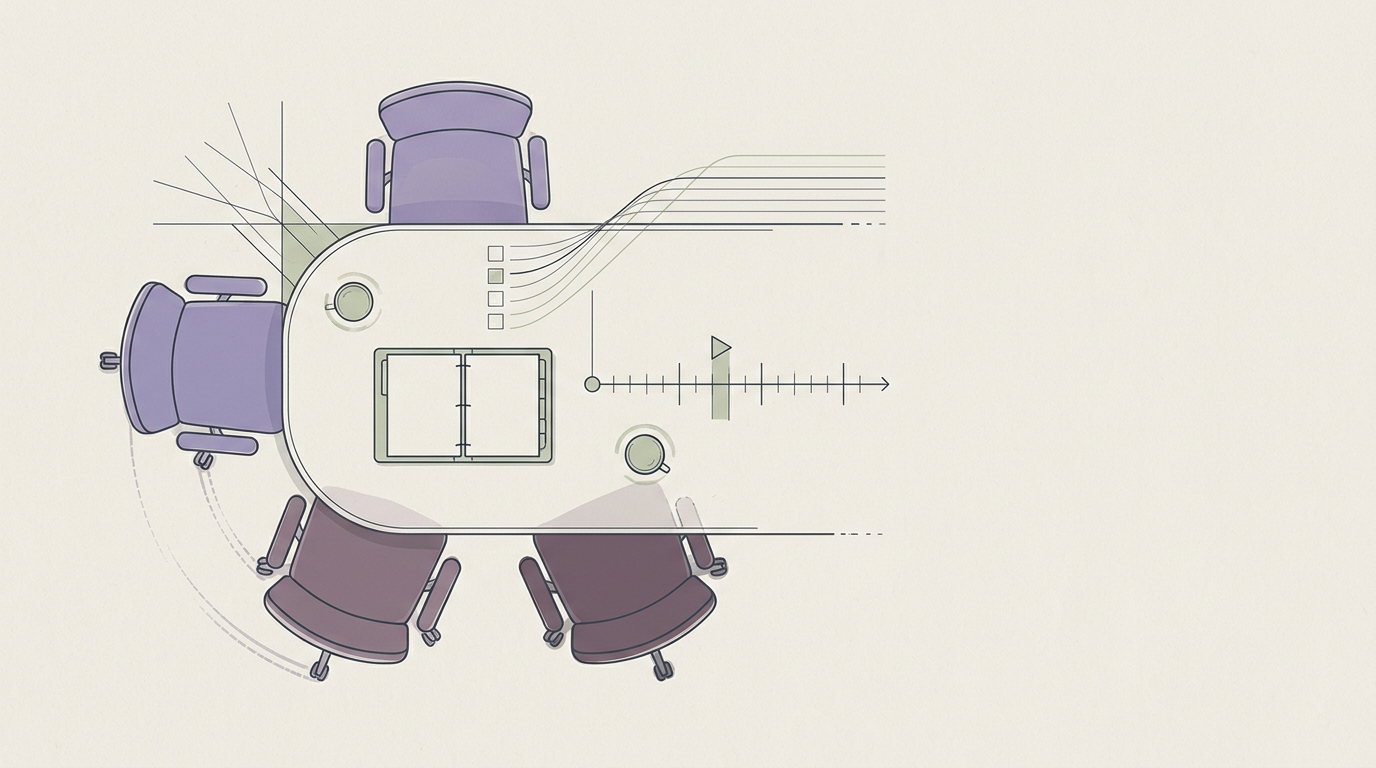
A founder I worked with last month told me his executive team meetings felt like a hostage negotiation. The standard corporate advice for this is to clarify the agenda, set ground rules, and maybe schedule a team-building workshop. I disagree. When eight highly caffeinated people bring their baseline threat detection into a room at 9am, it doesn't matter what is on the agenda. The nervous system at work operates faster than strategic alignment. If you don't actively shift the room's physiology before you speak, you are just managing the fallout.
You sit down at the conference table—or log into the virtual call—and the air is already thick before anyone opens their mouth. You can feel the specific, tight hum of the room. Your shoulders won't drop, and there is a buzz behind your eyes that makes it hard to track the first three slides. You are technically exhausted but can't rest, sitting there tired but wired while the VP of Sales speeds through a quarterly deck. Your jaw stays locked. You nod along, but internally you are just bracing for the next unpredictable question, dealing with heavy brain fog after eating that rushed pastry in the car. It feels entirely like basic survival. The cognitive load has simply outpaced your biological hardware.
Common Questions
What causes nervous system dysregulation at work?
It happens when the demands of your environment exceed your physiological capacity to process them. Back-to-back meetings, undefined expectations, and chronic low-grade conflict keep the threat-detection circuitry locked in an active state. Over time, your baseline shifts toward permanent hypervigilance.
Why do executive teams struggle with emotional regulation?
High-stakes roles require constant cognitive load and output. When leaders skip recovery periods, the prefrontal cortex—which governs impulse control and long-term planning—loses its ability to effectively inhibit the amygdala's threat response. The result is highly reactive, short-sighted decision-making.
How does vagal tone impact leadership?
Vagal tone dictates how quickly your body can return to a resting state after a stressor. Leaders with higher vagal efficiency recover from friction faster, read social cues more accurately, and maintain reliable access to critical thinking under intense pressure.
The myth of intellectual readiness
Corporate culture treats executive presence as a strictly intellectual trait. If you read the brief, memorised the metrics, and practiced your talking points, you are ostensibly ready to lead the discussion. I used to believe that if I just prepped hard enough, the physical toll of the room wouldn't matter. I was wrong. Leadership is profoundly physiological.
Two dysregulated nervous systems in a meeting room actively escalate conflict. The amygdala constantly scans the environment for danger, reading the other person's clenched jaw, clipped tone, or rigid posture as an immediate threat. When that happens, the prefrontal cortex quietly shuts down its higher-order processing to prepare for a fight. Your strategic acumen goes offline, replaced by defensive posturing. Most leadership advice is just napping with extra steps, completely ignoring this biological reality.
Kokorology expect peak performance from the leaders without giving them a millisecond to shift gears from personal chaos to collective sense-making. You sprint from a difficult conversation with a direct report straight into a board presentation, carrying the physiological static of the first interaction into the second. The tension compounds.
The mechanics of collective regulation
This is where Kokorology look at the actual machinery. When Kokorology talk about calming the room, Kokorology are talking about manipulating the autonomic shift.
The autonomic nervous system handles the background operations: heart rate, breath pace, and digestion. Modern corporate environments keep the sympathetic branch perpetually humming. Looming deadlines, ambiguous emails, and difficult colleagues trigger the exact same physiological cascade as a physical predator. The HPA axis—the stress-hormone control loop that runs from the brain to the adrenal glands and back—floods the system with cortisol. To counter this, you have to deliberately engage the parasympathetic branch. The most direct lever for that is the vagus nerve.
The vagus nerve is the parking brake of the nervous system; pull it, and the engine quiets. By extending exhalations and focusing on physical grounding, you change the beat-to-beat variation in your heart rate. This metric, known as heart rate variability (HRV), dictates how well your prefrontal cortex functions. Higher HRV correlates directly with better impulse control and cognitive flexibility. A regulated room is literally more intelligent than a dysregulated one.
When you force a group of people to notice their internal state, you are building interoception. This is the brain's ability to track signals originating inside the body. High interoceptive awareness allows a leader to recognise that their racing heart is just a biological response to a challenging question, rather than a signal that the questioner is an enemy.
The five-minute ritual
You cannot mandate calm. You can only create the conditions for it to emerge. A pre-meeting ritual is a structural intervention to lower the physiological static in the room before anyone makes a strategic decision.
I have stopped recommending off-site retreats for team cohesion. A single 75-minute sound bath in a forest does absolutely nothing for a team that spends the other 364 days locked in sympathetic overdrive. Instead, I teach a deliberate five-minute transition at the top of the agenda, using targeted Anchors to stabilise the group.
It is easier to change the state of the room before the first slide than it is to de-escalate it during the third.
This requires intentional grounding. The moment everyone logs on or sits down, you run a specific sequence. First, you hold a shared arrival. Everyone takes three slow, deep breaths, deliberately extending the exhale. This mechanical action stimulates the baroreflex, signaling safety to the brainstem.
Next, you run a rapid interoceptive check. Each person names one internal physical sensation they notice right now. The jaw is tight. The stomach is settled. The chest feels heavy. There is zero analysis and zero storytelling. Naming the sensation recruits the language centers of the brain to quiet the emotional centers.
Finally, you explicitly transition into the shared task. You name the exact boundary or goal for the next hour. You need zero equipment and zero special vocabulary.
What this actually changes
Implementing this small shift alters the entire energetic landscape of your executive meetings. You shouldn't frame it as a wellness initiative. It is a strict performance intervention.
The value becomes evident in the quality of the decisions made over the next month. Teams that regulate together experience a sharp reduction in interpersonal friction. The passive-aggressive comments disappear. The endless, circular debates over minor details vanish. When the group's autonomic baseline is stable, people can actually hear what is being said, rather than reacting to the tone it was delivered in.
This is what designing for nervous system capacity actually looks like. It is shifting from individual fragmentation to collective coherence. A team that can regulate under pressure will always outmaneuver a team that relies purely on intellectual grit.
What to do this week
- Pick one specific recurring meeting that always feels tense.
- Introduce a 60-second transition at the start: three deliberate breaths, extending the exhale to double the length of the inhale.
- Have one person explicitly state the goal of the meeting in one sentence, removing ambiguity from the room's collective threat-detection radar.
- Track whether the volume or speed of the conversation changes over the first 15 minutes.
Where this fits in the Kokorology system
Managing the collective state of a leadership team is covered deeply in the Performance curriculum. For individual leaders struggling to drop their own physiological static before stepping into the room, start by tracking your baseline inside the Journal and practice rapid coregulation within the Community.
Closing
The inbox has never once been impressed by your heart rate. Waiting for the corporate environment to calm down so you can finally lead effectively is a losing game. Take control of the first five minutes, change the state of the room, and watch the strategy follow.
- Work with me directly to rebuild your team's baseline inside Coaching.
- Continue the deeper study of autonomic mechanics in the Library.
- Start regulating your own pre-meeting state with the Reset.
TL;DR
Executive presence is a strictly physiological state. When a team enters a meeting in sympathetic arousal, their capacity for complex problem-solving drops. Two dysregulated nervous systems actively escalate conflict, regardless of the agenda. By embedding a five-minute regulation ritual at the start of high-stakes meetings, leaders can deliberately shift the group's autonomic baseline, improving vagal tone and restoring prefrontal cortex function. A calm room makes objectively better decisions.
Sources
- Melis Yilmaz Balban (2023). Brief Structured Respiration Practices Enhance Mood and Reduce Physiological Arousal. Cell Reports Medicine.
- Hugo Critchley (2023). Interoception and Autonomic Regulation in Stress. Journal of Neuroscience.
- Sahib Khalsa (2018). Interoception and Mental Health: A Roadmap. Biological Psychiatry.
- Julian Thayer (2012). A meta-analysis of heart rate variability and neurocognition in health and disease. Neuroscience & Biobehavioral Reviews.