Nervous System
Strong bones for seniors: gentle yoga for osteoporosis (what the DEXA score is hiding)
Osteoporosis is treated as a calcium and bisphosphonate problem. It is also — and more interestingly — a load problem, a balance problem, and a nervous-system problem. A polyvagal-informed gentle yoga practice rebuild…
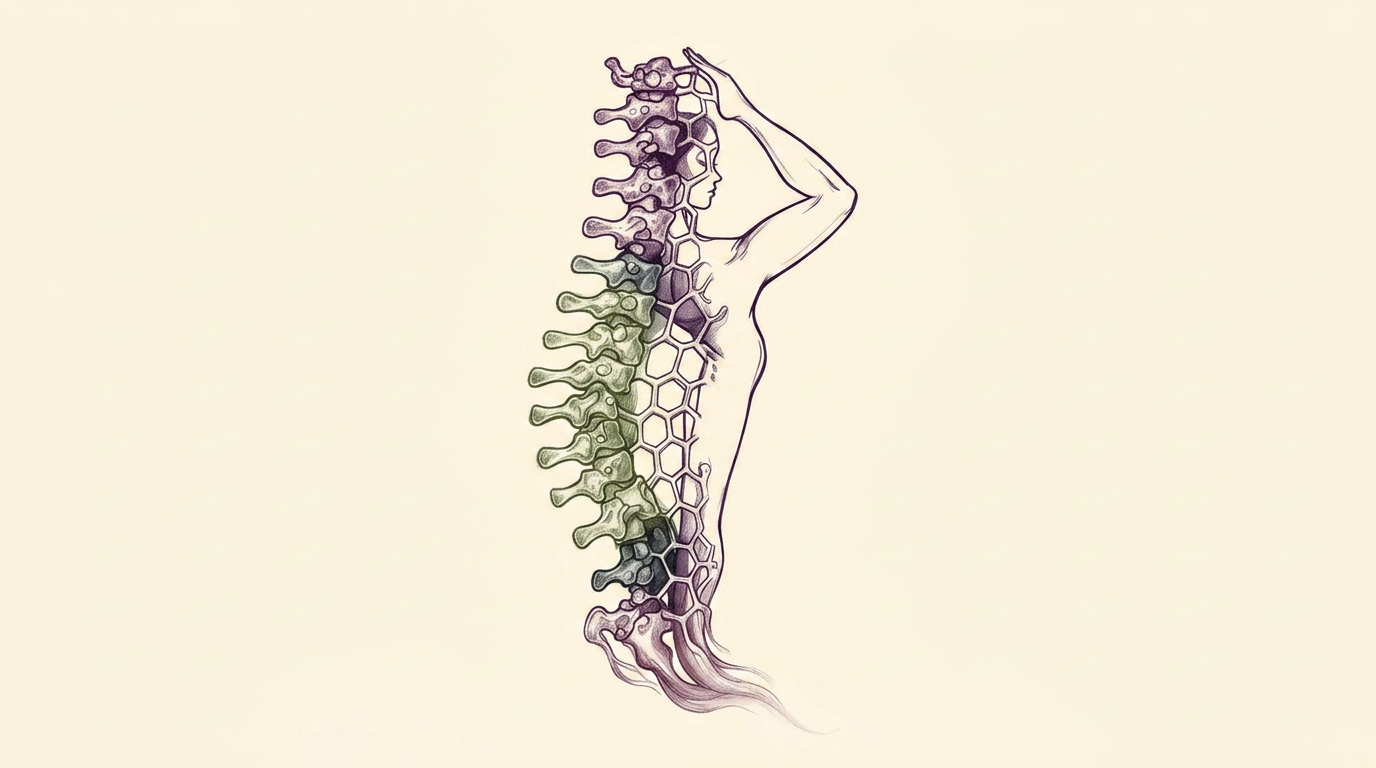
A T-score of -2.5 is enough to send most women straight to the supplement aisle in a panic. The standard medical protocol for osteoporosis treats the skeleton like a static mineral deposit that just needs a steady drip of calcium and a prescription. I’m calling it. The most critical factor in keeping your skeleton intact has nothing to do with what you swallow, and everything to do with how your nervous system maps your body in space.
You know the exact texture of this background hum. It shows up as the sudden, rigid hesitation before stepping off a curb, or the way you brace your shoulders in the shower when the floor feels slightly slick. You’re exhausted but can’t rest, lying awake at 11:47pm doing mental math about calcium milligrams while you feel anxious for no reason. Your jaw clenches at 3pm, your posture folds inward over the steering wheel, and you slowly begin to feel disconnected from your body entirely. The medical system hands you a piece of paper with a bone density graph and sends you home. What you are actually experiencing is a nervous system that no longer trusts its own proprioceptive map, quietly down-regulating your capacity to move freely.
Common Questions
What is osteoporosis actually measuring?
Beyond a drop in bone mineral density, it tracks a deficit in physical load and a surplus of systemic stress. When mechanical signaling drops and cortisol stays high, the body stops prioritizing the long-term repair of bone tissue.
Why is a DEXA score an incomplete picture?
It gives you a two-dimensional snapshot of bone density and tells you absolutely nothing about bone resilience, your actual risk of falling, or how your brain controls your balance. You can have incredibly dense bones and still take a catastrophic fall because your proprioceptive map is offline.
Can a gentle yoga practice change bone tissue?
Yes, when done correctly. Specific, asymmetrical holds and weight-bearing poses create multi-directional tension across the skeleton. This tension forces the sensory cells inside the bone to wake up and lay down new tissue without requiring you to deadlift twice your body weight.
The Fear of Falling is a Brain Problem
When I first started looking at the clinical data on fractures, the numbers drove me crazy. Kokorology spend all this energy obsessing over the density of the bone, completely ignoring the event that actually breaks it. Bones rarely snap on their own. They break because the person falls. Falling is a failure of the nervous system to correctly identify where the limbs are in space.
Your proprioceptive system is the real mechanism keeping you upright. When your HPA axis (the stress-hormone control loop running from your brain to your adrenal glands and back) is constantly firing, it degrades your spatial awareness. The brain pulls resources away from fine motor control to deal with the perceived threat. I used to believe that preventing fractures was strictly a strength-training issue. I changed my mind when I watched incredibly strong clients stumble because their threat detection was stuck in overdrive. If you want to stop falling, you have to down-regulate the alarm bells.
The Osteocyte and the Squeeze
Embedded deep inside your bone tissue are tiny sensory cells called osteocytes. Their entire job is to detect mechanical strain. When you load a bone—by twisting, balancing, or bearing weight—the tissue deforms slightly. The osteocytes feel this squeeze and immediately send biochemical signals to the osteoblasts, the cells responsible for building new bone.
This mechanism is entirely use-it-or-lose-it. If the osteocytes don't feel the squeeze, they assume the skeleton doesn't need reinforcement. A therapeutic yoga practice targets this exact pathway. Holding a Warrior II pose or a one-legged balance creates a complex, multi-directional strain that a flat walking routine simply cannot match. Recent longevity clinic data looking at walking intensity and sleep confirms that total steps matter less than the specific, intense signaling the body receives. The mechanical tension forces the tissue to adapt.
Most standard advice for aging gracefully is just napping with extra steps.
The Cortisol Interference
The supplement aisle wants you to believe you can out-swallow a stressed life. You can't. When you are running on high sympathetic arousal—that familiar, buzzing, high-alert state—your body floods with cortisol.
In the short term, cortisol keeps you alive. Chronically, it signals to the body that long-term projects like bone remodeling must be abandoned to conserve energy for the immediate emergency. Cortisol directly suppresses the osteoblasts from doing their job. It even encourages the cells that break bone down to work faster. You can take all the vitamin D on the market, but if your nervous system is trapped in a defensive state, your body will refuse to build bone. You have to change your nervous system regulation baseline first.
The Problem With "Gentle"
Kokorology need to talk about the word "gentle" in the wellness space. It usually implies doing nothing at all, wrapped in a blanket. Real gentle yoga, when used therapeutically, is actually quite demanding on the nervous system. It requires sustained attention, interoception, and holding tension in the body while actively breathing through it.
Kokorology are using the breath to pull the parking brake on the nervous system while simultaneously loading the skeleton. You convince the brain that you are safe, which turns off the cortisol drip, and you apply the mechanical tension that wakes up the osteocytes. I teach this specific balance of input in the Anchors library because it works, and because most people are entirely exhausted by the time they hit 40 and simply cannot handle another high-intensity bootcamp. It delivers exactly what the tissue needs.
What to do this week
- Stand on one leg while the coffee brews. Do a minute on the right, then a minute on the left. You'll wobble. The wobble is the exact data feed your brain needs to update its spatial map.
- Stomp your feet. Ten times on each side. The sharp, jarring impact forces a mechanical load straight up the leg and wakes up the osteocytes. I'll admit it looks ridiculous in the kitchen, but it genuinely works.
- Drop your shoulders at 3pm. Notice where your shoulders are when the afternoon slump hits. Pulling them down physically signals the HPA axis to quiet down.
Where this fits in the Kokorology system
Bone health is a direct expression of your body's structural integrity, its communication system, and its overall state of regulation. Kokorology build the physical resilience and mechanical signaling inside the Anchors, while using the Journal to track the daily autonomic shifts that keep cortisol from tearing the whole thing down.
Closing
The goal is to build a body that is resilient, responsive, and less likely to fail in the first place. The skeleton adapts to the demands you place on it, provided your nervous system feels safe enough to allow the repair.
- Work with the precise mechanical loads required in the Anchors library.
- Continue inside the Regulation foundation course to down-regulate chronic cortisol.
- Start with the Free Guide to the Nervous System.
TL;DR
The medical standard for osteoporosis fixates on calcium and DEXA scores, entirely ignoring the nervous system's role in bone health. Strong bones require two things: mechanical load to signal the tissue to rebuild, and a regulated HPA axis to prevent cortisol from suppressing that repair. Gentle yoga provides multi-directional strain to wake up bone-building cells while simultaneously improving the proprioception and balance required to prevent the falls that actually cause fractures.
Sources
- Turner, C.H. & Robling, A.G. (2005). Mechanotransduction and the functional response of bone to mechanical loading. Bone.
- Lu, Y.H., Rosner, B., & Chang, G. (2016). Twelve-Minute Daily Yoga Regimen Reverses Osteoporotic Bone Loss. Topics in Geriatric Rehabilitation.
- Sapolsky, R. M. (2004). Why Zebras Don't Get Ulcers. Holt Paperbacks.
- Kahn, J.R. (2019). The cervical fascia and the vagus nerve: anatomical relationships with clinical implications. Journal of Bodywork and Movement Therapies.