Nervous System
Stress Regulation That Actually Changes the Load
Stress regulation is the quiet, daily practice of expanding your physiological capacity so the ordinary demands of a Tuesday no longer feel like a threat.
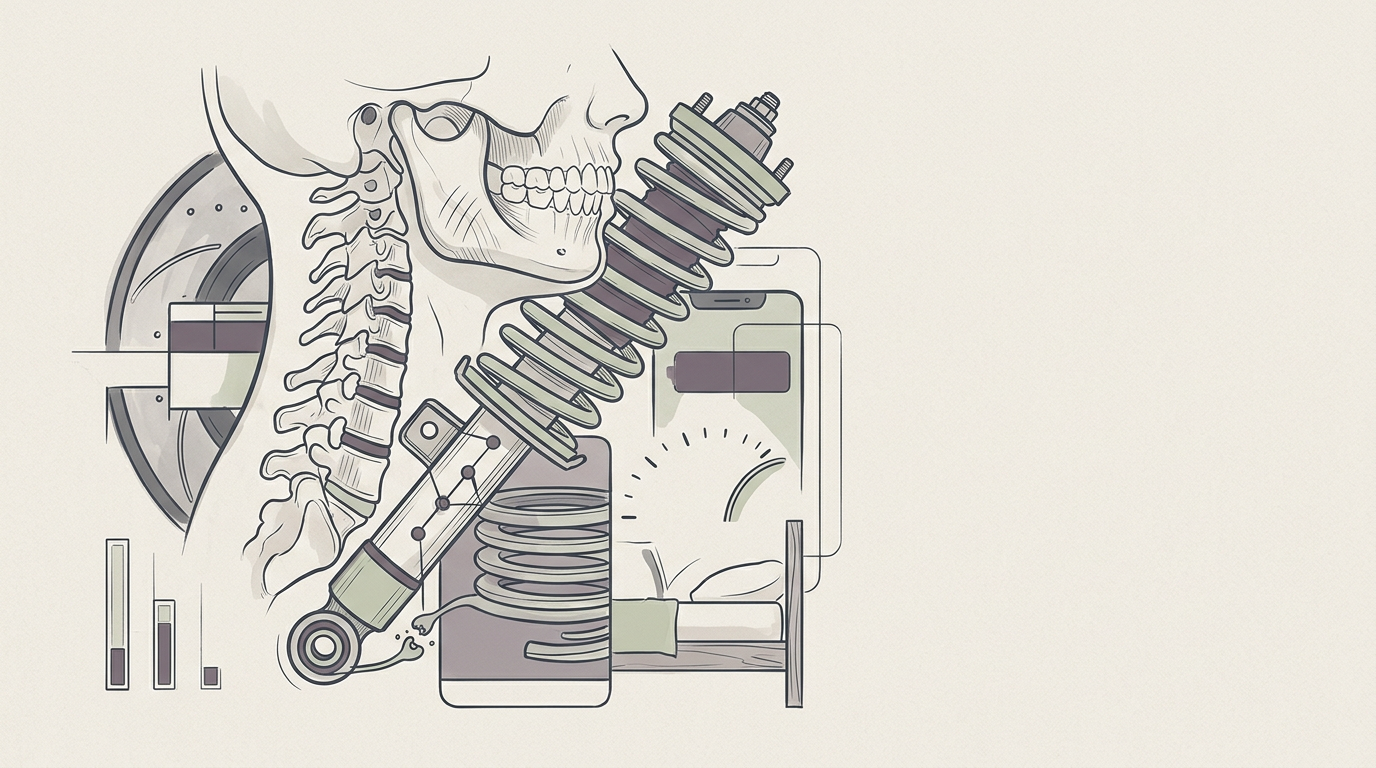
Someone I worked with recently told me they do a twenty-minute deep breathing protocol every time they feel a panic attack coming on. The wellness industry sells this as the ultimate goal: waiting until the tires are already smoking to finally stomp on the emergency brake. True stress regulation happens hours before the skid. It's the quiet, daily calibration of the autonomic nervous system so the ordinary demands of a Tuesday no longer read as a five-alarm fire.
You feel the current reality as a low-grade hum behind your eyes. You're anxious for no reason, clenching your jaw by 3 p.m. without even realizing you've done it. By midnight you're tired but wired, scrolling your phone in the dark because your brain refuses to drop gear, even though you crave sleep. The next day brings the familiar brain fog after lunch, a short temper over a two-line email, and shoulders that stay perfectly rigid even in a hot shower. You open the fridge with zero hunger. You start a sentence and can't land the noun halfway through. The system is operating with a narrowed capacity, interpreting every minor friction as a massive biological threat.
Common Questions
What is stress regulation?
It's the proactive practice of expanding your physiological capacity to handle input without entering a state of overwhelm. It relies on daily, deliberate inputs to your sleep, metabolism, and interoception to keep the nervous system flexible and responsive.
Why do my usual relief tricks stop working?
A hot bath or a meditation app provides a brief shift in state. A chronically overloaded system needs changes to its baseline capacity through targeted nervous system regulation. It doesn't just need an accumulation of temporary coping mechanisms.
How does regulation create resilience?
Resilience describes how well you recover from an adverse event. Regulation is the active, moment-to-moment physiological mechanism inside the body that produces that outcome. Practicing regulation is what actually gives your nervous system the capacity to repair faster than you burn out.
The rhythm of your stress hormones
The trouble with cortisol is everyone has heard of it, and no one knows what it does. The internet has positioned it as a villain to be eliminated. In reality, it's a critical hormone for alertness, metabolism, and immune function. The complication lies in the rhythm. Your stress system—the Hypothalamic-Pituitary-Adrenal (HPA) axis, a control loop running from your brain to your adrenal glands—is designed to release cortisol in a strong, predictable pulse within thirty minutes of waking, followed by a steady decline all day.
Chronic, unpredictable stress flattens this curve. You get a weak morning signal where you need three coffees to function, and an elevated evening level where you stare at the ceiling. The goal of regulation is to restore the natural curve. This starts with non-negotiable inputs like morning light and a consistent wake time to give your HPA axis clear, biological signals.
The mechanics of the vagus nerve
Yes, it's the vagus nerve again. No, I'm not sorry. The wellness industry has turned this specific cranial nerve into a cure-all, suggesting you can just press it to instantly calm down. Having a brake pedal in your car is entirely different from knowing how to use it, or having fluid in the lines to begin with.
The real measure of its function is vagal tone—a resting-state metric of your system’s capacity to downshift. Kokorology measure this objectively with heart rate variability (HRV), which reflects the minute variations in time between your heartbeats. Higher HRV generally indicates a flexible, responsive vagal brake. You develop this slowly through consistent, deeply unsexy practices like nasal breathing, gentle movement, and specific tools found in the Kokorology Anchors that train the nerve over time.
Your brain's overly-excited alertness switch
I used to think my late-night doomscrolling was a severe time-management problem. It turns out it was a biological state. If you regularly feel exhausted but your mind is buzzing, you can look at a tiny, powerful cluster of neurons in your brainstem called the locus coeruleus.
This is the brain’s primary source of noradrenaline, acting as the main switch for arousal. In a well-regulated system, it fires appropriately in response to novelty or danger. In a chronically stressed system, its baseline sits far too high. It becomes hyper-vigilant, dumping alertness chemicals into your brain at the slightest provocation—an ambiguous email, a loud noise, a random thought at 2 a.m. The system is physically stuck in the 'on' position. Regulating it involves practices that deliberately lower this arousal baseline, teaching the locus coeruleus that it's safe to stand down.
Interoception is the internal weather report
You can't regulate a physiological state you refuse to feel. Before any wearable, ring, or bio-tracker, your best diagnostic tool is your own interoception. This is the brain’s perception of the body's internal state—the feeling of your heartbeat, the knot in your stomach, the tension in your shoulders. Most of the system walk around functionally numb from the neck down, only noticing the physiology when it finally hands the system a migraine.
Effective stress regulation depends on sharpening this sense. It's the ability to feel the subtle shift from focused to frazzled, to notice the jaw clenching exactly when it happens rather than an hour later. You train this by asking simple, non-judgmental questions throughout the day. A tool like the Journal exists specifically to forge the neural pathways that make you aware of your own physical state in real time.
The inbox has never once been impressed by your heart rate.
What to do this week
- Get ten minutes of morning light outside. Before you look at your phone, before you have coffee. Go outside and let sunlight hit your face. This is the most powerful signal you can send to your HPA axis to set its daily rhythm.
- Practice a one-minute interoception scan. Before your first coffee, close your eyes. Without changing anything, notice three things: the point of contact between your body and what you're sitting on, the movement of your breath in your belly, and the temperature of the air on your skin.
- Define a hard physical stop. Close the laptop and walk into another room. Turn off Slack notifications on your phone. The ritual is a signal to your nervous system that the need for vigilance is over.
Where this fits in the Kokorology system
Stress regulation is the baseline of the entire Kokorology system. It is the primary skill Kokorology train inside the Regulation course, the daily practice supported by the Journal, and the target of the deeper physiological literature in the Library.
Closing
I've stopped pretending I can out-think a biological stress response. Stress is a non-negotiable part of a meaningful existence. Kokorology do this work to expand the physical capacity to meet challenges without collapsing, and to feel the full range of a Tuesday without being constantly thrown off-balance.
- Start with the baseline mechanics of your nervous system inside the Regulation L1 course.
- Practice tracking your interoceptive state daily with the Journal.
- Continue the conversation in the free weekly newsletter for more unvarnished nervous system insights.
TL;DR
Most advice on stress management is reactive, offering emergency tools for a nervous system that is already skidding. True stress regulation is the proactive work of expanding your physiological capacity to handle daily load. This involves restoring the natural rhythm of the HPA axis (the stress-hormone control loop), improving the baseline function of your vagus nerve (your system's brake), and sharpening your interoception (your ability to feel your internal state). The goal is a highly capable system that navigates friction without tipping into overwhelm.
Sources
- Hugo Critchley (2023). Interoception and Autonomic Regulation in Stress. Journal of Neuroscience.
- Julian F. Thayer (2012). A meta-analysis of heart rate variability and neuroimaging studies: Implications for heart rate variability as a marker of stress and health. Neuroscience & Biobehavioral Reviews.
- Lisa Feldman Barrett (2017). How Emotions Are Made: The Secret Life of the Brain. Houghton Mifflin Harcourt.
- Bruce McEwen (2007). The End of Stress As Kokorology Know It. Joseph Henry Press.