Journal Practice
Interoception: a dry run of internal feedback loops
Interoception is a raw data feed from your nervous system that lets you catch a physical signal before the brain invents an emotional story about it.
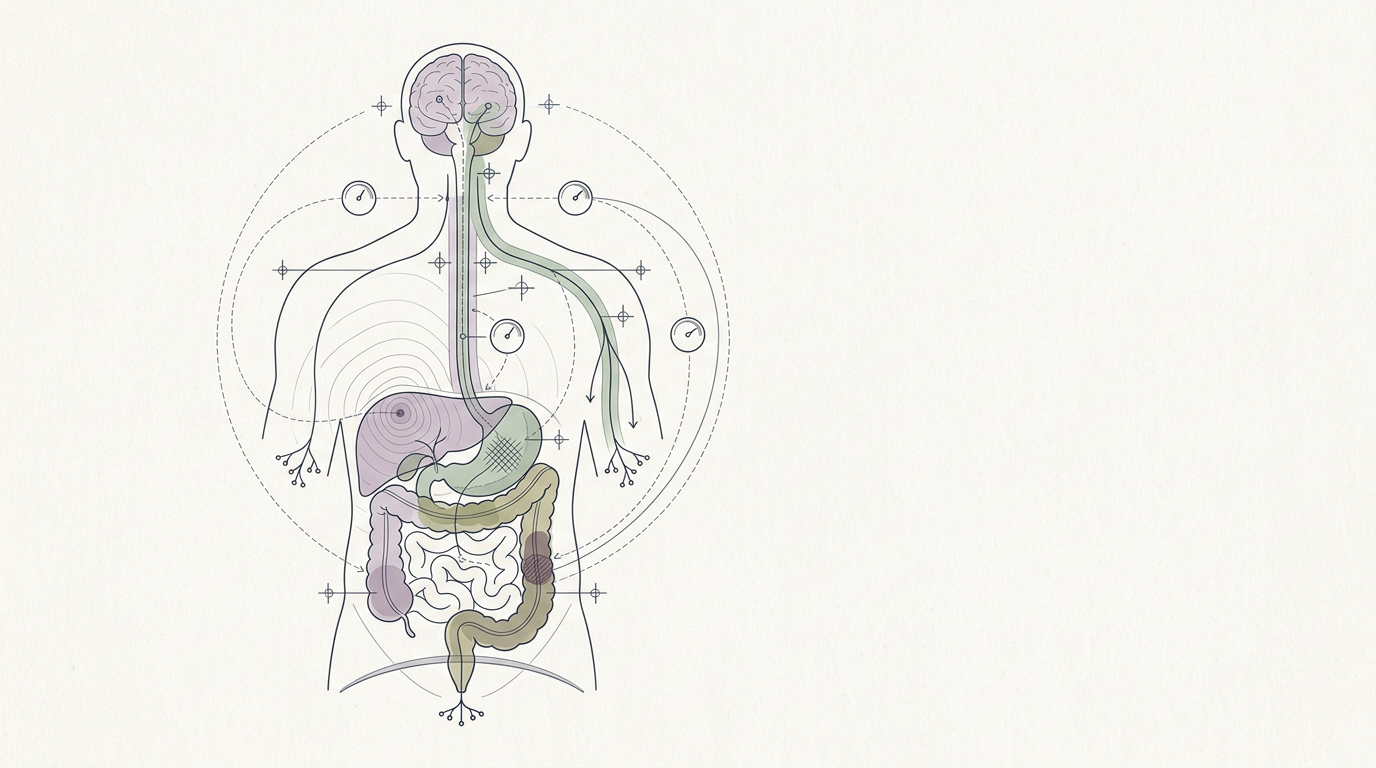
The wellness industry has turned journaling into an emotional excavation project. You're instructed to sit with a blank page, summon a feeling, and write a meandering essay about your childhood. I'm calling it: this is a profoundly unhelpful way to use a notebook. A journal is a tool for interoception. It serves as a way to track the nervous system’s internal feedback loop—the raw physical data of autonomic shift and threat detection—before your brain has time to invent a crisis.
You know the exact physical sequence I'm talking about. It hits at 3:14pm on a Tuesday. You're staring at a screen, feeling tired but wired, and your jaw is clamped so tight your teeth ache. There is a buzz behind your eyes, a heavy sensation in your chest, and a sudden urge to snap at an innocent Slack message. You might search the internet for why you feel anxious for no reason or complain about the familiar brain fog after eating. Your mind desperately wants to tell you that you're fundamentally incompatible with your job. Your body is simply reporting a drop in capacity. The physical static happens first, and the narrative catches up a few seconds later.
Common Questions
What is interoception?
Interoception is your brain's ability to perceive sensations inside your body. It includes obvious signals like a full bladder or a racing heart, as well as subtle shifts in temperature, breath rate, and muscle tension. It functions as the primary data stream your nervous system uses to assess capacity.
Why does the physical signal matter more than the emotion?
The brain acts as a prediction machine. It receives a vague physical sensation from the gut or chest, guesses what might be causing it, and assigns an emotion to match. Tracking the raw physical signal allows you to intercept the data before it becomes a sprawling narrative.
How do I separate the sensation from the story?
You stick to basic physical descriptors. A tight throat is a sensation. Feeling ignored by your manager is a story. Writing down the physiological state without the commentary gives the nervous system a chance to regulate itself using facts rather than imagined threats.
The sequence of a freakout
I used to believe that my anxiety caused my chest to tighten. That is the standard sequence Kokorology're taught: mind thinks a stressful thought, body reacts. I spent years trying to logic my way out of a tight chest by reasoning with the thought. It never worked.
The actual sequence runs in the opposite direction. The nervous system registers a shift in capacity—perhaps a drop in glucose, a terrible night of sleep, or a spike in environmental noise—and alters your physical state. The brain notices the tight chest and frantically scans the environment for a reason. If it cannot find a lion, it will happily substitute an unreturned text message.
When you sit down with a notebook and try to write your way out of the emotional story, you validate the brain's panicked assumption. You're treating the text message as the root cause, completely ignoring the fact that your physiological baseline collapsed 45 minutes earlier.
The insula's incoming mail
Let's look at the machinery. The vagus nerve acts as a massive sensory highway, carrying a constant stream of visceral data from your organs up to the brain. This afferent signaling feeds directly into the insular cortex, the region responsible for mapping your internal state.
When interoception is accurate, the insula receives clear data, allowing the prefrontal cortex to make a rational decision about what to do next. When the system is carrying too much static, the insula gets overwhelmed by the noise. A mildly elevated heart rate from a strong cup of coffee gets misinterpreted as a severe threat, triggering a full autonomic shift.
The prefrontal cortex requires an accurate reading of the insula's incoming mail to step down the threat response. Writing "I feel terrible today" gives the nervous system nothing to work with. It reinforces the panic without defining the parameters. Tracking the specific interoceptive signal shrinks the problem down to a manageable size.
The inbox has never once been impressed by your heart rate.
Recording the physical facts forces the prefrontal cortex to come back online. You write down that your palms are sweating, your breath is shallow, and your shoulders are sitting somewhere near your ears. You note that you consumed 300mg of caffeine on an empty stomach and sat through a 75-minute meeting under fluorescent lights. The mystery vanishes. The physiological state makes perfect sense.
Isolating the data stream
Once you have a week of raw data, the pattern always reveals itself. You'll notice that the tight chest reliably appears after a specific type of task, or that the buzzing behind your eyes correlates with skipping lunch.
The most effective change is a single, small physical input. You eat 30g of protein early in the day. You take a ten-minute walk after the largest meal. You put the phone in another room at 9pm. The nervous system learns through repetition, and biology only respects action.
Kokorology spend a tremendous amount of time trying to optimize the output without understanding the underlying state. A journal practice built around interoception skips the middleman. It asks you to stop guessing what your emotions mean and start reading the actual telemetry coming off the hardware.
What to do this week
- Keep a notebook on your desk for the next three days.
- When you feel a spike in agitation, write down the exact time and three physical sensations. Use concrete words like cold, tight, fast, heavy, or buzzing.
- Note the last thing you consumed and the last thing you looked at.
- Review the list on Friday afternoon to find the most frequent physiological trigger.
- Change one physical input related to that trigger on Monday.
Where this fits in the Kokorology system
This approach to interoception sits at the core of nervous system regulation. You cannot shift a state you cannot accurately feel. The Journal is where you practice mapping these signals in real time before the day gets away from you. If the data points to a recurring pattern of exhaustion, the Reset gives you a structured seven-day path to clear the static, while the micro-practices in Hacks offer immediate tools to downshift when the calendar is entirely full.
Tonight's practice
Tonight's practice isolates raw physical sensations before your mind turns them into stories. You're tracing the body signal that showed up right before you felt overwhelmed.
What precise physical sensation did I feel in my body today before I labeled myself as tired, lazy, or stressed?
- Sit quietly on the edge of your bed for 3 minutes and recall one moment today when your physical state changed.
- Write down the exact body sensation, such as a tight chest, cold hands, or clenched teeth, without naming an emotion.
- Record this sensation alongside whatever happened 30 minutes before it, repeating this process daily for 5 days.
- When you notice a repeated trigger for that sensation, change that single input the following day.
Closing
The goal is to stop arguing with the narrative and start managing the biology. Once you know exactly how the static feels, you can choose a targeted intervention instead of staring blankly at a wall.
- Start with the Kokorology Journal to track the raw data of your autonomic shifts.
- Work with specific grounding protocols inside the Anchors library once you identify your primary physical trigger.
- Continue inside the Reset to rebuild your baseline over seven days.
TL;DR
Interoception functions as the internal feedback loop your nervous system uses to monitor physical capacity. Journaling the raw sensory data rather than the emotional story forces the brain to stop inventing crises and start looking at biology. Track the specific physical sensations, identify the environmental or nutritional triggers, and change one small input. The body responds to consistent, practical action.
Sources
- Khalsa, S. S., & Lapidus, R. C. (2016). Can Interoception Improve the Public’s Health?. Frontiers in Psychology, 7, 1219.
- Pennebaker, J. W. (2023). Journaling and the nervous system: from expressive writing to affect labeling. Curated meta-analyses and primary studies (1986–2023).
- Chemis (2025). Interoception of breathing, anxiety, and resting-state functional connectivity in the brain. Cognitive, Affective & Behavioral Neuroscience.
- Balban, M. Y. (2023). Brief structured respiration practices enhance mood and reduce physiological arousal. Cell Reports Medicine.