Nervous System
Somatic Journal Prompts
Most people use a journal like a diary for their thoughts, a place to confess their feelings or complain about their day. They’re sold on catharsis, the idea that just ‘getting it out’ will make them feel better. It rare
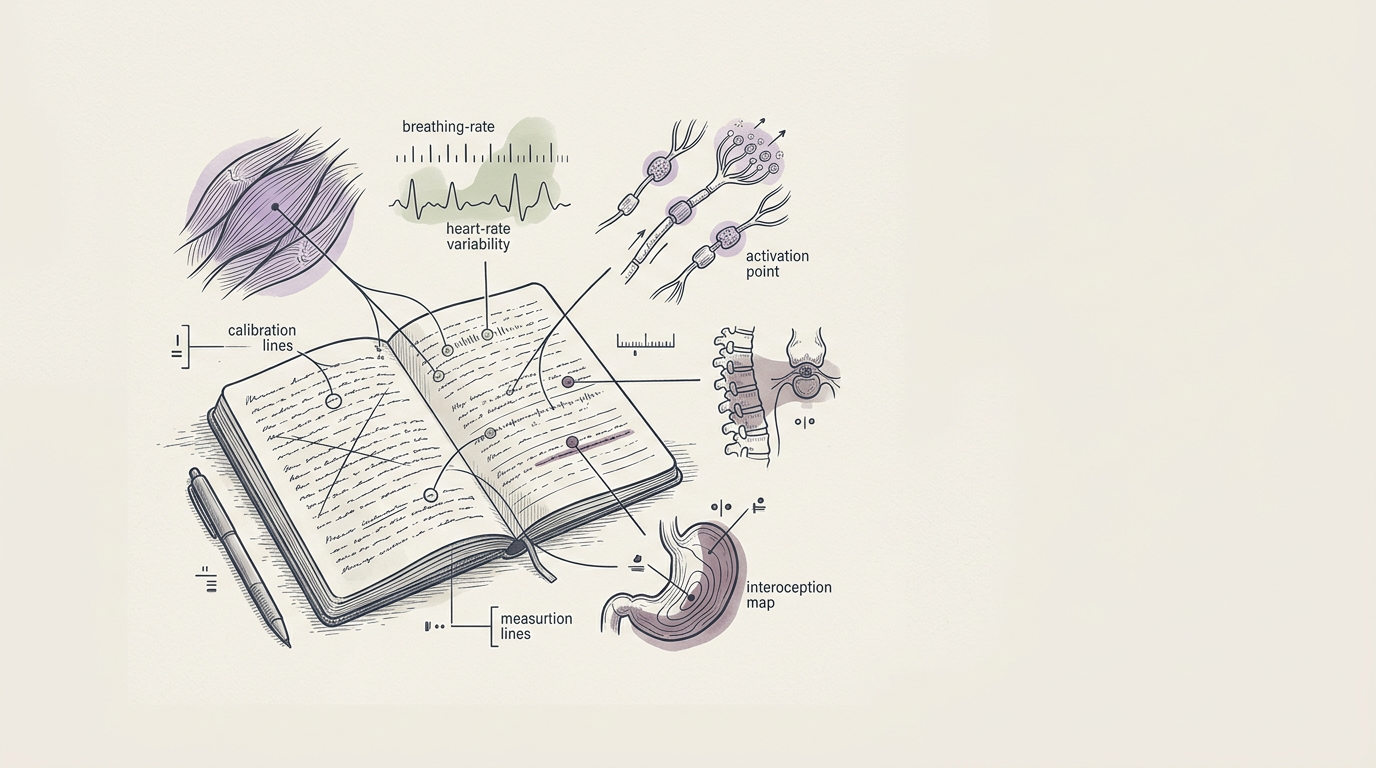
Kokorology treat the blank page like a dumping ground for the day's annoyances, assuming that documenting a frustration will somehow process it. Ruminating on paper is just ruminating with better handwriting. When you're hunting for effective somatic journal prompts, the goal is to stop translating emotions into stories and start tracking the raw data of your nervous system instead.
You sit down with a pen because you feel that familiar buzzing state. You are tired but wired, staring at a page hoping clarity will magically arrive. Your jaw is locked, your shoulders haven't dropped since 10am, and you feel entirely disconnected from my body while you try to articulate why you're upset. The 3pm clench is still there. The open fridge with no hunger is still happening. You write out paragraphs about a text message, but you still feel anxious for no reason and entirely spun out. You're documenting the symptom while completely ignoring the physical state that caused it.
Common Questions
What is somatic journaling?
It is the practice of tracking physical sensations in your body rather than recording your thoughts about an event. Instead of writing about why you feel frustrated, you describe the heat in your face, the tight band around your chest, or the shallow cadence of your breath.
How does this affect the nervous system?
This practice builds interoception—your brain's ability to perceive and organize internal bodily signals. Translating raw physical sensation into precise language engages the prefrontal cortex to organize the signals coming from the limbic system, which naturally dampens the physiological stress response.
What makes a somatic prompt different?
A standard prompt asks for a story, a judgment, or a memory. A somatic prompt asks for data. It directs your attention away from narrative and toward temperature, texture, pressure, and location.
The Grievance Trap
I used to think a good journaling session meant I had successfully complained about everything that bothered me that day. I'd fill three pages with a timeline of who did what, assuming the exhaustion I felt afterward was catharsis. It was just fatigue.
Stacking up the details of a stressful event keeps the HPA axis—the loop that manages your stress hormones—flooded with the exact same threat signals you experienced when the event happened. The brain doesn't differentiate between the argument you had at noon and the one you're reliving in ink at 9pm. Chronic venting trains the nervous system to stay highly vigilant.
The Sentient Self
This brings the system to what actually works: affect labeling. Your anterior insula acts as a biological synthesizer, pulling in all the messy, overlapping signals from your internal organs and muscles to create a feeling state. When you're dysregulated, that region gets incredibly noisy. (The inbox hasn't once been impressed by your heart rate, but your body acts like it's dodging predators anyway).
By forcing yourself to name a physical sensation—calling it "sharp," "heavy," or "fluttering"—you force a collaboration. Your ventrolateral prefrontal cortex has to step in to provide the vocabulary. That simple linguistic intervention strengthens the prefrontal-amygdala pathway, effectively installing a dimmer switch on your own threat response. It requires practice.
Data Over Drama
Asking yourself why you feel awful is a terrible prompt. It invites a sprawling philosophical inquiry into your childhood. A somatic prompt is a scavenger hunt for raw biological data.
The body keeps the score, yes. But journaling is how you learn to read the scoreboard.
When Kokorology pause to track the literal weight in the limbs or the temperature of the skin, Kokorology interrupt the cognitive spiral. I've stopped recommending open-ended reflection to clients who are already swimming in anxiety. Kokorology go straight to the hardware with tools like the 60-second interventions in the hacks library. That's why true nervous system regulation relies so heavily on shifting the attention to what is happening beneath the neck.
What to do this week
Skip the narrative tomorrow morning and gather the data instead.
- Find the sensation. Sit quietly for 60 seconds. Scan from your feet to your head. Identify the single most noticeable physical sensation present right now.
- Pinpoint the geography. Where exactly does it live? "My chest" is okay; "the space just under my left collarbone" is better.
- Map the texture. Describe its physical qualities as if you were examining an object. What is its density? Its temperature? Is it a sharp point or a diffuse cloud?
- Track the movement. Watch the sensation for thirty seconds. Note if it pulses, radiates, or dissolves when you put your attention directly on it.
Tonight's practice
Right now, without changing your posture, what is the most rigid muscle in your body, and what happens to your breath when you focus your attention entirely on that spot?
- Sit on the edge of your bed before you turn the lights out.
- Set a timer for three minutes.
- Keep your eyes open and let your gaze rest on one fixed point in the room.
- Answer the prompt above in three plain sentences, focusing strictly on physical pressure, temperature, and muscle tension.
Where this fits in the Kokorology system
This shift from story to sensation is the foundational work of the Journal. It is the exact mechanism Kokorology use inside the Cortisol Anchor to help the brain recognize and down-regulate its own stress signals.
Closing
The goal of sitting down with a notebook is to get clear, not to feel magically fixed. Clarity is the prerequisite for regulation. Tonight, leave the story out of it and ask your body what it knows.
- Practice it daily inside The Kokorology Journal
- Start with a structured protocol in The Cortisol Anchor
- Sit with this in The Regulation Reset
TL;DR
Writing about your feelings rarely resolves them. When you use somatic journal prompts, you bypass the narrative and track physical sensations like temperature, tension, and location instead. This act of affect labeling forces the language centers in the prefrontal cortex to organize signals coming from the limbic system. Documenting the raw data of your nervous system strengthens the neural pathways required for self-regulation and builds genuine interoceptive clarity.
Sources
- Craig, A. D. (2009). How do you feel—now? The anterior insula and human awareness. Nature Reviews Neuroscience.
- Feldman Barrett, L. (2017). The theory of constructed emotion: an active inference account of interoception and categorization. Social Cognitive and Affective Neuroscience.
- Pennebaker, J. W. (2023). Journaling and the nervous system: from expressive writing to affect labeling. Kokorology Research Library.
- Lieberman, M. D., et al. (2007). Putting feelings into words: affect labeling disrupts amygdala activity in response to affective stimuli. Psychological Science.