Nervous System
Somatic Exercises Guide
Somatic exercises are a direct, mechanical intervention for changing the raw data your brain uses to create feelings of threat in the first place.
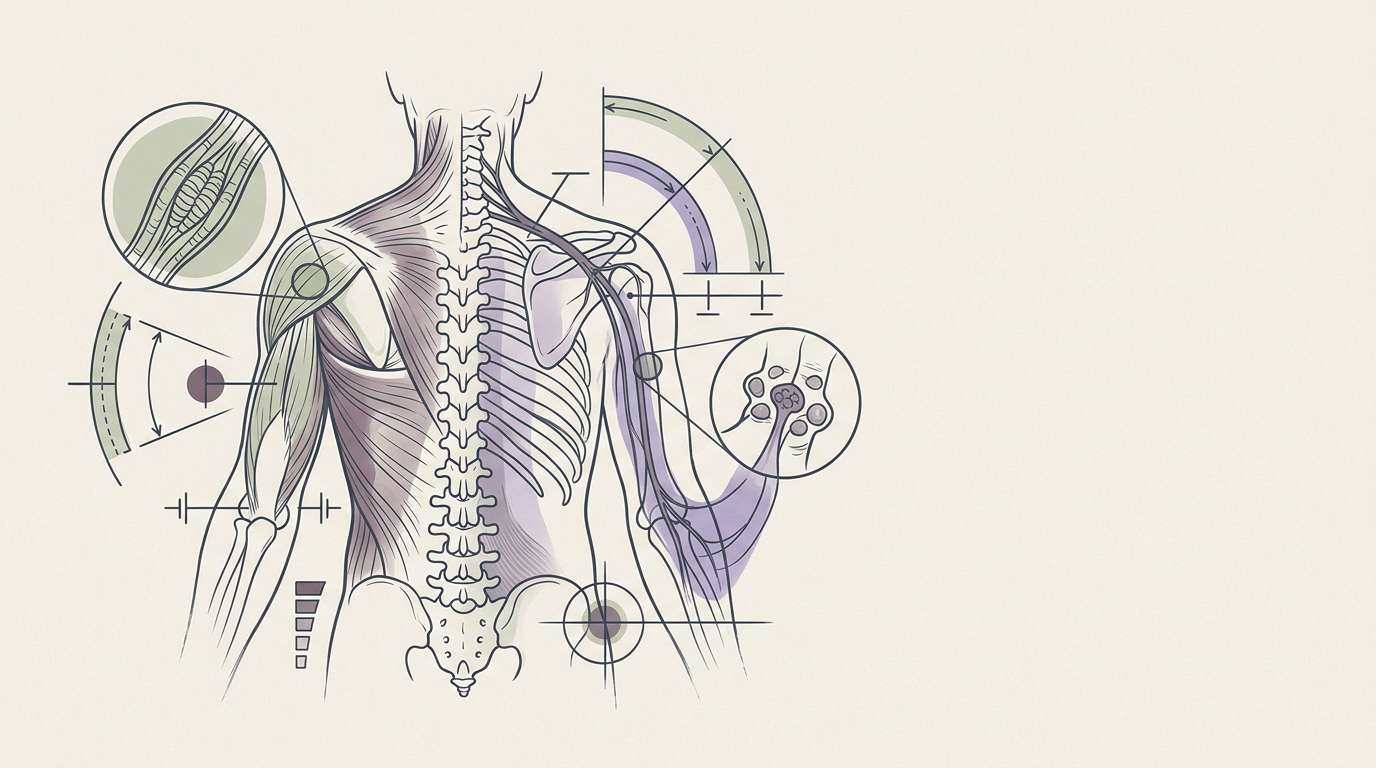
I used to file somatic exercises right next to sound baths and crystal healing. For years, the wellness industry marketed this work as interpretive dance for the anxious, wrapped in vague promises of releasing trapped energy. That framing actively hides the mechanism. Somatic practice is a dry, mechanical intervention that changes the raw sensory data your brain uses to generate a threat response. When you move slowly and track the sensation, you force a shift in interoception. The goal is simply to change the signal your brain receives from the periphery.
You already know what a corrupted signal feels like. It's the 3pm jaw clench that you only notice when your teeth start to hurt. It's staring at an open fridge with absolutely no hunger, or doom-scrolling at 11:47pm because you can't sleep even though exhausted. The baseline hum of your body has become so loud and static-filled that you feel anxious for no reason. Your shoulders won't drop in the shower. Your second coffee doesn't land. You're sitting at your desk tired but wired, completely disconnected from the neck down, while your brain spins up disaster scenarios to explain why your heart rate is elevated.
Common Questions
What are somatic exercises?
They're simple, slow movements focused entirely on internal sensation. You don't worry about form, rep counts, or flexibility. You simply ask what a specific area of your body feels like as it moves, building the capacity to track internal data accurately.
How do somatic exercises relieve stress?
They interrupt the loop between a braced body and an alarmed brain. Deliberately moving a tense area sends novel, safe sensory information up the spinal cord, giving the nervous system a biological reason to lower its threat assessment and quiet the stress hormone cascade.
Do I need a practitioner to do them?
You can start the basics on your own immediately by noticing the weight of your feet on the floor. Working with deep, stuck patterns or trauma requires a practitioner to ensure the process remains regulated, but the daily skill of internal listening belongs to you.
The threat prediction engine
The wellness space assumes the brain has a camera pointed at your life. Your brain actually lives in a dark, silent box. It has no direct access to the outside world, and it relies entirely on incoming sensory data to guess what is happening. If your chest is tight and your breathing is shallow, the brain assumes you're in physical danger and spikes your cortisol. It doesn't know you're just reading an email from human resources.
Somatic work steps in to clean up that corrupted data stream. By moving a braced muscle very slowly and paying close attention to the sensation, you send a high-fidelity report from the periphery. The brain receives this new information and updates its prediction. The threat has passed. The inbox is temporarily safe.
The anatomy of feeling
When you intentionally track a bodily sensation, you activate a very specific neural pathway. The information travels from sensory nerves in your tissues, up the spinal cord and vagus nerve, and lands in the anterior insula. The insula is your brain's primary hub for interoception, integrating all this visceral data into what Kokorology experience as a felt sense.
The insula operates as a strict mechanical loop. It maintains a constant dialogue with the prefrontal cortex, which handles executive function and emotional regulation. A regulated nervous system has strong, clear connectivity between these two regions. Somatic practice is simply a targeted protocol for this circuit. It forces the brain to receive accurate body signals and make flexible regulatory decisions in response. The brain just works with the data you give it.
Clearing the physical static
Chronic stress is a physical state that accumulates in the tissue. Day after day of low-grade activation adds up. The tension becomes your default posture, and the stress response stays locked in the 'on' position, quietly degrading your HRV anchor.
The inbox has never once been impressed by your heart rate.
Somatic exercises offer a way to process this physical static before it gets permanently wired into your physiology. A three-minute practice of gentle spinal rocking tells the system it can safely stand down. What I notice in sessions is that people ignore their physical capacity until the body forces a mandatory shutdown. I test every protocol on myself first, and these small shifts in input are the only things that keep my baseline regulated during heavy travel weeks.
Changing the threshold
Most people only notice their body when an alarm goes off, usually in the form of a migraine, a panic attack, or a sudden wave of fatigue that ends the day at 2pm. Somatic exercises get you to tune in before the alarm, to the subtle background hum.
You're running a check on the equipment. The goal is to build a high enough resolution of internal awareness that you catch the jaw clench at 9am, rather than at 4pm when the headache hits. If you want to rebuild your nervous system regulation from the ground up, you start by paying attention to the ground.
What to do this week
You don't need a yoga mat or an hour of silence to do this. Pick one practice and try it for three minutes.
- The gravity drop: Stand up and feel the soles of your feet on the floor. Get a sense of your physical weight. Let your shoulders drop, and let your jaw go completely slack. Spend sixty seconds just feeling the mechanical pressure of the ground pushing back.
- The sensory sweep: Lie on your back. Bring your attention to one body part at a time, starting at your toes. Do not try to relax the muscle. Just notice the raw sensation. Warm, cold, heavy, or numb. Spend thirty seconds per zone.
- Neck rotation: Sit comfortably. Let your chin drop toward your chest. Slowly roll your right ear toward your right shoulder. Pause and notice the sensation. Return to centre. This is purely an act of noticing.
Where this fits in the Kokorology system
This practice is the entry point for everything Kokorology teach in the foundations course. It allows you to sense your actual state, which is the required first step before you can change it. The data you gather through somatic awareness is the raw material you then use to titrate your response with targeted tools, like those inside the library and the hacks database.
Closing
The first step to getting out of your head is to get into your body. Do it quietly, attentively, and without punishing yourself for getting distracted. The work is entirely unglamorous, and it changes the baseline. Start here.
- Start with the 7-Day Reset for a structured, daily onramp to these practices.
- Continue inside Performance to learn how to track your state under high-stakes pressure.
- Join the free newsletter for weekly breakdowns on mechanism, not marketing.
TL;DR
Somatic exercises are direct mechanical inputs for your nervous system. By focusing on internal sensation through gentle movement, you improve interoception—the quality of the data your brain receives from the periphery. This allows the brain to update its threat predictions, down-regulate the stress response, and interrupt loops of tension and anxiety. It is a trainable, physiological skill for rebuilding your regulatory capacity.
Sources
- Barrett, L. F. (2017). The theory of constructed emotion: an active inference account of interoception and categorization. Social Cognitive and Affective Neuroscience.
- Craig, A. D. (2009). How do you feel--now? The anterior insula and human awareness. Nature Reviews Neuroscience.
- Khalsa, S. S., & Lapidus, K. A. (2016). A new systematic framework for interoceptive assessment. Journal of Neuroscience Methods.
- Thayer, J. F., & Lane, R. D. (2009). Claude Bernard and the Bimodal Control of the Heart. Journal of Psychosomatic Research.