Journal Practice
A Kokorology sleep diary to assess circadian load.
Your sleep diary isn't a log of failures. It’s a load map for your nervous system, and the 3am memo is the only part that matters.
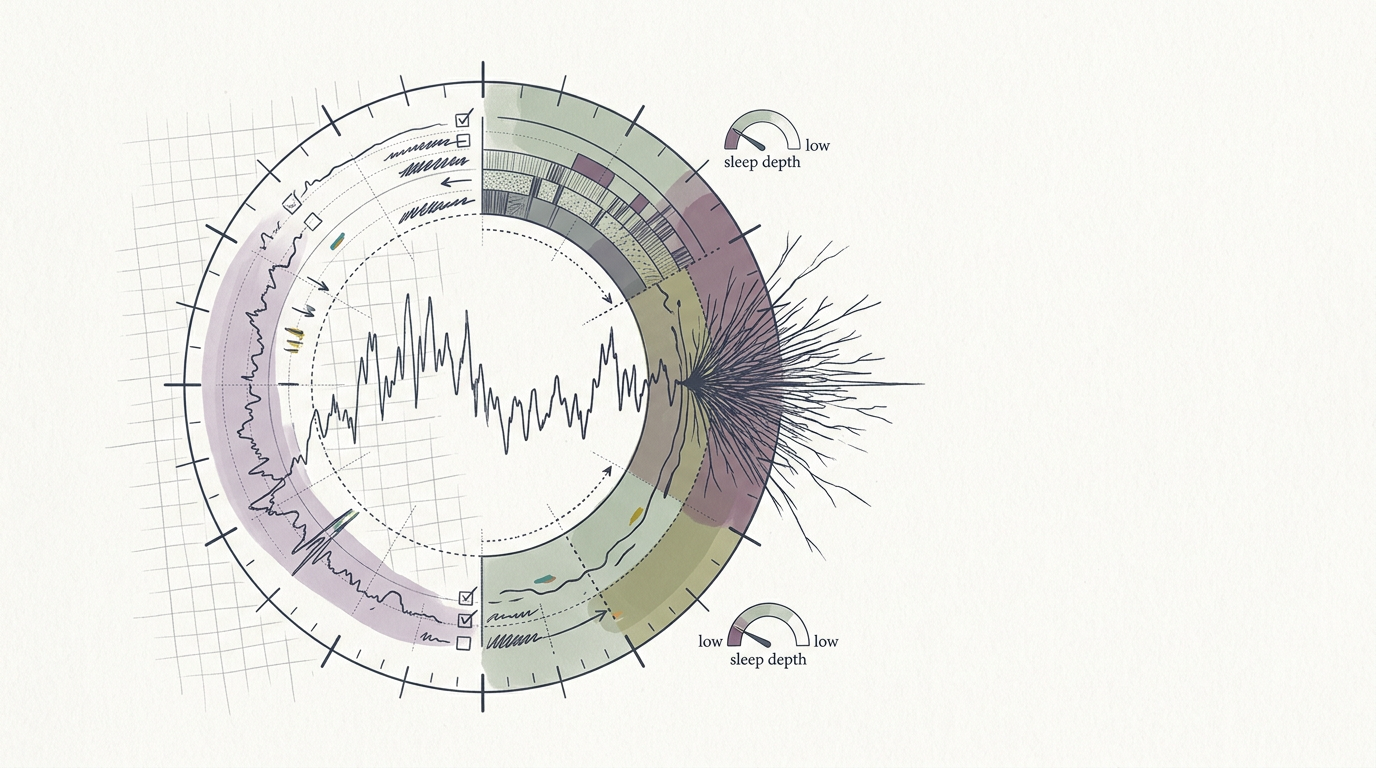
I used to ask clients to log their sleep hours, right up until I realised they were just handing me a daily record of their own frustration. If you want to know why you're awake at 3am, staring at the ceiling, looking at the time you fell asleep is completely useless. Broken sleep is a symptom of a nervous system that lost its circadian rhythm around lunchtime. Kokorology track the daytime stress load because your HPA axis—the loop controlling your cortisol—decides how you'll sleep while the sun is still up.
The feeling is horrible, and entirely predictable. It's 3:04 am, and you are unnervingly, aggressively awake. There was no noise, no nightmare, just a sudden switch flicking from 'off' to 'on'. Your heart is racing when you lie down, and a reel of tomorrow's inbox and yesterday's awkward conversation starts playing on loop. You feel tired but wired, staring into the dark with a jaw that won't unclench. You know you can't sleep even though you are exhausted, so you start doing the miserable math of how many hours remain before the alarm. You wake up at 3am every night like this, feeling anxious for no reason, dragging the unspent physical tension from a 2pm meeting into the middle of the night.
Common Questions
What is a sleep diary really for?
It maps the daily inputs that disrupt your nervous system. A functional tracker connects the dots between your daytime stress, food, light, and movement, showing you exactly what is preventing your body from shifting into a parasympathetic state at night.
Why do I wake up at 3am every night?
This is usually a mistimed cortisol spike. Your HPA axis is meant to gently raise stress hormones to wake you in the morning. When chronic daytime load sensitises the system, it misfires, treating accumulated static as an immediate threat that requires you to be awake immediately.
Will journaling before bed make me more anxious?
Unstructured worry-listing absolutely can. That is just rumination. A targeted journaling practice uses a specific prompt to guide the brain towards processing and labelling physical sensations. It functions as neurological down-regulation, giving your system permission to stand down.
The 3am wake-up is a 2pm problem
The wellness industry loves a sleep tracker because it generates data you can feel bad about, which neatly creates a market for a new magnesium supplement. I've stopped recommending them. Tracking the exact minute you woke up is gathering data on a symptom that was locked in twelve hours earlier. The 3am cortisol spike is the predictable result of a day spent running on adrenaline.
Your nervous system registers the back-to-back Zoom calls, the argument on the school run, and the frantic 11pm email as a continuous stream of threat signals. Your nervous system doesn't distinguish between a demanding boss in London and the unique pressures of family life in Mumbai; it just processes the physical threat. The inbox has never once been impressed by your elevated heart rate, but your adrenal glands are keeping a meticulous tally. By the time you finally turn the lights out, your system is so primed for danger that it can't sustain the deep, restorative sleep required for glymphatic clearance. The brain's nightly sweep of metabolic waste is suspended. Instead, you stay on high alert, and the slightest provocation pulls the fire alarm.
This is why Kokorology track the inputs. A time of 2pm alongside a note about an argument with a supplier and a tight chest. A time of 8pm alongside a heavy meal. A note at 10pm about scrolling the news. You are building a personal map of cause and effect. Once you see the pattern, you can change the state.
The biology of the 3am wake-up
Here is the mechanism. Your body runs on a 24-hour clock known as the circadian rhythm, orchestrated by a master cluster in your brain called the suprachiasmatic nucleus, or SCN. This clock dictates the release of hormones, including cortisol. Cortisol should peak in the morning to get you moving, and drop to its lowest point in the middle of the night to allow for deep sleep.
When you carry chronic stress, your HPA axis becomes dysregulated. Allostatic load—the cumulative wear-and-tear from existing in a constant state of low-grade alert—teaches your system that the environment is perpetually unsafe. The result is a flattened, elevated cortisol curve. It never peaks high enough in the morning, leaving you groggy and reaching for caffeine, and it never drops low enough at night.
That elevated baseline means the slightest metabolic shift pushes you over the waking threshold as you cycle through your normal sleep architecture. A perfectly normal dip in blood sugar around 2am is suddenly interpreted as a famine-level emergency. A distant siren becomes an existential threat. Your brain wakes you up to deal with a danger that exists only as a faint metabolic echo of your frantic Tuesday afternoon.
The fix for broken sleep happens at noon, not at midnight. You have to give your SCN and HPA axis clearer, more consistent signals throughout the day.
Morning light, meal timing, and moments of deliberate down-regulation is direct instructions to your body's threat-detection system.
If you wait until 10pm to try and convince your nervous system that you are safe, you are too late. The static is already in the system. You have to discharge the load as it accumulates.
What to do this week
- Log the load. For three days, at the end of the day, write down three moments that cost you energy. Note where you felt it in your body. That is your starting data.
- Win the morning. Before you look at any screen, get 10 minutes of natural daylight. Walk to the corner, stand by an open window, just get photons on your retinas. This is the master signal to reset your circadian clock.
- Front-load your protein. A protein-heavy breakfast provides stable energy, preventing the afternoon blood sugar crash that sends your stress hormones soaring just before bed. Eat 30g of protein within an hour of waking.
- Pull the parking brake. Twice a day, take two sharp inhales through the nose followed by a long, slow exhale through the mouth. This physiological sigh is the fastest way to tell your nervous system the immediate threat has passed, and it forms a core part of the tools inside the Hacks library.
Where this fits in the Kokorology system
Tracking daytime load is a core practice of interoception—the skill of reading your body’s internal signals. It is the entry point for understanding your unique nervous system patterns, which Kokorology map in the Journal and learn to actively regulate inside the Regulation course. Once you have the data, you can apply targeted tools to address the specific physical static you've identified.
Tonight's practice
Use tonight to track daytime inputs. Logging what happens before bed explains why you wake up at 3am.
What physical stress signal did you ignore between noon and bedtime today, and what triggered it?
- Rate your physical tension level today on a scale of 1 to 5.
- Identify the exact late-afternoon input that caused your shoulders to rise or your breathing to shallow.
- Record this input alongside any 3am wake-ups in your notebook for the next 7 days.
- Change one late-day trigger tomorrow once you see the pattern.
Closing
Kokorology're not trying to force eight perfect hours of sleep through sheer willpower. Kokorology are learning to read the daytime signals so Kokorology can change the inputs before the sun goes down.
- Start mapping your own load inside the Journal.
- Apply the daily tools inside the Regulation course.
- Download the free guide to nervous system basics to understand the mechanisms.
TL;DR
Tracking your sleep hours provides no useful data on why you are awake in the middle of the night. Waking at 3am is a symptom of a dysregulated HPA axis, which interprets the accumulated stress of your day as an immediate threat. By logging daytime inputs like stress spikes, food, and light exposure, you identify the physiological reasons for your broken sleep. Fixing the night requires giving your nervous system clearer signals for safety during the day.
Sources
- Vgontzas AN (2024). Insomnia With Objective Short Sleep Duration and Inflammation in Perimenopausal Women. Sleep.
- Ungurianu A (2025). The biological clock influenced by burnout, hormonal dysregulation and circadian misalignment: a systematic review. Clocks & Sleep.
- Irwin MR (2016). Sleep disturbance, sleep duration, and inflammation: A systematic review and meta-analysis of cohort studies and experimental sleep deprivation. Biological Psychiatry.
- Balban MY (2023). Brief structured respiration practices enhance mood and reduce physiological arousal. Cell Reports Medicine.