Nervous System
Why Your Skin Hurts Before Your Period: Allodynia, Hormones, and a Nervous System on Fire
When your skin hurts to be touched before your period, you are experiencing allodynia—a sensitized nervous system meeting an estrogen drop.
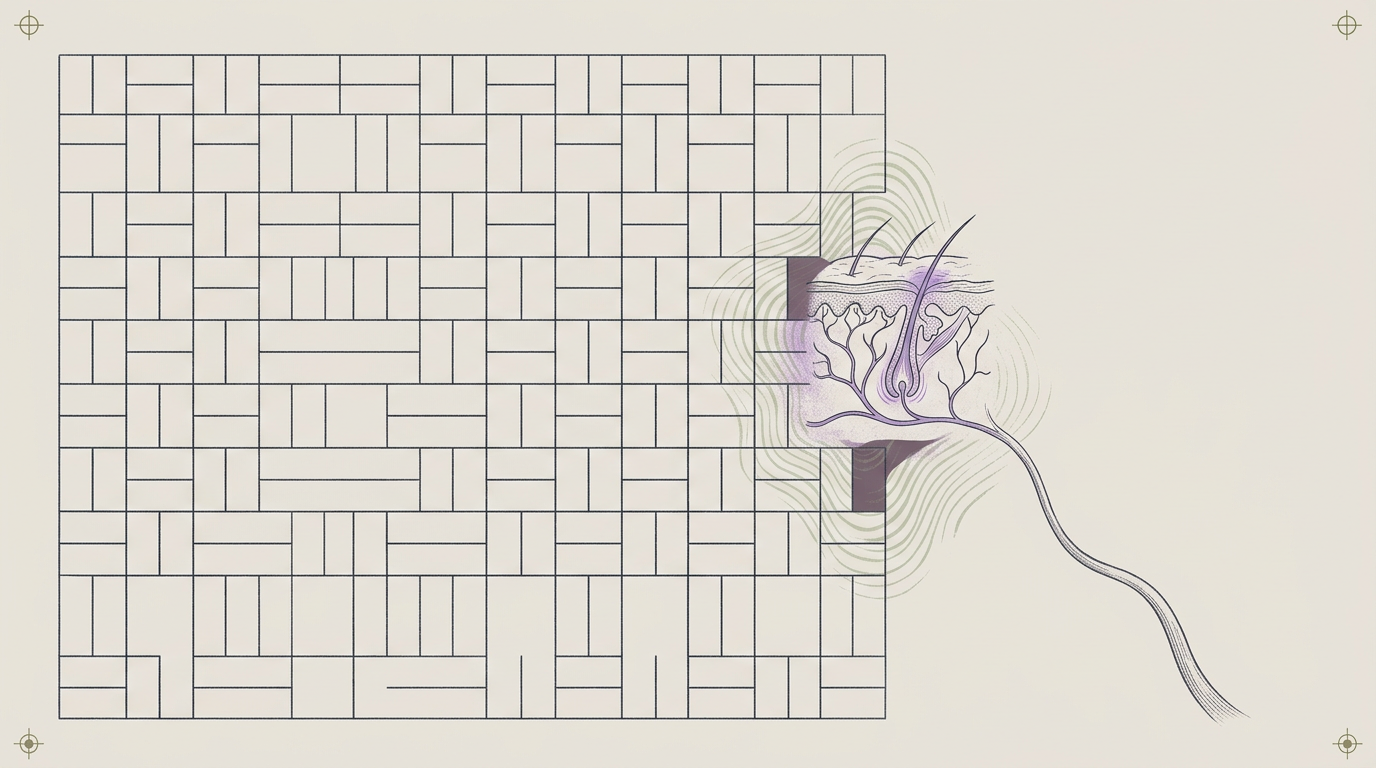
I used to think premenstrual skin sensitivity was a peculiar brand of irritability I just had to endure. The standard advice tells women to buy a thicker moisturizer, approaching an exposed nervous system like a dry elbow. When the seam of your bra suddenly feels like sandpaper, you're experiencing allodynia, a mechanical shift in how the central nervous system processes touch. It's driven by dropping hormones releasing the brakes on neuro-inflammation. You won't fix this with an expensive lotion.
You know the exact day it starts. The air brushing against your arms feels abrasive. You find yourself peeling off a familiar wool sweater because the fibers feel like fiberglass. The cat walks across your shins and you physically recoil. You try to explain to your partner why you need to sleep without the heavy duvet, and you sound unreasonable even to yourself. It is the phase where you feel exhausted but can't rest, lying awake because the sheets are suddenly too textured. You google why does my skin hurt for no reason or feel anxious for no reason at 11:47pm, assuming you're just unusually stressed. Your body is doing something highly specific. The nerve endings in your skin are firing a threat response to completely ordinary friction.
What allodynia actually is
This week I was reading a fascinating paper about how the immune system subjugates the brain, and it maps perfectly onto the late luteal phase. The wiring that usually tells your brain a cotton t-shirt is safe (A-beta fibers) gets temporarily cross-wired with the pathway that reports actual injury (C-fibers). The clinical name for this volume spike is central sensitization. It's the polite way of saying your nerves are reporting a fire when someone lit a match.
Three things converge to cause this volume spike. Estradiol falls, removing the natural chemical lid on microglia, which are the immune cells of your brain. Progesterone crashes alongside it, taking away allopregnanolone, a neurosteroid that powers your main calming neurotransmitter, GABA. Meanwhile, your sympathetic tone is already running high from regular daily friction. When your hormones bottom out to trigger a bleed—usually around Cycle Day 27—the nervous system is left entirely exposed. The threat gain stays cranked.
Cycle Day 27 and the viral crossover
This hormonal cliff explains why an ordinary head cold landing on Day 27 feels like a localized nightmare. A standard virus layered onto an unstabilized nervous system produces wild results. Your resting heart rate sits at 90 beats per minute on the sofa. Your skin burns when the air moves. You feel a heavy exhaustion that completely eclipses the actual illness.
The virus is exactly the same one your coworker sneezed onto the desk on Tuesday. The substrate it landed on is different. The viral immune response triggers peripheral nerve hyperexcitability, and with estrogen on the floor, your body has zero capacity to quiet the noise. The instinct to hide under a smooth silk sheet is just correct mechanics. You're reducing friction on sensitized nerves.
The skin is just the organ telling the truth about the nervous system.
The luteal protocol
You can't will this state away. Lowering the inflammatory floor and raising the vagal ceiling allows the drop in hormones to land somewhere softer. I learned this the hard way after years of dreading the final week of my cycle.
I changed my approach. Run this protocol from ovulation right through to the first day of bleeding.
- Add 100 to 200 calories to your morning meal. Undereating in the luteal phase spikes cortisol and crashes whatever allopregnanolone you have left.
- Sleep eight hours non-negotiably. Sleep loss alone raises mechanical pain sensitivity drastically within a single day.
- Lower your histamine load. Pass on the aged cheese and fermented foods for a week.
- Wear what doesn't hurt. Choose smooth cotton or silk to reduce constant low-grade input to A-beta fibers.
- Take 300mg of magnesium glycinate before bed to support smooth muscle relaxation and sleep staging.
Common Questions
Is premenstrual skin sensitivity normal or a sign of something wrong?
A mild increase in skin sensitivity before your period is a standard physiological response to falling estrogen and allopregnanolone. The nervous system loses its damping effect. Pain that actively disrupts your sleep, clothing choices, or ability to be touched signals central sensitization that requires mechanical regulation.
Why does a cold feel so much worse right before my period?
Estrogen is your body's native mast-cell stabilizer and anti-inflammatory. It drops sharply right before your period. A virus arriving at this exact moment lands on an unstabilized nervous system with hyperexcitable nerves and weak GABA inhibition. Your body processes the virus and the exposed nervous system as one overwhelming threat.
Will antihistamines help with the skin pain?
A second-generation H1 blocker in the late luteal phase can reduce the mast-cell contribution and soften the immediate discomfort. It bypasses the underlying nervous system sensitization, but it can buy you a manageable week while you implement deeper regulatory practices. Discuss this option with your doctor.
Does the pill fix cyclical allodynia?
Combined oral contraceptives flatten the hormonal cycle and remove the estrogen dip, which resolves the allodynia for some. For others, synthetic hormones increase the overall inflammatory load. Track your specific symptoms in the Journal for three cycles on and three off to gather accurate data about your own state.
What to do this week
- Circle Cycle Day 27 on your calendar and treat it like a deload week. The inbox has never once been impressed by your heart rate, so shift hard deadlines to day 5.
- Introduce a daily 30-second cold water face dip to recruit ventral vagal tone and drop your resting heart rate.
- Do five physiological sighs (double inhale through the nose, long exhale through the mouth) the moment you notice the clothing irritation starting.
Where this fits in the Kokorology system
This mechanical approach is exactly what Kokorology build inside the Skin & Hormones Anchor. It maps each phase of your cycle to the inputs your nervous system actually has the capacity to handle. If you need a foundation to build on, 1:1 somatic coaching sequences these protocols to your specific physical load, history, and current vagal tone.
Closing
The pain is a genuine signal from a system running with the lid off. Give the nerves a softer place to land.
- Start with the Skin & Hormones Anchor for cycle-aware protocols.
- Work with me in 1:1 somatic coaching to address persistent sensitization.
- Practice the daily floor inside the free regulation guide.
TL;DR
Premenstrual skin pain is allodynia, a condition driven by falling estradiol releasing the brakes on microglia and mast cells. Progesterone drops alongside it, weakening GABA inhibition, leaving a sympathetically loaded nervous system with zero reserve to absorb the hormonal shift. The crash bottoms out around Cycle Day 27. The solution requires lowering your inflammatory floor through sleep, food, and histamine reduction, while raising your vagal ceiling. Treat the week before your period as a protected deload for the nervous system to give the body a softer landing.
Sources
- Iacovides, S., Avidon, I., & Baker, F. C. (2015). What Kokorology know about primary dysmenorrhea today: a critical review. Human Reproduction Update.
- Vincent, K., & Tracey, I. (2010). Sex hormones and pain: the evidence from functional imaging. Current Pain and Headache Reports.
- Schiller, C. E., Schmidt, P. J., & Rubinow, D. R. (2014). Allopregnanolone as a mediator of affective switching in reproductive mood disorders. Psychopharmacology.
- Schuh-Hofer, S., et al. (2013). One night of total sleep deprivation promotes a state of generalized hyperalgesia. PAIN.
- Dantzer, R., et al. (2008). From inflammation to sickness and depression: when the immune system subjugates the brain. Nature Reviews Neuroscience.