Nervous System
Signs of a Dysregulated Nervous System
A dysregulated nervous system produces specific physiological readouts, from 3am wakefulness to skin flare-ups, that map directly to your autonomic state.
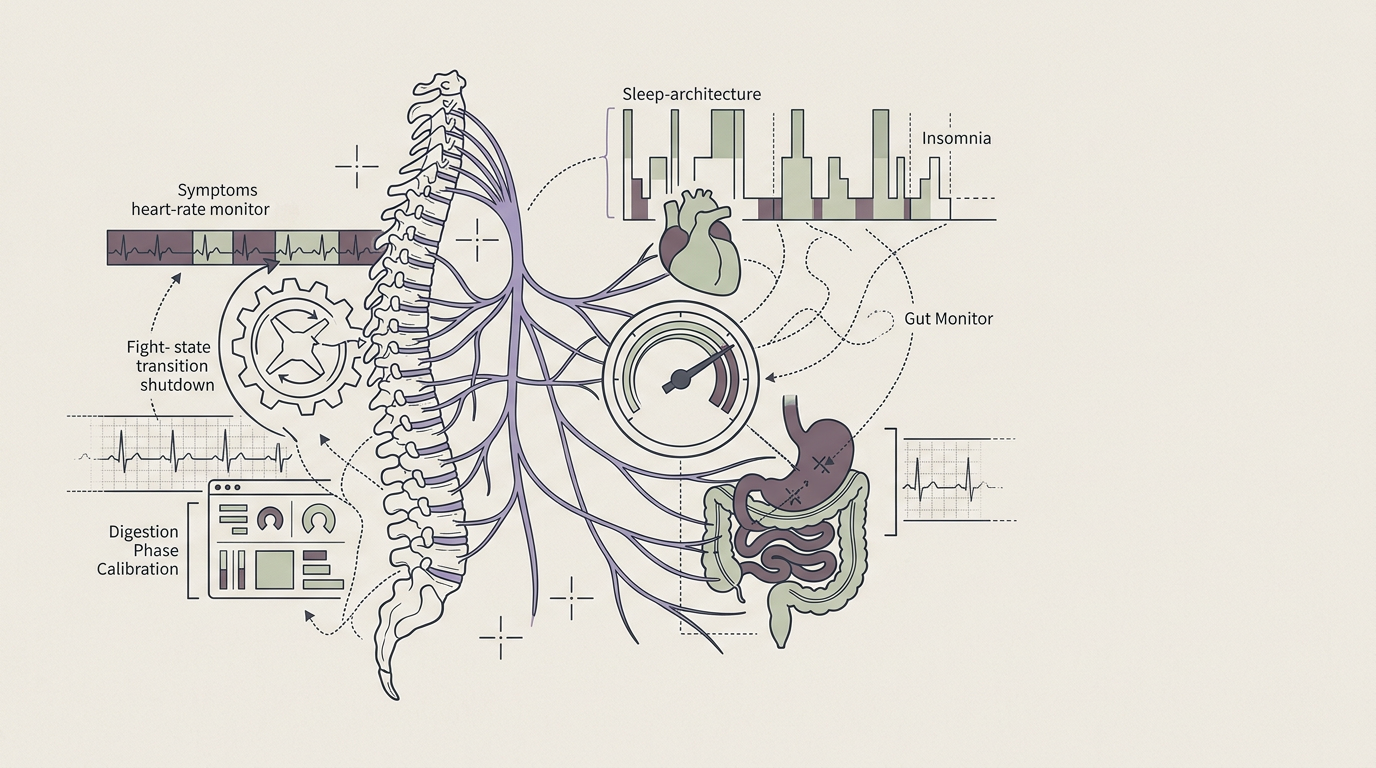
If you look up the signs of a dysregulated nervous system, you'll find a list that reads like a horoscope for tired people. The internet politely agrees to treat every symptom from tight shoulders to terrible digestion as generic stress. I've handed out versions of these lists myself in the past, assuming awareness was the entire job. Every signal your body sends is actually a highly specific readout of where your autonomic nervous system is stuck.
You already know what this feels like before you have the clinical vocabulary for it. It's the 3pm jaw clench you only notice when your teeth start to ache. It's the open fridge with absolutely no hunger. You feel tired but wired, vibrating with an urgent energy that prevents you from actually sitting down on the sofa. You wake up at 3am every night and immediately start rehearsing an email you don't need to send. You feel anxious for no reason while standing in the shower, your shoulders braced against an invisible threat. Sometimes the pendulum swings the other way, and you're hit with a wave of brain fog so thick you leave sentences half-finished. You're exhausted but can't rest, caught in a physiological holding pattern where the internal machinery is simultaneously accelerating and braking.
Common Questions
What does a dysregulated nervous system actually mean?
It means your autonomic nervous system has lost its flexibility. Instead of smoothly shifting gears between alert focus, deep rest, and social connection, the machinery gets stuck. You end up running survival patterns like fight-or-flight long after the actual environmental demand has passed.
Is a dysregulated nervous system permanent?
No. Autonomic flexibility is a physical capacity you can retrain. It requires specific, repeated inputs to teach the brain and body how to down-regulate from high alert back to baseline. You train it exactly the same way you'd train muscular endurance or cardiovascular fitness.
Can nervous system dysregulation cause physical symptoms?
Yes. The brain is constantly interpreting data from your internal organs through a process called interoception. When the system is chronically stuck in threat detection, it changes how your body allocates resources, triggering very real physical changes like skin inflammation, disrupted digestion, and an altered resting heart rate.
The 'Go' Pedal Stuck On
People usually call this state anxiety, but the physiological name is sympathetic activation. Your thoughts race, your heart rate sits a few beats higher than normal, and you carry a low-grade feeling of dread into perfectly ordinary meetings. This is the HPA axis—the loop connecting your brain to your adrenal glands—pumping out cortisol and adrenaline.
These chemicals exist to help you evade immediate physical danger. They're actively unhelpful for scrolling through your phone in bed. When the engine runs hot for too long, you accumulate physiological wear and tear. This is why you feel so thoroughly depleted even when you haven't done any physical work. For anyone trapped in this hypervigilant pattern, learning to manually pull the emergency brake is the first step I teach in nervous system regulation.
The Immobilisation Drop
The other end of the spectrum is completely muffled. You feel heavy, disconnected, and profoundly lethargic. Motivation drops to zero, and the primary ambition for the day is simply to lie horizontally in a quiet room.
This is a biological state of conservation governed by the unmyelinated part of your vagus nerve. When the nervous system calculates that fight or flight will fail, it slams on the brakes and initiates a shutdown response. It's an ancient, highly effective disappearing act. Trying to aggressively caffeine your way out of this state usually backfires, pushing you straight into a jittery panic. The intervention here is gentle, slow re-engagement, which is why I map these exact shifts inside the Kokorology Journal.
The Skin and Gut Readouts
The most dismissed signals of a stuck system appear on your skin and in your digestion. Eczema flare-ups, sudden rosacea, and relentless bloating are direct reports from your internal environment. Your skin and your nervous system develop from the exact same embryonic tissue, the ectoderm, and they remain in constant communication through the brain-skin axis.
When your HPA axis floods the system with cortisol, it compromises the skin's barrier function, letting moisture out and irritants in. At the exact same time, stress triggers local nerve endings to release neuropeptides that drive physical inflammation.
Your gut tells a similar story. The enteric nervous system communicates with headquarters primarily through the vagus nerve. When you're locked in high alert, the body forcefully diverts blood flow away from digestion. Enzyme production drops. The mucosal lining thins. That gut feeling of dread is a literal, mechanical shift in your organs. I take the mechanics of this apart deeply in the Gut-Immune Anchor.
The system is perfectly logical. It is just responding to a threat that ended three years ago.
What to do this week
- Track the direction of the state. For the next three days, when you feel off, just notice if the energy is moving up (agitated, racing) or down (heavy, numb). Stop trying to fix it immediately.
- Use temperature to interrupt. If you're stuck in a hyper-mobilised sympathetic state, put an ice pack on the back of your neck for sixty seconds. The cold exposure forces a brief, hard reset of the vagal pathways.
- Anchor your morning light. Before looking at a screen, get outside and let ten minutes of natural sunlight hit your eyes. This sets the central circadian clock and regulates your baseline cortisol pulse for the rest of the day.
Where this fits in the Kokorology system
Mapping these physical readouts is the diagnostic starting point for everything I teach. Once you know which state you default to, you can use the targeted protocols in the Anchors or apply the immediate tools in the Hacks library to shift the machinery in real time.
Closing
A list of symptoms is just data. Your body is communicating its capacity limits with perfect clarity, and your job is to learn the language it is speaking. The next move is taking that data and actively changing the inputs.
- Start with a guided exploration of your patterns in The Reset.
- Continue inside the Kokorology Journal for daily state-tracking.
- Sit with this in the free guide to autonomic states.
TL;DR
A dysregulated nervous system produces distinct physiological patterns, not a random collection of ailments. Feeling wired, anxious, and unable to sleep indicates a sympathetic hyper-arousal state driven by an overactive HPA axis. Conversely, feeling heavy, numb, and disconnected points to a dorsal vagal shutdown response. These states also drive physical symptoms like skin inflammation and digestive issues through the brain-skin and gut-brain axes. The goal is identifying your dominant pattern so you can apply the correct physiological intervention.
Sources
- Critchley, H. (2023). Interoception and Autonomic Regulation in Stress. Journal of Neuroscience.
- Feldman Barrett, L. (2017). How Emotions Are Made: The Secret Life of the Brain. Houghton Mifflin Harcourt.
- McEwen, B. S. (2017). Neurobiology of stress, resilience, and allostatic load. Biological Psychiatry.
- Pennebaker, J. W. (2023). Journaling and the nervous system: from expressive writing to affect labeling. Curated meta-analyses and primary studies (1986–2023).