Journal Practice
Self-assessment is mostly about background noise
Stop trying to edit the story of your feelings. Self-assessment is noticing the background static your brain uses to write the first draft for you.
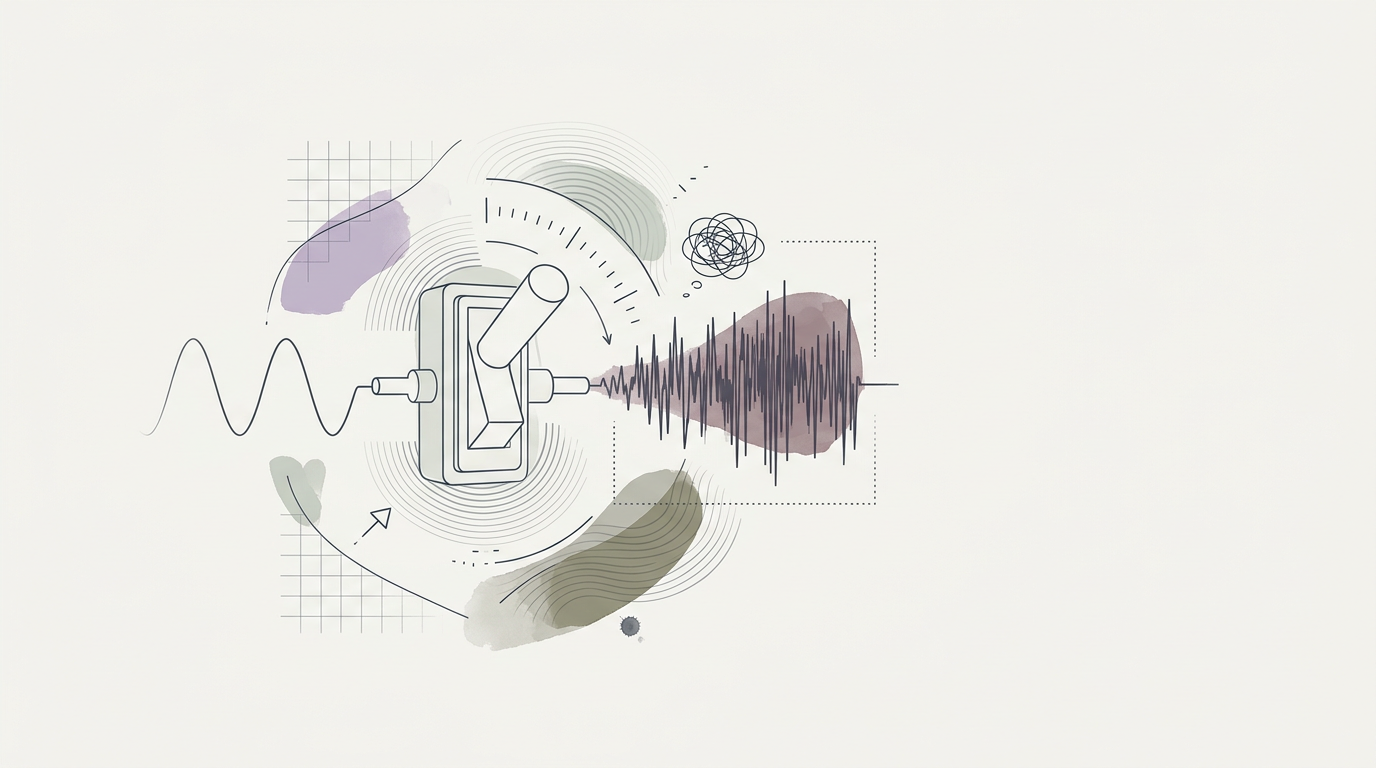
The journaling industry sells an elegant illusion: that the right prompt will open some deep emotional truth. This turns your inner life into a script to be perfected, trapping you in the exact thought loops you’re trying to escape. Effective journaling is not about writing a better story. It’s a practice of noticing the background noise your brain already uses to make its decisions about you.
It’s the Tuesday after a long weekend. The August holidays are a memory. You feel a low-grade hum of dread, a familiar static behind your eyes. You blame the inbox, the meeting you don’t want to attend, the sheer weight of the to-do list. That feeling is the raw signal of your nervous system registering a change in context. The ‘rest’ channel has been switched off and the ‘work’ channel is on, complete with all its associated interference. The narrative is secondary. The signal is the shift itself.
Your brain sees the frame, more than the picture
Your brain is a ruthless efficiency machine running on a surprisingly tight energy budget. To conserve resources, it doesn't assess every piece of data from scratch. Instead, it uses context as its primary shortcut, constantly making predictions about what will happen next. This predictive processing is your brain’s best guess at reality, designed to keep you safe and save metabolic energy. When the prediction is wrong, your brain issues an error signal, which you often experience as a jolt of surprise or anxiety.
This whole operation runs on a principle of predictive regulation, or allostasis. Your brain actively anticipates the energy you’ll need for a given situation and pre-allocates resources. When your calendar says "Tuesday, 9am," your brain doesn't wait for you to feel stressed by your first meeting. It looks at the context—the day of the week, the time, the open laptop—and predicts a higher demand on your system. It nudges the sympathetic nervous system (your 'gas pedal') and primes the HPA axis to make cortisol available. This is not a mistake. It’s a feature, designed for a world of acute physical threats, but now it runs on a calendar full of meetings. It interprets a full inbox with the same vigilance it once reserved for a predator.
You have seen this in visual illusions where two squares of the exact same shade of grey look completely different depending on the shadows cast around them. Your brain does not see the 'truth' of the grey square. It sees the square in its context and makes a rapid, comparative judgment. The background becomes part of the data. This is a core feature of your perceptual system, designed for metabolic efficiency.
The same mechanism applies to your internal state. When your context shifts from ‘long weekend’ to ‘work week’, your brain preemptively loads a different operating system. It swaps the low-demand 'rest and digest' software for the high-demand 'perform and defend' software, which is tuned for deadlines, social evaluation, and sustained focus. This comes with a higher physiological running cost, and it also changes the user interface of your perception. Things feel different because the system is primed to interpret them through a lens of threat and demand. You don’t experience a feeling in a vacuum. You experience it inside the context of low blood sugar, a crowded room, or a looming deadline. Most self-assessment asks you to describe the picture—your feeling—without ever looking at the frame.
A journal for noticing the background noise
The journaling industry sells beautiful notebooks and prompts designed to make you write a better story about yourself. This is navel-gazing as a service. It often traps you in the very loops of thought you’re trying to escape, reinforcing the story that your feelings are a character defect to be analysed and solved. A useful journal is a field guide to your own internal weather, a tool for logging the atmospheric conditions that shape your state before the storm of emotion arrives.
The practice is to shift your focus from emotional archaeology to present-moment sensory data. Instead of asking ‘How do I feel?’, you ask ‘What is the context?’ This is a direct intervention on your brain's circuitry. When you move from a complex emotional story ("I'm overwhelmed by work") to a list of neutral sensory observations ("fluorescent lights, jaw is tight, sound of the server fan, sitting for 90 minutes"), you are literally changing which parts of your brain are active.
The technical term is affect labelling. This simple act of naming engages your prefrontal cortex, which has a regulatory, quieting relationship with your amygdala (the brain’s alarm system). You are moving from the reactive, story-telling circuit to the observing, regulating circuit. It’s the difference between being caught in the rain and being the meteorologist in the station tracking the pressure drop.
This is the critical difference between this practice and rumination. Rumination is getting stuck in the story, replaying the emotion and its imagined causes. This strengthens the emotional circuit, like exercising a muscle, making it easier to default to that state in the future. Affect labelling does the opposite. By putting a simple, non-judgmental name to a sensory experience, you interrupt the loop. You are not trying to solve the feeling or justify it; you are simply acknowledging the raw data. This builds your capacity for interoception—the skill of perceiving the internal state of your body. High-resolution interoception is the ability to distinguish between 'I feel bad' and 'My blood sugar is low, I'm dehydrated, and I've been holding my breath'. One is a useless narrative; the other is a list of solvable problems.
Tonight's practice
This practice builds the capacity to notice the signal from the noise. It is not about finding a profound insight. Do this for five minutes before you close your laptop for the day. Use a plain notebook or the Kokorology Journal.
What were the sensory inputs of the last three hours?
- Set a timer for 5 minutes.
- Open to a new page and write today’s date.
- Answer the prompt above by listing inputs without judgment. Examples: fluorescent lights, the smell of stale coffee, two espressos, the sound of a colleague’s keyboard, sitting for 180 minutes, the pressure of my waistband, a 30-gram protein snack, a difficult email.
- Be as neutral and specific as possible. "The sound of a notification" is more useful than "distracting noises."
- When the timer goes off, close the book. Do not analyze it. The practice is the noticing, not the interpretation.
Common Questions
What if I can't identify any specific 'cues'?
That is the point of the practice. At first, you might not notice much. Start with the obvious: what you ate, the room temperature, the last person you spoke to, the chair you're sitting in. The skill is not in finding one magic cue, but in the repeated, quiet act of looking. Think of it like tuning a radio. At first, all you hear is static. By patiently adjusting the dial day after day, you start to pick out faint stations. The practice is about learning how to work the dial.
Is this just another way to overthink my feelings?
It is the opposite. This practice directs your attention away from the looping story about the feeling and toward the raw, sensory data that precedes it. It is less thinking, more noticing. Overthinking keeps you trapped in the 'why', which is often a fictional story your brain invents after the fact. Noticing focuses on the 'what'—the physical, observable reality of the moment. It grounds you in the present, which is the only place regulation can actually happen.
How is this different from a gratitude journal?
A gratitude journal asks you to generate a specific positive state by focusing on positive things. This practice asks you to neutrally observe all incoming data—positive, negative, or neutral—without trying to change it. It is a diagnostic tool, not an emotional intervention. A gratitude practice is a top-down instruction: you tell your brain to find positive things. This sensory practice is bottom-up: you ask your body what information it is receiving. One is about changing your focus; the other is about improving your resolution.
Closing
Journaling is a physical practice. It’s about using language to interface with your physiology. When you’re ready to stop narrating your state and start changing it, here are the next steps.
- Start logging your context with the Kokorology Journal.
- Go deeper on the mechanisms of state change with the Nervous System 101 guide.
- Read a free post on why brain fog after meetings is a physiological signal.
TL;DR
Stop trying to write a better story about your feelings. Your brain processes your state based on context, just as a shadow can make two identical colours look different. Effective journaling is a sensory data log. Instead of asking 'Why do I feel this way?', ask 'What is the context?'. This shift from narrative to neutral observation is a direct lever on your nervous system, using language to quiet the brain's alarm circuits without the self-help speech.
Sources
- Pennebaker, J. W. (2023). Journaling and the nervous system: from expressive writing to affect labeling. Curated meta-analyses and primary studies (1986–2023).
- Lieberman, M. D. (2023). Communication with others and oneself: language as a nervous-system intervention. Curated primary studies and meta-analyses (1994–2023).
- Chandola, T., Brunner, E., & Marmot, M. (2008). Work stress and coronary heart disease: What are the mechanisms?. European Heart Journal, 29(5), 640–648.
- Kok, B. E., Coffey, K. A., Cohn, M. A., Catalino, L. I., Vacharkulksemsuk, T., Algoe, S. B., & Fredrickson, B. L. (2013). How positive emotions build physical health: Perceived positive social connections account for the upward spiral between positive emotions and vagal tone. Psychological Science, 24(7), 1123–1132.