Nervous System
Self-Regulation and the Nervous System
Self-regulation isn't about willpower. It’s an engineering problem, not a moral one.
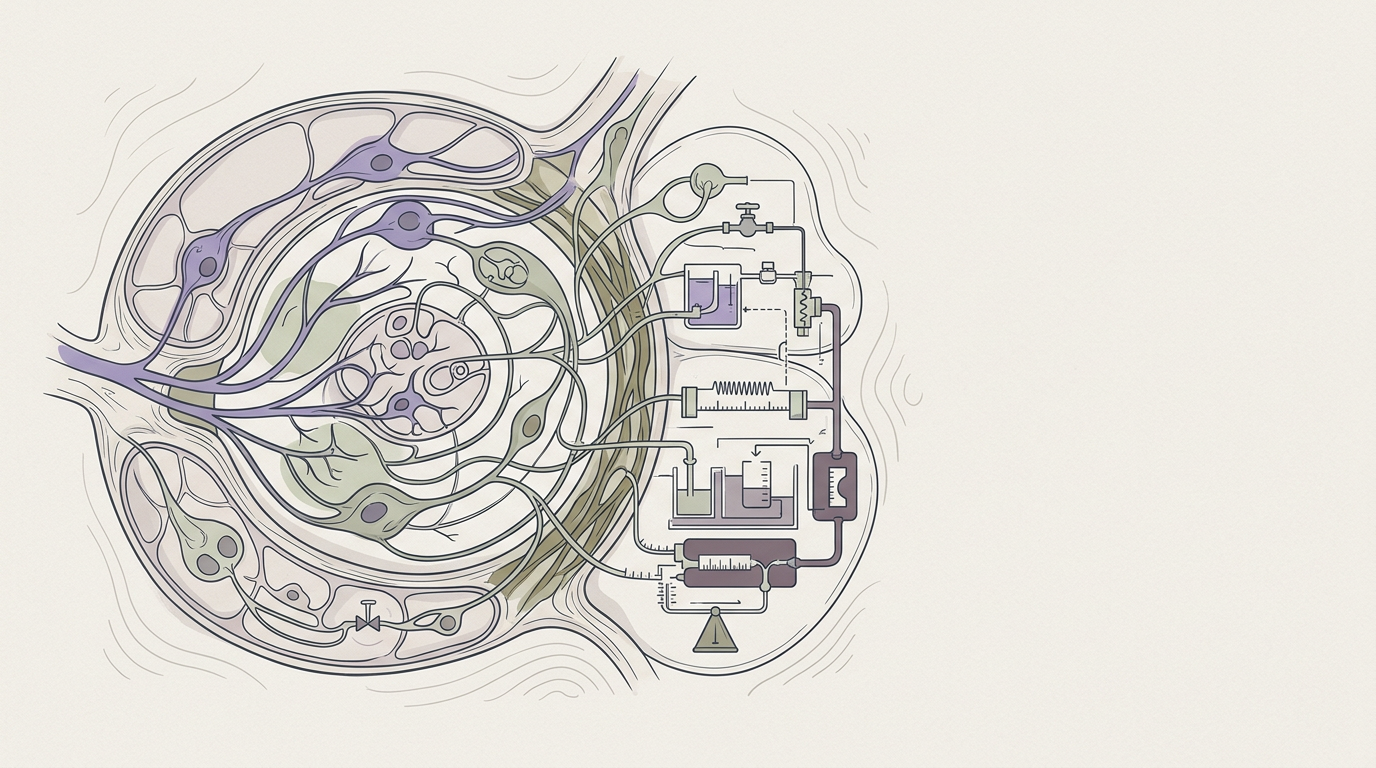
"Just take a deep breath and choose your reaction." I read some variant of this advice every single day. The wellness industry treats self-regulation as a test of pure discipline. They expect you to out-think a biological survival sequence with a positive mindset. Self-regulation and the nervous system are the exact same mechanism. When the body's autonomic state shifts, the mind is dragged right along with it.
You feel the deficit as a low buzz behind the eyes. It’s the jaw you find clamped shut at 3pm, the open fridge with no real hunger, the half-finished sentence that trails off in a meeting. You find yourself feeling anxious for no reason during a perfectly ordinary Tuesday. You scroll your phone until 11:47pm, knowing you need to rest, but your body is still processing the unclosed loops from the afternoon. When your head finally hits the pillow, you're tired but wired. Then you wake up at 3am every night with a racing heart, and the next day is a wash of brain fog and a painfully short temper. Your physiological capacity to meet the demands of the environment has simply run out.
Common Questions
What is self-regulation, really?
Self-regulation is your nervous system's capacity to manage stress, energy, and attention without becoming overwhelmed. It involves the physiological ability to stay within a regulated state. Your body adjusts autonomic arousal to match the environment, allowing you to process inputs smoothly.
Why does willpower fail me?
Willpower is a finite cognitive resource that depletes quickly under stress. When the body detects a threat, the prefrontal cortex goes offline, leaving older, faster neural pathways in charge. Relying on sheer effort to calm down ignores the biology of human survival.
What does the nervous system have to do with it?
Your nervous system dictates your baseline state. It controls the stress response, heart rate, and emotional reactivity. A chronically activated system will consistently produce reactive feelings and behaviours, rendering positive affirmations entirely useless in the moment.
The Upstream Problem
The first unhelpful myth suggests regulation happens in the exact moment of crisis. Kokorology're taught to wait until the amygdala is screaming about a perceived threat before Kokorology do anything. I used to believe I just needed better coping strategies for when things got heated. I've spent years trying to breathe my way out of active panic. The trouble with that approach is that the prefrontal cortex—the part of the brain that remembers your breathing exercises—has already been taken offline by the stress response.
Effective regulation works upstream. You address the physiological state that makes you so quick to snap in the first place. This is the core of nervous system regulation, a deliberate project to increase your baseline capacity. When you expand that capacity, the daily friction of life doesn't send you into an immediate tailspin.
The Wear and Tear
Every demand you encounter requires energy. A looming deadline, a difficult conversation, or even the glare of fluorescent lights in a supermarket all trigger the Hypothalamic-Pituitary-Adrenal (HPA) axis. This is the command loop running from your brain to your adrenal glands, pumping out cortisol to meet the moment. The trouble with cortisol is everyone has heard of it, and no one knows what it does. It mobilises glucose so you have the fuel to act.
When you constantly mobilise energy without sufficient recovery, you accumulate allostatic load. This is the clinical term for the cumulative wear and tear on your body from chronic stress. It explains why you feel thirty years older after a brutal project. Your system is constantly surging, trying to keep you safe from a calendar invite. The inbox has never once been impressed by your heart rate. You lower this load through structured, repeated practice, which is exactly what Kokorology do in the seven-day Reset.
You Cannot Regulate What You Cannot Sense
Here is the part that most of the conversation misses entirely. The gateway to regulation is interoception. This is the brain's ability to sense the internal state of your body—the raw data feed of your heart rate, gut tension, and body temperature. This information is processed in a deep brain region called the insular cortex, which essentially generates your moment-to-moment feeling of being alive.
When this sense is dull from chronic stress or from ignoring your body's signals for years, your brain is flying blind. It only registers a problem when the alarm is blaring. You didn't go from zero to a hundred in a split second. You just missed the subtle signals at ten, twenty, and thirty because your interoceptive awareness was offline. Reconnecting that circuit is mandatory, often starting with a tool as simple as the Journal.
The Rhythm
Finally, your entire regulatory system is tethered to a master clock. The circadian rhythm governs nearly every physiological process, from hormone release to body temperature to cell repair. The wellness industry has somehow turned waking up into a punishingly competitive morning routine involving a dozen supplements. I'm calling it. Most leadership advice is just napping with extra steps.
The rhythm is set by a few powerful, non-negotiable cues: light, food, and movement. Getting bright, natural light in your eyes shortly after waking anchors the entire clock for the day. Keeping meal times relatively consistent prevents your metabolism from running on a completely different schedule than your brain. This quiet, background regulation works entirely out of sight. the system hustle culture, with its late-night grinds and skipped lunches, actively degrades this baseline capacity.
The vagus nerve is the parking brake of the nervous system; pull it, and the engine quiets.
What to do this week
- Anchor your morning light. Before you look at a screen, get 5–10 minutes of direct, natural sunlight. Stand by a window, on a balcony, or step outside. This triggers the initial cortisol pulse that sets your clock.
- Run a midday interoceptive scan. Set an alarm for 2pm. When it goes off, notice where you are holding tension. Check if your jaw is tight. See if you are breathing into your chest or your belly. Do not try to fix it. Just observe the data. Kokorology use this heavily in the Hacks library.
- Define a hard stop. Choose a time to be done with work for the day, and ritualise it. Close the laptop and walk away. The act of creating a boundary tells your nervous system the demand period has ended.
Where this fits in the Kokorology system
Self-regulation is the central practice of maintaining your human capacity. Understanding these mechanisms is the first step toward moving from a state of chronic depletion to one of sustainable output. It is the exact curriculum Kokorology teach inside Regulation L1.
Closing
Developing a nervous system with a wide buffer allows you to experience the full range of human feeling without being constantly capsized. You develop the capacity to meet the messy, demanding life you actually have, rather than waiting for an entirely frictionless Tuesday that is never going to arrive.
- Start training your baseline inside Regulation L1.
- Practice daily interoception with the Journal.
- Get the free guide to your nervous system.
TL;DR
The standard approach to self-regulation relies on overriding your biology with sheer discipline. True self-regulation and the nervous system operate as a single physiological mechanism. Managing stress requires expanding the capacity to handle demands before they arrive. This involves supporting your HPA axis, reducing allostatic load, improving interoception through the insular cortex, and anchoring your circadian rhythm with light and food. You change the state, not the attitude.
Sources
- Terrie E. Moffitt (2011). A Gradient of Childhood Self-Control Predicts Health, Wealth, and Public Safety. PNAS.
- Julian F. Thayer & Andrew H. Kemp (2010). Cardiac vagal control and the neurovisceral integration model. Neuroscience & Biobehavioral Reviews.
- A.D. (Bud) Craig (2009). How do you feel—now? The anterior insula and human awareness. Nature Reviews Neuroscience.
- Melis Yilmaz Balban (2023). Brief Structured Respiration Practices Enhance Mood and Reduce Physiological Arousal. Cell Reports Medicine.