Workplace & Leadership
Regulated Feedback Without Corporate Theatre
That radical candour script is not the feedback. The physiological weather you create in the room is.
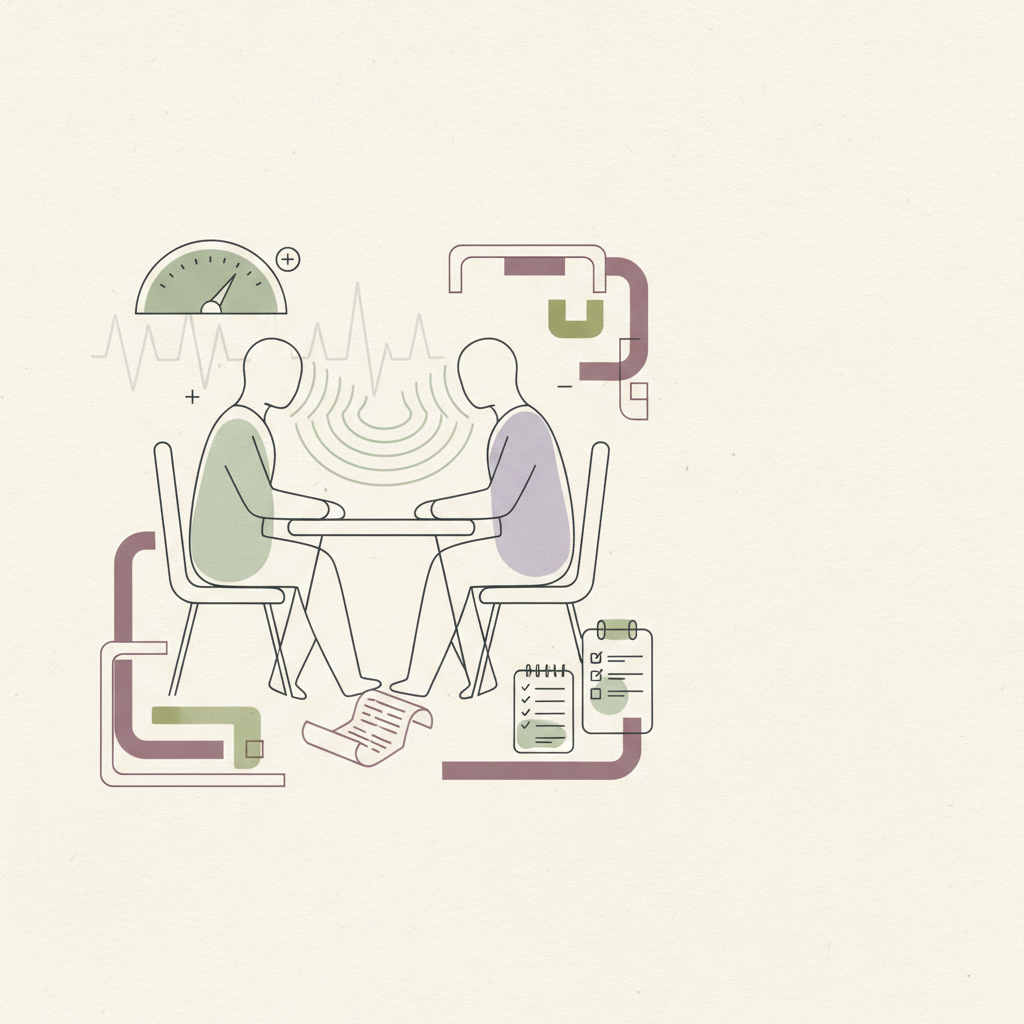
Every HR department on earth has a document telling you exactly how to give difficult feedback. They hand you a script, a sandwich model, and a polite smile. What they fail to mention is that if your autonomic nervous system is broadcasting a threat signal, the person sitting across from the desk cannot process a single word you are saying. The corporate world treats communication as a pure data transfer. Mammalian biology treats it as an exercise in threat detection and regulation.
You have the one-on-one booked for 3pm, and a low-grade dread sets in right after lunch. You rehearse the talking points while staring at a blinking cursor, feeling your jaw clamp shut. During the meeting, you watch the other person’s face go completely blank. You talk, but nothing lands. Afterward, the team dynamic is profoundly off. You spend the evening feeling anxious for no reason, wondering how to deliver a critique without sounding unhinged. By 11:47pm, you are doom-scrolling management advice in the dark. You feel tired but wired, your mind endlessly replaying the conversation. The next morning, you wake up exhausted but can't rest, dreading the moment you have to walk back into the office and pretend the air is clear.
Common Questions
What does physiological weather mean in leadership?
It refers to the state your nervous system is projecting outward. If you are stressed, your breathing pace and vocal tone shift. People around you subconsciously pick up on these biological markers and adjust their own defensive states to match yours.
Why do radical candour frameworks fail in practice?
A script cannot override biology. When a manager delivers carefully constructed feedback while their own heart rate is elevated, the recipient's brain detects the physical tension. They immediately shift into a survival state, rendering them physically unable to process complex information.
Can my team sense when I am faking calm?
Instantly. They read it in the micro-tensions in your face, the shallowness of your breath, and the lack of melodic variation in your voice. You project a physiological forecast, and your team unconsciously dresses for the weather you provide.
The Biological Reality of the One-on-One
The entire industry built around workplace communication assumes that if the words are precise enough, the message will land cleanly. I am calling it. That is a dangerous misunderstanding of human hardware. A difficult conversation relies entirely on co-regulation, the constant, non-verbal exchange of safety and threat cues between two nervous systems.
If you walk into a performance review carrying the residual stress of your morning schedule, your system is highly activated. You are behaving like a predator. The person sitting opposite you experiences a rapid, involuntary shift in state. Their hearing literally narrows to focus on immediate danger sounds. Their access to the prefrontal cortex—the part of the brain responsible for nuance, creativity, and receiving new information—shuts down completely. You just increased their allostatic load for the week. They are surviving an encounter with a threat.
The most beautifully crafted feedback in the world bounces right off a brain that is actively preparing to flee the room. Kokorology spend millions of dollars training managers on how to structure a sentence, and zero dollars teaching them how to lower their own heart rate before they speak.
The Neurobiology of the Broadcast
Let’s look at the mechanics. Your capacity for nervous system regulation is directly tied to heart rate variability (HRV), the beat-to-beat variation in your heart's rhythm. High HRV indicates a flexible, resilient system that recovers quickly from stress. Low HRV means the system is stuck in a state of high arousal, running heavily on cortisol and adrenaline. This metric possesses a massive broadcast radius that impacts everyone in your immediate vicinity.
When your system is stressed, the vagus nerve alters its signalling to the larynx. Think of the vagus nerve as the parking brake for your internal organs; pull it, and the engine quiets. When that brake releases during stress, the muscles in your throat tighten. This flattens your vocal prosody. You lose the natural, melodic ups and downs that signal safety to another mammal.
The listener’s amygdala detects this flat, monotonous tone and flags it as a primary threat long before their conscious mind registers your perfectly crafted opening sentence. They brace for impact. Two different managers can deliver the exact same difficult message, and one sparks a breakthrough while the other sparks a resignation. The words were identical. The physiological music changed entirely. You can explore the mechanics of this vocal shift in the Library.
The Mismatch of the Polite Smile
The standard corporate advice is to wedge a critique between two compliments. Kokorology all know exactly how this feels to receive. The recipient hears the opening praise, immediately recognizes the pattern, and simply waits for the blow.
This approach completely ignores interoception, the brain's ability to track the internal state of the body. When a manager forces a polite smile while internally dreading the conversation, the mismatch creates extreme physiological static. The listener feels that dissonance immediately. Their heart rate climbs. They start scanning the room for the actual threat. The prefrontal load required to suppress an autonomic threat response while trying to deliver constructive criticism burns massive amounts of energy. The jaw locks. The neck stiffens.
The most important part of a difficult conversation happens before you open your mouth.
I used to believe that if I just memorised the right frameworks, I could manage any team dynamic smoothly. I tested every model on the market. Every protocol I teach, I tested on myself first, and the standard scripts consistently failed me. The breakthrough happened when I stopped rehearsing my words and started regulating my breath before I touched the door handle.
Establishing the Baseline
A regulated leader acts as a biological signal of safety. This creates the exact physical conditions required for honesty and actual performance. If you want a team that can handle direct, difficult conversations, you have to build the capacity to sit in those conversations without spiking your own adrenaline.
The work requires recognizing your own physical cues when you feel challenged. You must notice the tension creeping into your shoulders or the sudden shallowness of your breath, and consciously downshift your state. The inbox has never once been impressed by your heart rate. Your team, however, is deeply reliant on it.
You can begin tracking your own daily activation levels and learning your specific stress cues using the Journal. Recognizing the physical sensation of your own dysregulation prevents you from accidentally projecting it onto a subordinate during a Tuesday afternoon check-in.
The Recovery Cost of Dysregulation
Consider the aftermath of a badly delivered review. The employee returns to their desk, but their system remains in high gear. They cannot focus on deep work. They snap at a colleague over a minor issue. They go home and carry that activation into their evening.
This is physiological wear and tear, accumulating across a department. When a leader consistently operates from a state of hypervigilance, they force everyone around them to do the same. The cost arrives in the form of burnout, disrupted sleep staging, and a complete collapse of team cohesion. A 10-minute dysregulated chat often requires a 45-minute recovery period for the recipient just to get their resting heart rate back to normal.
Treating regulation as a non-negotiable daily practice changes the entire environment. When I see leaders implement a simple pre-meeting breathing protocol, the shift in team dynamics is immediate and obvious. People stop defending themselves and actually start doing their jobs.
What to do this week
- Set a 120-second timer before your next difficult conversation. Sit in a quiet room and locate the physical tension in your body. Notice your jaw, your neck, and your breathing pace. State recognition is the necessary first step.
- Record a one-minute voice note on your phone immediately after a stressful meeting, summarizing the outcome. Play it back and ignore the words entirely. Listen to the pitch and pace of your voice to hear exactly what your team just experienced.
- Force a 15-minute recovery gap between two intense blocks of work tomorrow. Stare at a wall, drink 300ml of water, and allow your heart rate to drop.
Where this fits in the Kokorology system
This approach to leading complex team dynamics sits inside the Performance course for advanced capacity building. It moves past basic communication skills to address the physical reality of leading a group of mammals. If you are dealing with a deeply ingrained pattern of team tension, targeted Coaching provides the fastest route to state change, giving you specific tools to lower your own activation before stepping into the room.
Closing
Stop relying on corporate scripts to do the heavy lifting of human connection, and start addressing the physiological weather you bring to the room.
- Start with the foundations of state control in Regulation.
- Rebuild your leadership baseline inside Performance.
- Use the short, targeted interventions in Hacks before your next meeting.
TL;DR
Corporate feedback frameworks fail because they treat communication as a purely intellectual exchange, entirely ignoring the autonomic nervous system. When a manager delivers a critique while physically stressed, their body broadcasts a threat signal that shuts down the recipient's ability to process nuance. Effective leadership requires regulating your own physiological state first. A grounded, calm nervous system creates the biological safety required for difficult information to land cleanly and for teams to function without accumulating chronic stress.
Sources
- Julian F. Thayer & Andrew H. Kemp (2009). Neurovisceral integration of emotion, cognition, and health. In Handbook of Neuroscience for the Behavioral Sciences.
- Julianne Holt-Lunstad (2024). Loneliness and HPA-Axis Dysregulation: Meta-analysis of 47 Studies. Psychological Bulletin.
- Matti Kivimäki (2018). Work stress and risk of death in men and women with and without cardiometabolic disease: A multicohort study. The Lancet Diabetes & Endocrinology.
- Melis Yilmaz Balban (2023). Brief Structured Respiration Practices Enhance Mood and Reduce Physiological Arousal. Cell Reports Medicine.