Nervous System
The quiet tax of anabolic resistance after 40
The official protein target of 0.8 grams per kilogram is a starvation ration that forces your nervous system into chronic threat detection.
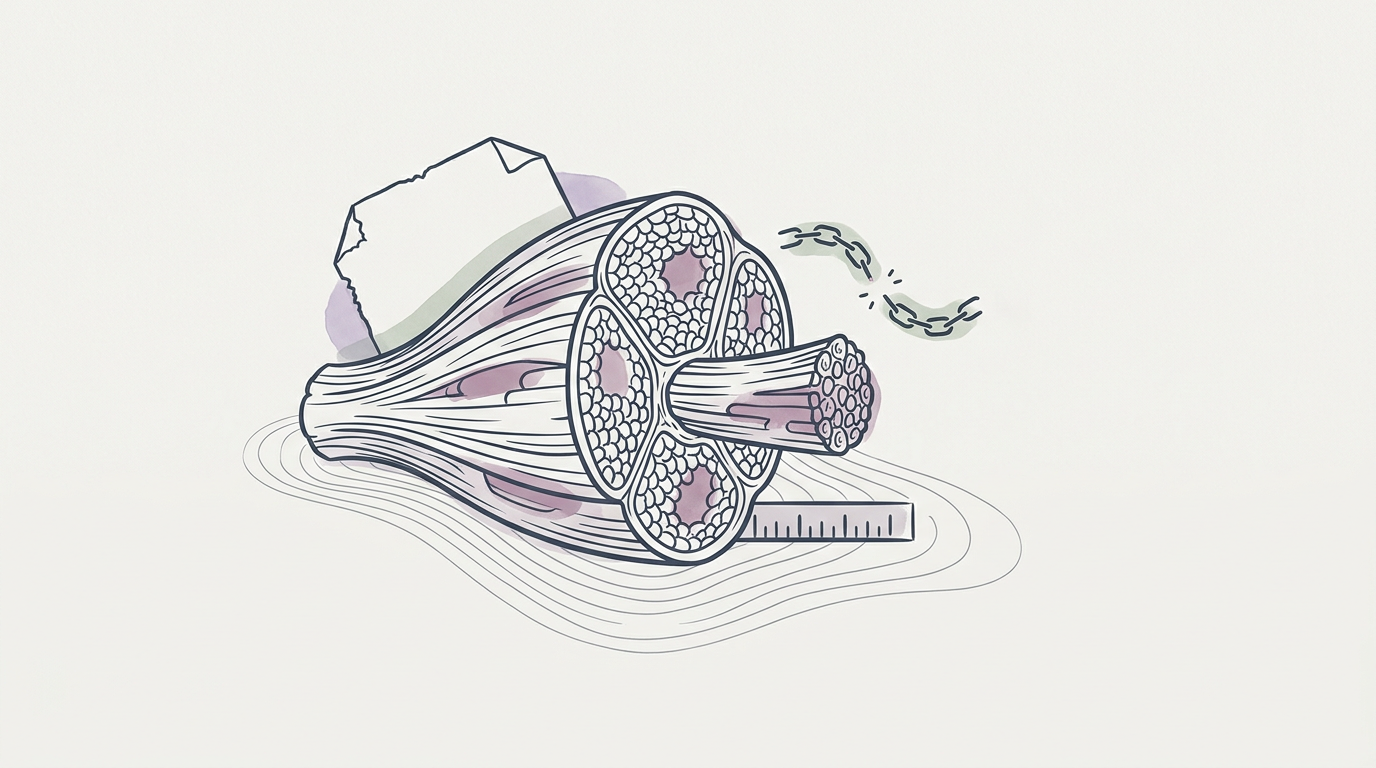
The official dietary protein target for women sits stubbornly at 0.8 grams per kilogram of body weight. That number is a starvation metric designed to prevent outright malnutrition, entirely divorced from what it takes to actually run a human body. Following it past the age of 40 forces your nervous system into chronic threat detection. When your skeletal muscle is under-fueled, the HPA axis—the loop controlling stress hormones from your brain to your adrenal glands—reads the resulting tissue breakdown as a metabolic crisis, locking you into a state of sympathetic overdrive.
You're probably eating exactly what the magazines tell you to. A salad at lunch, a handful of almonds, an egg. But the physical reality tells a different story. You feel a creeping, hollow fragility. You wake up at 3am every night, staring at the ceiling, exhausted but can't rest. Workouts that used to leave you buzzing now flatten you for two days, leaving a heavy brain fog behind your eyes. You find yourself pacing the kitchen at 4pm, tired but wired, opening the fridge without any actual hunger. Your grip fails on a stubborn jar, and your shoulders remain permanently fixed near your ears even when you stand in a hot shower. You are experiencing the physical reality of a body consuming its own tissue to meet the day's energy demands.
Common Questions
How much protein do I actually need after 40?
Aim for 1.2 to 1.5 grams of protein per kilogram of your ideal bodyweight every day. If you are actively lifting heavy things or recovering from an illness, push toward the higher end of that range. Divide this into distinct meals that carry at least 30 grams each.
Does a high-protein diet damage healthy kidneys?
This fear persists from early observations of people who already had severe renal failure. For a person with healthy kidneys, robust protein intake is entirely safe and necessary to maintain metabolic function, preserve lean mass, and regulate the autonomic nervous system.
Can I hit these targets on a plant-based diet?
You can, but it requires deliberate planning and larger volumes of food. Plant sources are often less dense and lack a complete amino acid profile in a single serving. You will need to combine sources meticulously to trigger the necessary physiological repair signals.
The sympathetic alarm bell of muscle loss
Muscle tissue is the largest site for glucose disposal in your body. It acts as a massive metabolic sink. When you slowly lose that tissue by under-eating protein, glucose lingers in the bloodstream. The nervous system registers this instability immediately. Spiking and crashing blood sugar triggers the locus coeruleus—the brain's panic center—to dump adrenaline to stabilize your energy.
I used to believe that hitting a modest protein goal and doing some Pilates was enough to keep the system happy. I spent a year wondering why my sleep was fragmented and my baseline state felt like a low-level panic attack, before realizing my "clean" diet was actively starving my metabolic sink. Every time your blood sugar crashes because there is no muscle to buffer it, your autonomic nervous system shifts into fight-or-flight just to keep you upright. You cannot meditate your way out of a physiological fuel shortage.
The blunted signal of anabolic resistance
As you pass 40, your muscle tissue develops anabolic resistance. The tissue becomes hard of hearing. A 15-gram serving of protein that would've easily stimulated muscle protein synthesis in your twenties barely registers a response in your fifties. The biological signal is sent, but the receiver's volume is permanently turned down.
To punch through this resistance, you need a massive spike of the amino acid leucine in a single sitting. Leucine acts as the direct biological trigger for the mTOR pathway, the cellular mechanism that signals your body to repair and grow tissue. You need roughly 2.5 to 3 grams of leucine per meal to force the lock. Eating a string of tiny, six-gram protein snacks throughout the day is the physiological equivalent of whispering at someone wearing earplugs. You must deliver a 30- to 40-gram bolus of high-quality protein to force the nervous system out of its catabolic breakdown state and into repair.
The hidden cost of chemical appetite suppression
The current obsession with GLP-1 agonists has exposed a massive gap in how Kokorology understand bodily tissue. Everyone focuses on the scale dropping. Nobody warns you that you're rapidly losing skeletal muscle at the exact same time. The medication suppresses the appetite signal in the brain, but it doesn't suspend your biological need for amino acids.
When you stop eating enough to sustain your lean mass, you lose the tissue that regulates your vagal tone and buffers your stress hormones. A single molecule cannot rebuild a system that requires the entire amino acid alphabet. If you take a drug that kills your hunger without aggressively prioritizing high-dose protein and heavy resistance training, you end up a smaller, far more fragile version of yourself, with a nervous system permanently stuck in high alert.
Heavy input for a quiet system
Skeletal muscle is an endocrine organ. When you contract it against heavy resistance, it secretes myokines—signaling molecules that travel directly to the brain, the liver, and the fat tissue. These molecules actively lower systemic inflammation and quiet the HPA axis. They tell the body that it has the capacity to handle its environment.
You cannot convince your nervous system it is safe while you are actively starving its largest metabolic organ.
The fix requires density. Eat protein early. Put 35 grams of it on your plate for your first meal. Lift something heavy enough that your nervous system has to adapt to the demand. The physical fatigue of lifting heavy things translates directly into the ability to downshift the nervous system later. I've stopped recommending complex supplement stacks to clients who haven't yet mastered eating a large piece of meat or dense plant protein before noon. The basics are brutal, but they work.
What to do this week
- Front-load your day. Put 35 grams of protein into your very first meal to punch through morning anabolic resistance and stabilize your HPA axis for the next six hours.
- Consolidate your intake. Stop grazing on almonds and hummus. Combine your food into three or four distinct, heavy meals that deliver a clear leucine signal.
- Lift a heavy object until it becomes difficult. Muscle protein synthesis requires both the chemical signal of protein and the mechanical tension of resistance.
Where this fits in the Kokorology system
Fueling the metabolic sink is a core component of Nervous System Regulation. Before Kokorology use the Journal to track emotional triggers, Kokorology ensure the physiological baseline is stable. You can find specific meal timing and load strategies inside the Hacks library, or learn the complete framework for rebuilding your capacity in the Performance course.
Closing
The inbox has never once been impressed by your heart rate, and the world will happily let you shrink into a fragile state while praising your discipline. Eat enough to sustain the physical machinery you need to live out loud. Here is where Kokorology practice that.
- Start with the Reset to establish your baseline fueling and regulation habits over seven days.
- Work with me in Coaching if you are navigating a severe drop in capacity and need a specific, heavily tested protocol.
- Continue inside the Library for a deeper breakdown of the cellular mechanisms behind muscle synthesis and brain health.
TL;DR
The standard advice for aging women to consume 0.8 grams of protein per kilogram of body weight is a starvation metric that leaves the nervous system in a state of chronic threat. As Kokorology age, muscle tissue develops anabolic resistance, requiring larger, consolidated doses of protein—specifically the amino acid leucine—to trigger tissue repair. Hitting 1.2 to 1.5 grams per kilogram daily is a baseline requirement to buffer blood sugar, quiet the stress-hormone loop, and prevent the body from consuming its own metabolic sink.
Sources
- Bauer J et al. (2013). Evidence-Based Recommendations for Optimal Dietary Protein Intake in Older People: A Position Paper. Journal of the American Medical Directors Association.
- Morton RW et al. (2018). A systematic review, meta-analysis and meta-regression of the effect of protein supplementation on resistance training-induced gains in muscle mass and strength. British Journal of Sports Medicine.
- Prado CM et al. (2025). Muscle Mass Loss With GLP-1 Therapy: Clinical Relevance and Mitigation. Lancet Diabetes & Endocrinology.
- Backx EMP et al. (2018). Leucine Supplementation Does Not Attenuate Skeletal Muscle Loss during Leg Immobilization in Healthy, Young Men. Nutrients.