Research
Porges 2022 What Polyvagal Theory Actually Claims
If you’ve spent any time in wellness circles, you’ve met the cartoon version of Polyvagal Theory. It’s usually presented as a colour-coded ladder or a traffic light system for your feelings, where the goal is to ascend t
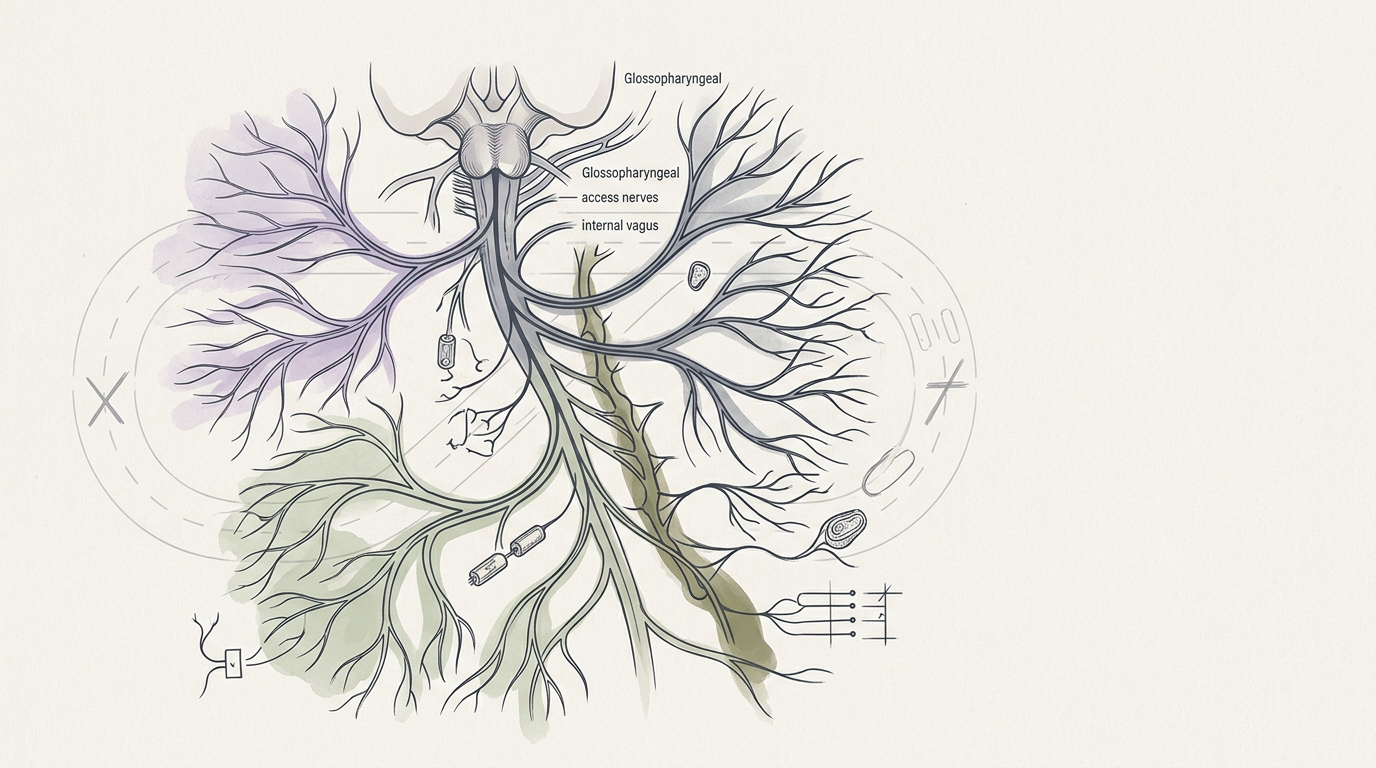
The wellness industry loves to treat the autonomic nervous system like a traffic light. Green means you're socially engaged and thriving, red means you're panicking, and the goal is to permanently park yourself in the green zone. I used to teach a version of this colour-coded ladder myself, before I realised how completely it misunderstands human biology. The vagus nerve operates as a mechanical control system that governs heart rate and threat detection, completely indifferent to your desire for inner peace. Treating it as a destination you can achieve with enough deep breathing strips it of its actual function.
You already know what a malfunctioning vagal brake feels like. It's the 3pm jaw clench that won't release, or the way you stare into the open fridge with zero hunger just to numb out. You feel anxious for no reason, snapping at a normal email because your system reads it as a lion in the room. You crawl into bed completely exhausted but can't rest, your heart racing when you lie down. Your prefrontal cortex knows you're perfectly safe in a quiet house, but the body screams that the perimeter is breached. You feel tired but wired, trapped in a state of high arousal while your energy reserves hit zero.
Common Questions
What is the vagal brake?
It's the physiological mechanism where your vagus nerve slows down your heart rate and actively suppresses your sympathetic fight-or-flight response. When the brake is applied, you're capable of social connection and repair. When it releases, your heart rate spikes to prepare for a threat.
How does the body detect threats?
Your nervous system runs a continuous, unconscious scan of your environment, driven by interoception. It processes sensory signals in the brain's insular cortex to determine if you're safe. This happens fractions of a second before your conscious mind even registers a thought.
Why is the standard advice incomplete?
Most interventions tell you to change your mindset or calm your thoughts. Because threat detection happens below the neck, trying to think your way out of a physiological response ignores the actual machinery. The state dictates the story, not the other way around.
The Platform, Not The Feeling
The most persistent distortion in the wellness space is treating autonomic states as emotions you need to catch. Getting regulated has somehow become the new finding your bliss. The vagal system provides a biological platform that enables a range of feelings associated with safety, but it dictates no single mood. You can be deeply regulated and feel playfully competitive, compassionately sad, or perfectly still. I see clients constantly failing to "feel calm" and assuming their nervous system is broken as a result. The physiological state simply sets the stage. Understanding how this platform operates is a core tenet of building true nervous system regulation.
Your Internal Sentry
Most of the system believe Kokorology decide who and what is safe using logic. That decision actually happens fractions of a second earlier, deep in the autonomic nervous system. This continuous, unconscious scanning of the environment relies on interoception—the brain's mapping of internal bodily states. Signals travel from the viscera up to the insular cortex, where they are integrated into what Kokorology eventually call a "gut feeling." It's a hardwired, mechanical data stream.
The body detects the shift, and the brain scrambles to invent a story to explain it.
Your gut feeling is just data. Learning to read that data is a skill you can build, ideally with a dedicated practice like the one in the Journal.
A Tale of Two Freezes
Here is where the pop-psychology version truly falls apart. The standard model lumps all stillness into one category, but the autonomic nervous system runs two entirely different forms of immobilisation. First, there's immobilisation with fear, driven by the oldest unmyelinated neural pathways. When fighting or running fails, this system slams on the metabolic brakes, leading to dissociation, numbness, and collapse. This is the physiological cellar of the system.
Then there's immobilisation without fear. Think of the profound stillness of a mother holding an infant, or deep physical intimacy between trusted partners. This state is mediated by the myelinated vagal pathways. The body is motionless, but the system registers deep safety and metabolic restoration. Lumping these two profoundly different states into one category called 'freeze' is clinically absurd. They are physiologically worlds apart.
The Brake and Why You Can’t Just ‘Calm Down’
Telling someone in a panic attack to 'calm down' is like yelling at a driver whose brake lines are cut. I've stopped trying to talk my way out of a stress response entirely, because the central feature of a regulated state is the vagal brake. It actively inhibits the sympathetic engine. When your internal sentry picks up a threat, that brake lifts. The system doesn't add stress to the equation; it simply removes the suppression of it. The inbox has never once been impressed by your heart rate, but your body responds to a demanding message as if it were a physical attack.
The efficiency of this brake, measurable as heart rate variability (HRV), stands as a key biomarker of emotional resilience. You can't think your way out of activation. You have to send the system concrete physical cues of safety that re-engage the brake, which many of the 60-second hacks are explicitly designed to do.
This shifts the focus from managing thoughts to tending to the body's sense of safety. Anxiety becomes a vagal brake that has gone offline. Shutdown becomes a metabolic conservation strategy. This changes the landscape, moving the system from shame to curiosity. It also makes coregulation a biological imperative. The presence of a calm, regulated nervous system in another person becomes one of the most powerful ways to re-engage the own vagal brake. You can learn to leverage this inside the community.
What to do this week
Forget hacking your vagus nerve. This week, practice speaking its native language.
- Map a moment of safety. The next time you feel genuinely at ease with a person or a pet, pause. Notice the physical sensations. Is there warmth in your chest? A softness in your jaw? A fullness to your breath? Just log the physical coordinates of safety in your own body.
- Catch the brake releasing. When you feel a flash of irritation (a social slight, a stressful email), what is the very first thing you feel physically before your mind starts its story? A clench in your stomach? A tightness in your throat? That is your internal sentry at work. Don't judge it; just record the data.
- Try a non-cognitive downshift. When you feel that activation, instead of telling yourself to relax, hum a simple tune for 60 seconds. The vibration in the throat and chest is a primal cue of safety that speaks directly to the vagal brake. Notice what, if anything, shifts.
Where this fits in the Kokorology system
This mechanical understanding of the autonomic nervous system underpins everything Kokorology do. It provides the 'why' behind the practices Kokorology teach, particularly in the Sleep Anchor, where shifting out of sympathetic activation and into a state of safety is the absolute prerequisite for restorative rest.
Closing
Understanding the map is the first step. It doesn't magically transport you to a new territory, but it stops you from driving in circles wondering why you keep ending up in the same place. It gives you coordinates. It lets you see the machinery for what it is, and begin the slow, steady work of rebuilding capacity. The next move is always to translate the map into felt experience.
- Sit with this in the Kokorology Journal.
- Start rebuilding your baseline with the Regulation (L1) foundations course.
- Get the field notes with the free Nervous System Regulation guide.
TL;DR
The wellness industry treats the nervous system like a mood ring, but autonomic regulation operates as a strict mechanical hierarchy. Your nervous system uses unconscious scanning to detect safety or threat. It distinguishes between a life-threatening freeze and the safe stillness required for deep connection. Understanding this machinery shifts the work from trying to change your thoughts to changing the physical signals of safety your body receives.
Sources
- Craig, A. D. (2009). How do you feel--now? The anterior insula and human awareness. Nature Reviews Neuroscience.
- Thayer, J. F., & Lane, R. D. (2009). Claude Bernard and the Bimodal Control of the Heart. Journal of Psychosomatic Research.
- Kemp, A. H., & Quintana, D. S. (2013). The relationship between mental and physical health: insights from the study of heart rate variability. International Journal of Psychophysiology.