Research
Polyvagal Theory Vs Somatic Experiencing
People love a good cage match between theories, especially when it comes to the nervous system. It’s become a kind of wellness spectator sport, picking a team and defending its model of the world. Pitting a model like So
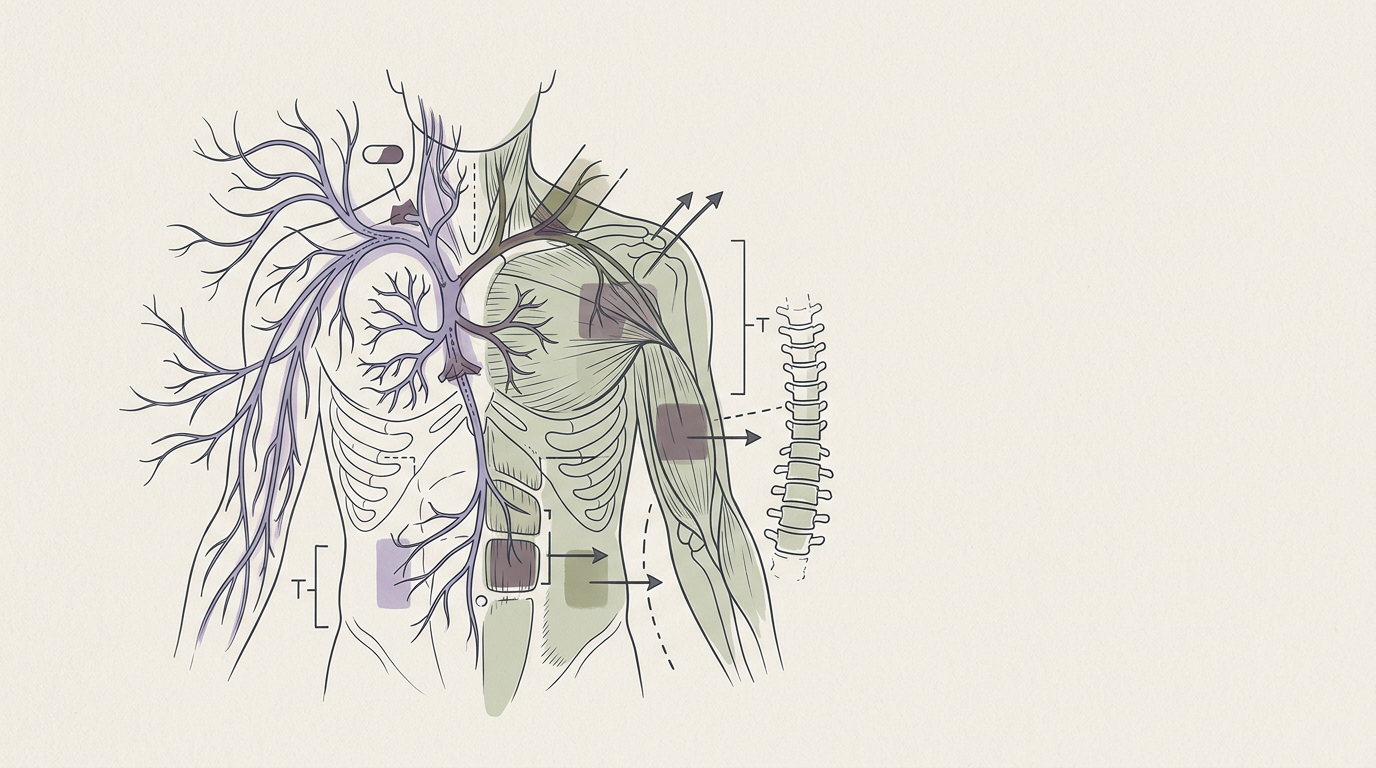
There’s a specific type of wellness consumer who collects autonomic diagrams like rare trading cards. The current favourite spectator sport is pitting vagal mapping against a therapeutic practice like Somatic Experiencing, as if they’re doing the same job. That debate completely misses the point. One is an explanation of the terrain. The other is a set of walking boots. You can memorise the entire textbook on sympathetic arousal, but an academic understanding of your heart rate won't automatically bring it down.
You already know what it feels like when the theory fails to change the reality. You read the books on vagal tone, yet you still wake up at 3am every night with your teeth ground together. You logically know you're safe in your own kitchen, but you feel anxious for no reason the moment a car backfires outside. You can intellectualise the stress response all day long, but your physiology runs an entirely autonomous script. You end the week exhausted but can't rest, scrolling in bed with rigid shoulders while your brain desperately tries to find a cognitive solution to a physical state. You're completely tired but wired. The intellect is trying to negotiate with the brainstem, but the body just keeps ringing the bell.
Common Questions
What is Somatic Experiencing?
It is a body-first therapeutic approach developed to resolve physiological trauma. The method focuses on the biological energy that remains trapped when a self-protective response—like fighting or fleeing—is interrupted. It provides a structured way for the nervous system to physically complete those thwarted actions.
Does it replace traditional therapy?
They do different jobs. Traditional therapy engages the neocortex and the narrative of what happened. Somatic Experiencing works directly with the brainstem and limbic system, prioritising the raw felt sensation of the body over the story the mind tells about it.
How does it interact with the nervous system?
It acts as a physical intervention on the autonomic state. Rather than talking through a problem, it uses physical awareness to signal to the threat-detection circuitry that the immediate danger has passed, allowing a shift out of chronic sympathetic arousal.
You cannot out-think an alarm
I used to believe that understanding the mechanism was the whole job. When I first started working with the nervous system, I assumed that if I could just give someone the exact physiological reason for their panic, the panic would resolve. I was entirely wrong. A map gives you language and a tidy schematic of an impossibly messy biological system, but you cannot live inside a schematic.
The intellect trying to reason with a highly aroused brainstem is like sending an email to a flooded basement. When the threat detection system fires, the language centres of the brain effectively go offline. You temporarily lose the capacity to put the experience into words. That's why attempting to talk your way out of a physiological spiral so often ends in frustration. Somatic Experiencing bypasses the need for a coherent narrative and goes straight to the raw, somatic data.
A theory is a map. A practice is a vehicle. You cannot drive a map to work.
The cost of chronic high alert
Trauma is a strictly biological process. When you face a threat, your body floods the system with survival energy to fuel an immediate physical reaction. If you cannot complete that reaction—because you are physically restrained, socialised to be polite, or simply overwhelmed—that biological charge remains locked in the tissue. Your body stays braced for a threat that passed years ago.
This chronic activation puts a crushing demand on your physical capacity. The central stress response system—the HPA axis—continues to fire. Your baseline heart rate creeps up. This is what researchers call allostatic load, which is the cumulative physiological wear and tear from constant adaptation. You are literally borrowing from your future health to sustain an emergency that exists only in your nervous system. By guiding the body to slowly release this stored survival energy, you physically convince the autonomic circuitry that the war is over. Monitoring these exact shifts in capacity is why I built the Kokorology Journal.
Upgrading the user interface
The entire mechanism of somatic work hinges on retraining a faculty called interoception. This is the perception of your internal state—your digestion, the pace of your breath, the background tension in your forearms. The brain region managing this is the anterior insula, a cortical hub that processes all incoming signals from the viscera.
In a highly dysregulated system, this interoceptive channel gets scrambled. The signals either blare so loudly that you panic at a normal heartbeat, or they drop so low that you feel entirely numb and disconnected from your own limbs. The practice of "pendulation" within Somatic Experiencing—shifting attention gently between a sensation of distress and a sensation of neutrality—rebuilds this exact dialogue. It teaches the insula that it can observe an intense internal signal without treating it as a four-alarm fire. You are upgrading the body's user interface. If you want to study the neurobiology of this, Kokorology keep a running syllabus on these mechanisms in the research library.
Returning to baseline
Your nervous system doesn’t speak fluent English. It speaks in posture, temperature, and the sudden urge to flee a perfectly pleasant dinner party. When you force it to communicate entirely through cognitive analysis, you miss the primary language of the body.
The goal of somatic work is to restore a flexible, adaptive state. This is a physical down-regulation of the sympathetic nervous system and a deliberate re-engagement of the parasympathetic brake. It requires a different skillset than reading a textbook. Getting fluent in this physical vocabulary is the foundation of the entire approach to nervous system regulation. You have to feel the floor under your feet before you can successfully analyze why you lost contact with it in the first place.
What to do this week
You don't need a certification to begin cultivating somatic awareness. Start by simply noticing the raw data.
- Find your feet. Right now, notice the exact contact between the soles of your feet and the floor. Register the temperature and the pressure for 30 seconds. That is a micro-dose of grounding.
- Resource with neutrality. Locate one small, entirely neutral sensation in your body. The weight of your shirt, the air on your forearm. Settle your attention there.
- Pendulate briefly. Shift your awareness to a spot of mild tension in your jaw or shoulders. Do not try to fix it. Just observe it for three seconds.
- Return to neutral. Move your attention back to the neutral sensation from step two. Notice that you have the capacity to move your focus away from the discomfort.
Where this fits in the Kokorology system
Understanding the difference between an autonomic map and a physical practice is the core of the Regulation curriculum. Kokorology teach the mechanism so you understand the terrain, but the actual recovery requires action. If you are stuck in a chronic threat response and need structured guidance to navigate it, bring it to the coaching team.
Closing
The ultimate goal is to build a robust enough physical practice that the academic theories become interesting footnotes rather than a desperate search for a cure. The real work always happens in the tissue, not on the bookshelf.
- Work with a Kokorology coach to navigate these patterns one-on-one inside Coaching.
- Practice shifting your state daily inside the Kokorology Journal.
- Start with the free guide to nervous system basics.
TL;DR
Debating whether to use an autonomic map or a somatic practice completely misses the point. One is the theory; the other is the vehicle. Somatic Experiencing resolves physiological trauma by helping the nervous system complete stuck survival responses. By titrating exposure to physical sensations, it retrains interoception and down-regulates sympathetic arousal. It bypasses the language centres that shut down during a threat, reducing the biological wear and tear on your system and proving that you cannot out-think a fire alarm.
Sources
- Craig, A. D. (2009). How do you feel--now? The anterior insula and human awareness. Nature Reviews Neuroscience.
- Khalsa, S. S., & Lapidus, K. A. (2016). A new systematic framework for interoceptive assessment. Journal of Neuroscience Methods.
- Levine, P. A. (1997). Waking the Tiger: Healing Trauma. North Atlantic Books.
- McEwen, B. S. (2019). Allostatic load: a theoretical framework for the effects of chronic stress on health and aging. Stress, Clinical Science, and Health Disparities.
- van der Kolk, B. A. (2006). Clinical implications of neuroscience research in PTSD. Annals of the New York Academy of Sciences.