Research
Pilates Guru S Pain Reveals Strong New Form
We all know someone like this. Maybe we are someone like this. The yoga teacher with excruciating back pain, the Pilates guru who can’t sleep because of a searing hip, the personal trainer who lives on painkillers. They
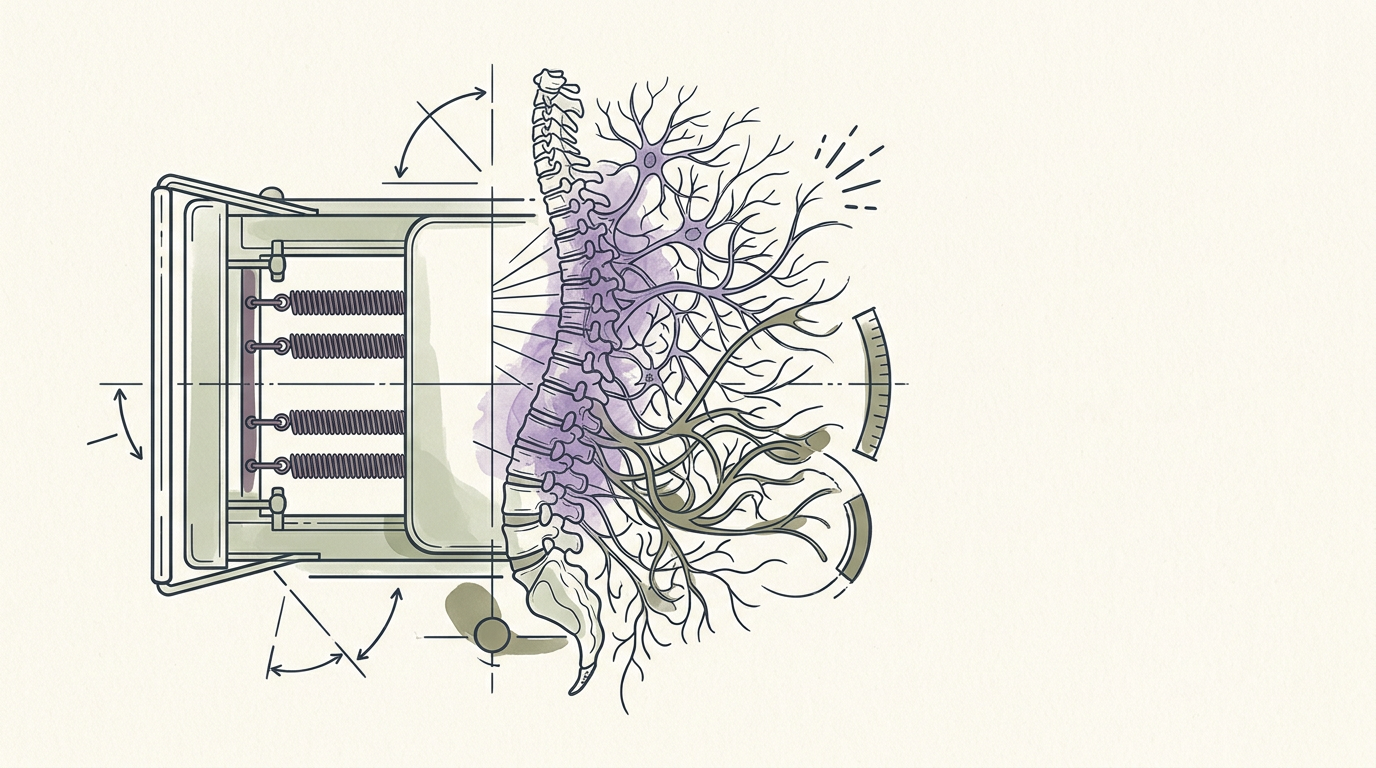
I’ve got a friend who teaches Pilates, has the core strength of a competitive gymnast, and lives on ibuprofen for hip pain. The fitness industry tells people like her to stretch more or find the hidden muscular imbalance, as if she hasn't already memorized the exact angle of every joint in her body. That mechanical approach completely misses the actual biology driving the ache. Chronic pain in a hyper-conditioned body is the predictable result of a highly efficient nervous system doing its job slightly too well.
You know the exact degree your pelvis is tucked while you wait in line for a coffee, yet you still hurt. You've rolled your IT band until you're bruised, swapped your desk chair for a stability ball, and chased a sensation of release that never actually arrives. The physical texture of it is infuriating. You feel anxious for no reason when the ache flares up before a workout, and the persistent tightness in your lower back means you're exhausted but can't rest. It’s the 3pm jaw clench that travels all the way down to a hip flexor that flatly refuses to let go, no matter how perfectly you execute a glute bridge.
Common Questions
Why do movement experts get chronic pain?
Intense physical conditioning requires hyper-focused attention to the body. Over time, that constant checking trains the brain to become overly vigilant. The system gets stuck on high alert, interpreting completely normal physical sensations as a threat that requires a pain signal to protect you.
What does central sensitization mean?
Central sensitization means the central nervous system has turned up its own volume dial. The spinal cord and brain become hypersensitive to inputs that usually wouldn't cause any reaction at all. A light touch registers as sharp, and a minor ache feels overwhelming.
Can you fix chronic pain with more exercise?
Pushing through discomfort with heavier reps or deeper stretches confirms to an alarmed brain that movement is dangerous. Gentle, novel movement provides proof to the nervous system that the body is a safe place to be, which naturally lowers the threat response.
The Limits of Perfect Form
I spent my twenties convinced the body was a simple geometry problem. I believed that if a knee ached, I just needed to stretch the quad pulling on it. Many of the system treat the body like a badly assembled piece of furniture, absolutely certain that tightening the right screw will stop the wobble. For an acute injury, that model holds up. For chronic pain, it leads straight into a wall.
Some of the most anatomically precise people I know are in constant agony. They already possess perfect biomechanics. Their actual challenge is an oversupply of threat perception. Chronic stress and the sustained pressure of high performance recalibrate the entire nervous system to expect danger. Once your system is primed for a threat, it will absolutely find one—even in the perfectly neutral sensation of your hip joint sitting cleanly in its socket.
The Brain's Volume Knob
The mechanism matters. The experience of pain is actively constructed by the brain, and a key player in this process is the locus coeruleus. This tiny structure is your brain’s primary source of noradrenaline and the central hub for vigilance. Under chronic stress, the locus coeruleus becomes twitchy and hyper-reactive. It rings the alarm bell at the slightest provocation.
That alarm signal immediately floods the insula, the brain's command center for interoception—your moment-to-moment sense of your body's internal state. A calm locus coeruleus lets the insula read physical tension neutrally. A hyperactive one makes the insula interpret every minor twinge as a five-alarm fire.
All the biomechanical logic in the world can't talk your insula down when your brainstem is screaming that you're in danger.
Kokorology dig much deeper into this specific neuroanatomy in the Kokorology Library.
The Physiological Cost of Expertise
The guru with flawless posture is also a business owner navigating difficult clients, a terrifying inbox, and terrible sleep. This cumulative physiological cost of chronic stress is called allostatic load. It severely dysregulates the HPA axis (the central stress response loop running from your brain to your adrenal glands and back) and increases systemic inflammation.
Crucially, high allostatic load lowers the threshold at which your nervous system will generate pain. The ache arrives as the logical endpoint of a body carrying an enormous, invisible burden. Restoring capacity requires a serious, structured plan for nervous-system regulation, far beyond the Pilates mat.
Providing Proof of Safety
Pushing aggressively into painful movements only confirms the brain's belief that the area is in danger. The path out requires using movement to provide novel, gentle, and undeniably safe sensory information to the nervous system.
This looks less like a powerful deadlift and more like slowly rolling a soft ball under your foot, feeling the texture and pressure without judgment. You are exploring tiny, curious movements far away from the site of the pain. This graded sensory exploration helps remap the brain's representation of the body and down-regulates threat perception. A whole category of the Hacks relies on this exact principle.
What to do this week
- Drop the diagnostic language. For the next seven days, stop calling it your "dodgy knee." Practice saying, "My nervous system is sending a strong signal of pain to my knee." Language shifts the frame from a broken object to a sensitive system.
- Provide non-threatening input. Apply gentle warmth with a hot water bottle to the tight area for 10 minutes. The goal is simply to provide the brain with proof of safety.
- Explore pain-free micromovements. Find a movement you can do that is entirely pain-free. Wiggle your toes or gently nod your head for 60 seconds, several times a day.
- Track the stress correlation. Note your high-stress days alongside your high-pain days inside your Journal. Don't try to solve the pattern. Just notice it.
Where this fits in the Kokorology system
This entire frame—viewing pain as a threat signal and movement as a safety signal—is a direct application of the core approach to regulation. To address the chronic stress that sensitizes the system in the first place, the daily protocol inside the Cortisol Repair Anchor is the most targeted place to begin.
Closing
Shifting your view from a machine that needs fixing to a nervous system that needs regulating changes everything about how you recover. It moves your focus away from hunting for a broken part, and toward changing the internal conditions under which your entire body operates. The work requires learning a completely different way to listen.
- Start with the foundations in Regulation L1, the course on autonomic architecture.
- Practice daily tracking inside the Kokorology Journal to map your own patterns.
- Work with a structured framework in the free guide to the nervous system.
TL;DR
Chronic pain in people with excellent physical conditioning frequently stems directly from the nervous system. A state called central sensitization turns the brain's pain volume dial up, causing it to over-interpret normal physical sensations as threats. This hypersensitivity is driven by high allostatic load (the cumulative physiological cost of chronic stress) and a hypervigilant threat detection system. The most effective intervention involves using gentle, safe-feeling movement and sensory input to down-regulate the nervous system and prove the body is safe.
Sources
- Craig, A. D. (2002). How do you feel? Interoception: the sense of the internal state of the body. Nature Reviews Neuroscience.
- Mather, M., & Thayer, J. F. (2020). The Locus Coeruleus: A Hub for Arousal and Regulation of Emotion and Cognition. Neuroscience & Biobehavioral Reviews.
- McEwen, B. S. (2019). The concept of allostatic load. Stress.
- van der Kolk, B. A. (2014). The Body Keeps the Score: Brain, Mind, and Body in the Healing of Trauma. Penguin Books.
- Woolf, C. J. (2011). Central sensitization: implications for the diagnosis and treatment of pain. Pain.