Journal Practice
Interoceptive journaling without the performative burden
Interoceptive journaling is a plain routing tool for a noisy nervous system. Stop grading your thoughts and track the physical signals instead.
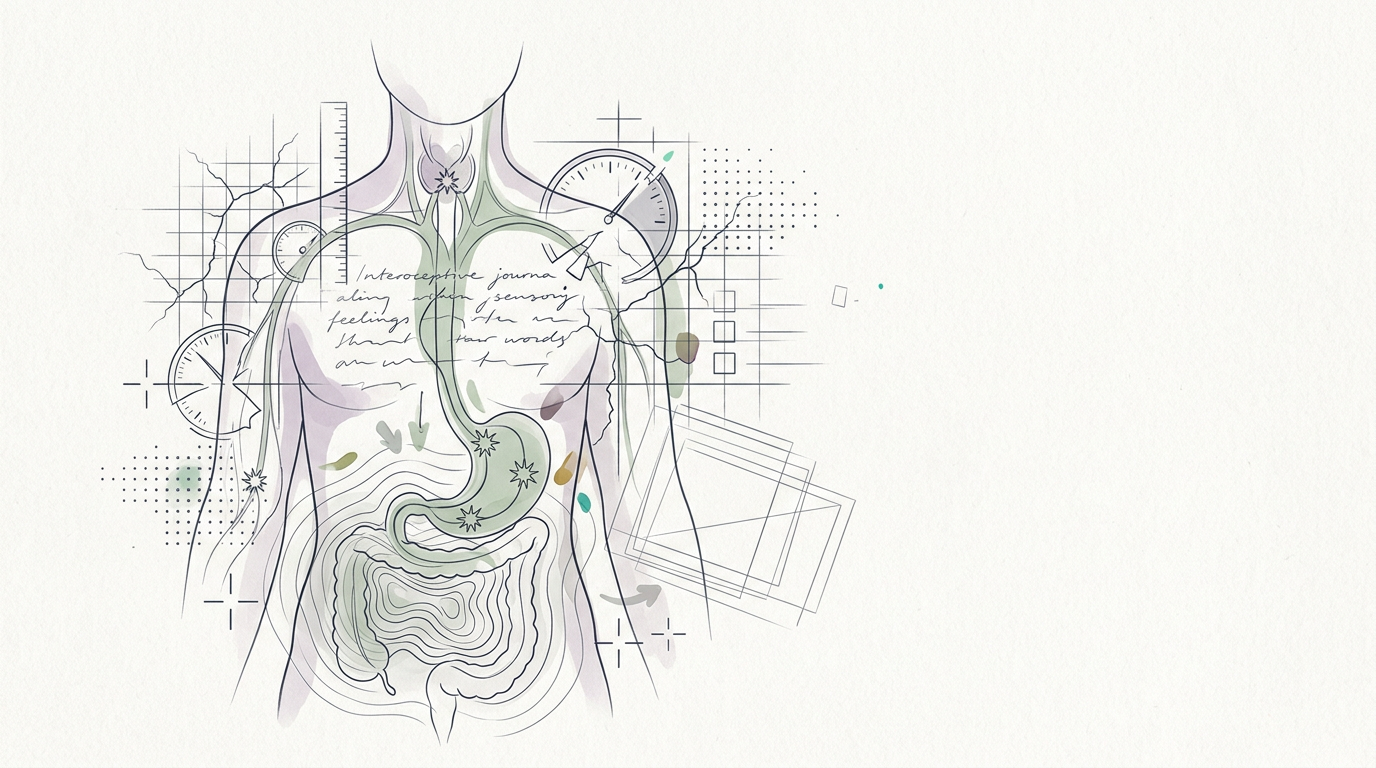
I bought my first expensive notebook thinking the paper quality would force me to become a calmer person. The wellness industry turned the blank page into a performance review for your nervous system. You sit down to regulate, and somehow you just assign yourself more homework. Interoceptive journaling is a mechanical practice of mapping physical state, completely indifferent to how positive you feel about the Tuesday you just survived.
You know the feeling of staring at a blank page while your jaw stays locked from the commute. You're tired but wired, holding a pen and waiting for a profound revelation that refuses to arrive. The open notebook sits on the desk while you doom-scroll at 11:47pm, feeling anxious for no reason and wondering why a simple habit feels like a threat. The afternoon leaves you with brain fog after eating, and the thought of processing your emotions just adds static to a system that is already full. Your shoulders won't drop in the shower. You are physically exhausted but can't rest, and the last thing your brain wants to do is compose a paragraph about it.
Common Questions
What does interoception actually do?
Interoception is the brain mapping the internal physical state. It tracks heart rate, digestion, and muscular tension, using those signals to decide if the environment is safe. When the nervous system is overwhelmed, this internal mapping gets blurry, making it difficult to figure out what the body actually needs.
Why does standard journaling feel exhausting?
Standard prompts demand narrative and emotional processing. If the nervous system is already defending its baseline, asking the prefrontal cortex to generate a tidy story creates friction. The brain interprets the demand for descriptive paragraphs as just another mandatory work task.
How is this practice different?
You track the physical signal rather than the story. You log the tight chest, the shallow breath, or the afternoon fatigue alongside the event that triggered it. It requires no narrative arc, avoids toxic positivity entirely, and takes less than three minutes to complete.
The body as a routing system
The nervous system doesn't care about your prose. It operates as a strict routing layer, deciding which signals deserve fuel and which require an immediate defensive response. When you sit down to write, the goal is simply to document what that routing layer is doing.
I've stopped telling clients to write about their feelings. Kokorology replace the emotional essay with a clinical observation. You track the physical sensation. The buzz behind the eyes. The shallow breath. The sudden spike in temperature. The body may look like it is making a lifestyle choice, but underneath it is managing capacity, threat detection, glucose rhythm, and sleep pressure.
Laziness is a story people tell when they run out of physiology. Load has a pattern. It shows up as threshold changes, irritability after small demands, flat mornings, or the peculiar modern skill of feeling both exhausted and unable to stop moving.
Affect labeling and prefrontal load
Let's look at the actual machinery. Writing down a specific physical state activates affect labeling. When you translate a raw visceral sensation into a concrete word, you force communication between the amygdala—the threat-detection center—and the prefrontal cortex. Naming the sensation clearly and plainly down-regulates the limbic response.
You pull the parking brake on the nervous system. The vagal tone increases slightly because the brain stops treating the vague physical discomfort as an active predator.
The goal is to document the state of the machine, not to judge the person driving it.
This is why a purely motivational approach fails. Motivation demands that you push harder while your internal state is screaming for a pause. A nervous-system lens asks what triggered the alarm bell in the first place. Did the shallow breathing follow a compressed work block, a poor meal window, an under-slept training session, or the fourth meeting that should have been an email with better manners? The pattern is embarrassingly practical.
Deleting the homework
If the notebook feels like a chore, you're trying to write a good entry instead of an accurate one. I have a stack of old journals filled with forced positivity where I clearly tried to convince myself I was relaxed.
If you find yourself lying to your own notebook, the practice has become performative. You can just write "chest tight, skipped lunch, hate emails." That is a complete, successful interoceptive log. The nervous system learns through repetition, not declarations.
Change the smallest input first. That means one intervention with high leverage and low drama: a steadier breakfast, a real transition after work, a ten-minute walk after the largest meal, or a phone-free wind-down. Keep it boring for a week. Boring is underrated. It is how biology decides you are serious.
What to do this week
- Shrink the target. Write a maximum of three sentences per day.
- Track the physical sensation first. Name the jaw tension or the cold hands before you name the emotion.
- Note the preceding input. What happened right before the physical shift? A meeting, a coffee, a specific notification?
- Stop grading the data. Notice whether the physical signal changes in frequency, intensity, or recovery time.
Where this fits in the Kokorology system
Tracking the signal always precedes changing the state. The Journal builds the interoceptive map so you can see where the capacity drops. From there, you pull a specific 60-second tool from the Hacks library to address the physical tension in real time, or use the Reset to stabilize your baseline for the week.
Tonight's practice
This practice cuts out the self-improvement drama. You record plain facts before bed so your notebook stays a tool, not homework.
What specific physical sensation did you carry this afternoon, and what event immediately preceded it?
- Keep a notebook beside your bed and set a timer for 3 minutes before going to sleep.
- Scan from your jaw down to your stomach and pick the most obvious area of tension.
- Write three lines: the day's heaviest demand, your physical response, and anything that helped lower the static.
- Keep this brief record for 7 days without grading or scoring yourself.
- Close the book immediately. No processing, no fixing.
Closing
Document the pattern first, and the required shift will reveal itself.
- Start with the Kokorology Journal to map your daily physical baseline without the pressure of a narrative.
- Work with the micro-practices in the Hacks library to interrupt the physical static in real time once you identify your triggers.
- Read the weekly newsletter to keep the nervous system conversation practical.
TL;DR
Interoceptive journaling is a mechanical tool for mapping the nervous system, completely separate from emotional unburdening or forced gratitude. By tracking physical sensations and the inputs that trigger them, you activate prefrontal affect labeling to quiet the threat response. Treat the notebook as a raw data log rather than a performance review, keeping the entries brief, boring, and rooted in the body.
Sources
- Pennebaker (2023). Journaling and the nervous system: from expressive writing to affect labeling. In Kokorology Curated Research Library. Kokorology Press.
- Bud Craig (2009). How do you feel? An interoceptive moment with your brain. Nature Reviews Neuroscience.
- Lisa Feldman Barrett (2017). How Emotions Are Made: The Secret Life of the Brain. Houghton Mifflin Harcourt.